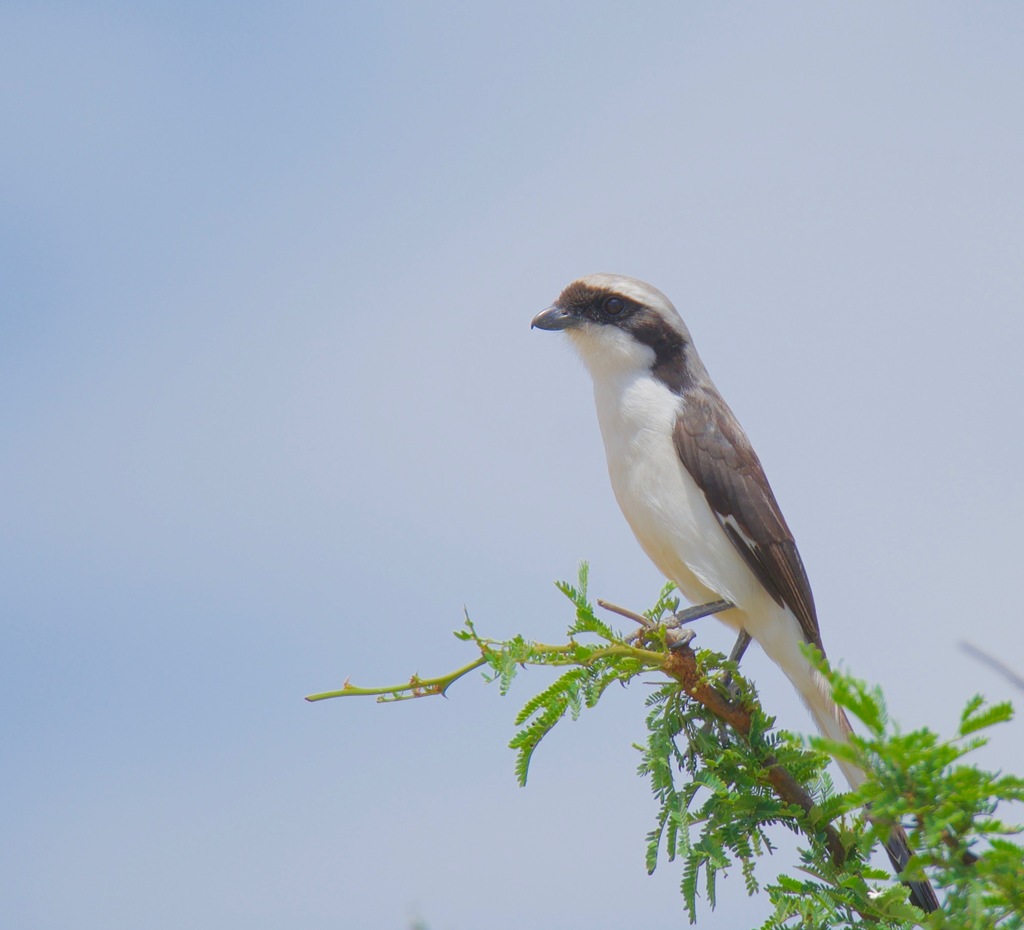
Grey-backed Fiscal
Photo © Donald Hampton
Photo © Donald Hampton — CC BY-SA 4.0 — Source: iNaturalist #37324448Identification
The grey-backed fiscal is a large shrike measuring about 25 cm (10 in) in length. Males are distinctive with a grey crown, white supercilium, and a striking large black mask that gives the species a characteristic bold appearance. The upper parts are medium grey, while the rump is white and the wings are blackish with a conspicuous white patch visible in flight. The long tail features a white base contrasting with a black tip, and the underparts are white.
Females are similar to males but display patches of chestnut on the flanks that become visible during display and preening, offering a useful field mark for sex identification. Juveniles appear quite different, being brownish overall with brown wings and tail heavily barred with grey, making them less conspicuous than their parents.
Range & Habitat
The grey-backed fiscal is found across a wide swathe of sub-Saharan Africa, occurring in countries including Burundi, Cameroon, Central African Republic, Chad, Democratic Republic of the Congo, Ethiopia, Kenya, Mali, Mauritania, Nigeria, Rwanda, Sudan, Tanzania, and Uganda. This extensive range underscores the species' adaptability across diverse African landscapes.
The species inhabits dry savanna and subtropical or tropical dry lowland grassland, and is often encountered in wooded grassland, gardens, and damp acacia scrub. These varied habitats provide the open perching sites and scattered trees that the species favours for hunting and social activity.
Behaviour & Diet
The grey-backed fiscal is a highly sociable and gregarious bird, typically seen in pairs or small groups rather than as solitary individuals. Birds are often spotted perched conspicuously on tree stumps, wires, and branches, where they engage in characteristic wing fluttering and tail waving displays accompanied by noisy babbling. These active, vocal birds are engaging subjects for observation due to their expressive behaviour.
The species is a cooperative breeder, with both males and females participating in breeding efforts. Females construct nests positioned up to 10 m (33 ft) off the ground, typically near tree trunks or on peripheral branches, while males contribute by bringing nesting materials and food. A clutch of about four eggs is laid, with the female undertaking incubation for approximately fourteen days. Young remain in the nest for a further twenty days before fledging.
Best Time & Places to See It
The grey-backed fiscal is a common bird across its extensive range with a large total population, making it a reliable species for travellers exploring African savannas and grasslands. Its sociable, conspicuous behaviour and vocal nature make it relatively easy to locate compared to more retiring shrike species. The bird's preference for open perches on wires, stumps, and exposed branches means it is often spotted during general wildlife viewing.
Look for this species in dry savanna habitats and acacia scrubland across East and Central Africa, particularly in countries such as Kenya, Tanzania, Uganda, and the Central African Republic. Gardens and cultivated areas within its range also regularly support populations.
Photography Tips
The grey-backed fiscal's bold plumage and conspicuous perching behaviour make it an excellent photographic subject. The male's striking black mask, white supercilium, and contrasting grey and white plumage provide strong compositional elements. Photograph birds perched on open wires or tree stumps where backlighting can emphasize the white wing patches visible in flight.
The species' sociable habits mean you may encounter small groups, offering opportunities to capture behaviour such as wing fluttering and tail waving displays. If observing females, watch for moments when they spread their wings to reveal the chestnut flank patches. Early morning light will best render the subtle grey tones of the upperparts and highlight the contrast between the dark mask and pale supercilium.
Serengeti National Park
Tanzania
+558 birds+57 mammals
Across Tanzania's northern plateau, where volcanic soils meet acacia woodland and open grassland, unfolds one of Earth's most dynamic ecosystems. The Serengeti National Park sprawls across…
VIEW NATIONAL PARKArusha National Park
Tanzania
+555 birds+16 mammals
Where the slopes of Mount Mawenzi rise above the Arusha region, a compact yet ecologically rich national park unfolds across montane forest, moorland, and alpine zones.…
VIEW NATIONAL PARKVirunga National Park
Uganda
+418 birds+13 mammals
Where the Western Rift Valley fractures the landscape of North Kivu, Virunga National Park sprawls across terrain as geologically dramatic as it is ecologically vital. Volcanic…
VIEW NATIONAL PARKBwindi Impenetrable National Park
Kanyashogi, Uganda
+603 birds+26 mammals
Steep ridges cloaked in montane forest rise from Uganda's southwestern borderlands, where the landscape grows so dense and tangled that early explorers named it impenetrable. At…
VIEW NATIONAL PARKKidepo Valley National Park
Uganda
+478 birds+24 mammals
Where the Narus and Kidepo rivers carve through northeastern Uganda's semi-arid lowlands, a landscape of sparse acacia woodland, grassland, and riverine thickets creates one of East…
VIEW NATIONAL PARKMgahinga Gorilla National Park
Cyanika, Uganda
+429 birds+6 mammals
Where the Virunga Mountains rise steeply from the Uganda–Rwanda–Democratic Republic of Congo frontier, montane forest cloaks the volcanic slopes in a dense, moisture-laden embrace. Mgahinga Gorilla…
VIEW NATIONAL PARKLake Mburo National Park
Uganda
+505 birds+24 mammals
Rolling acacia woodland and scattered lakes define this intimate savanna preserve in southwestern Uganda, where the rift valley's geological drama shapes every water source and grassland.…
VIEW NATIONAL PARKTsavo East National Park
Athi ward, Kenya
+468 birds+50 mammals
Across the semi-arid lowlands of southeastern Kenya, where acacia woodland fragments into scrubland and the landscape rolls toward the Indian Ocean horizon, lies one of Africa's…
VIEW NATIONAL PARKAmboseli National Park
Etonet/Lenkism ward, Kenya
+501 birds+43 mammals
Where the Amboseli basin opens toward the Tanzanian frontier, a shallow alkaline lake mirrors vast skies across one of East Africa's most iconic savanna landscapes. The…
VIEW NATIONAL PARKTarangire National Park
Tanzania
+527 birds+50 mammals
Acacia woodland and grassland sweep across the Manyara Region where the Tarangire River carves through low hills and volcanic soils, creating one of East Africa's most…
VIEW NATIONAL PARKNgorongoro Conservation Area
Tanzania
+626 birds+55 mammals
Volcanic calderas and open grassland dominate this high plateau in northern Tanzania, where the landscape rises above 2,000 metres and ancient geological forces have shaped both…
VIEW WILDLIFE MANAGEMENT AREAToro-Semliki Proposed National Park
Uganda
+474 birds+5 mammals
Where the Albertine Rift's western escarpment rises above the Semliki River valley, a vast mosaic of forest, savanna and wetland converges to create one of East…
VIEW NATIONAL PARKQueen Elizabeth National Park
Uganda
+672 birds+30 mammals
Across the southwestern escarpment of Uganda, where the Western Rift Valley descends through ancient volcanic terrain, Queen Elizabeth National Park sprawls across more than 8,300 square…
VIEW NATIONAL PARKMabamba Swamp
Memere, Uganda
+464 birds+2 mammals
Across the Central Region of Uganda spreads one of Africa's most biodiverse freshwater wetlands, a sprawling nature reserve of roughly 283 square kilometres where papyrus swamps…
VIEW NATURE RESERVEZiwa Rhino and Wildlife Ranch
Nakasongola, Uganda
+359 birds+11 mammals
Where papyrus wetlands merge into sprawling savanna, Uganda's central landscape opens into one of East Africa's most vital rhino recovery zones. Ziwa Rhino and Wildlife Ranch…
VIEW WILDLIFE SANCTUARYAbijata-Shalla Lakes National Park
Ethiopia
+438 birds+7 mammals
Two crater lakes of contrasting chemistry define this remote corner of Ethiopia's Rift Valley, where soda lakes and freshwater basins create a mosaic of distinct aquatic…
VIEW NATIONAL PARKBale Mountains National Park
Ethiopia
+397 birds+20 mammals
Where the Ethiopian highlands rise above 4,000 metres, the Bale Mountains create a landscape of stunning ecological extremes—from afroalpine grasslands swept by wind and mist to…
VIEW NATIONAL PARKMago National Park
Ethiopia
+128 birds+3 mammals
Where the Omo River cuts through southern Ethiopia's arid borderlands, Mago National Park sprawls across a landscape of dramatic escarpments, riverine forests, and semi-arid savanna that…
VIEW NATIONAL PARKOmo National Park
Ethiopia
+61 birds+4 mammals
Where the Omo River carves through southwestern Ethiopia, a landscape of riverine woodland, acacia savanna, and scattered grassland unfolds across one of East Africa's most remote…
VIEW NATIONAL PARKAwash National Park
Didiga, Ethiopia
+473 birds+23 mammals
Where the Ethiopian Rift Valley carves through volcanic plateaus, a ribbon of riverine forest winds through acacia scrubland and grassland, creating a mosaic of habitats that…
VIEW NATURAL PARKNech Sar National Park
Arba Minch, Ethiopia
+191 birds+10 mammals
Where the East African Rift Valley plateaus drop dramatically toward the shore of Lake Abaya, a mosaic of habitats unfolds across sun-scorched savanna and acacia woodland.…
VIEW NATIONAL PARKYabelo Wildlife Sanctuary
Bedewera, Ethiopia
+359 birds+5 mammals
Where acacia woodlands meet volcanic plateaus in southern Ethiopia, a landscape of austere beauty unfolds across nearly 2,500 square kilometers. Yabelo Wildlife Sanctuary sprawls across semi-arid…
VIEW WILDLIFE SANCTUARYNairobi National Park
Nairobi, Kenya
+515 birds+35 mammals
Just minutes from Kenya's capital, where the Nairobi River winds through acacia woodland and open grassland, lies one of Africa's most paradoxical wildlife sanctuaries. The park's…
VIEW NATIONAL PARKLake Nakuru National Park
Nakuru West, Kenya
+494 birds+32 mammals
Alkaline waters ringed by acacia woodland and grassland create one of East Africa's most distinctive wetland ecosystems, where the interplay of geology and climate sustains a…
VIEW NATIONAL PARKSamburu National Reserve
Samburu, Kenya
+430 birds+42 mammals
Across the arid plains of northern Kenya, where scattered acacia woodland gives way to rocky outcrops and dry riverbeds, Samburu National Park unfolds as one of…
VIEW NATURE RESERVEHell’s Gate National Park
Olkaria ward, Kenya
+388 birds+18 mammals
Volcanic scarps and geothermal vents dominate the floor of Hell's Gate, where the East African Rift has carved a dramatic gorge through crystalline rock formations. The…
VIEW NATIONAL PARKRuma National Park
Suba, Kenya
+250 birds+8 mammals
Where the Winam Gulf narrows toward the Kenyan mainland, Ruma National Park rises as a sanctuary of evergreen woodland set within the humid tropics of Homa…
VIEW NATIONAL PARKNo community photos yet. Log in to add the first one.
No community observations of this species yet.