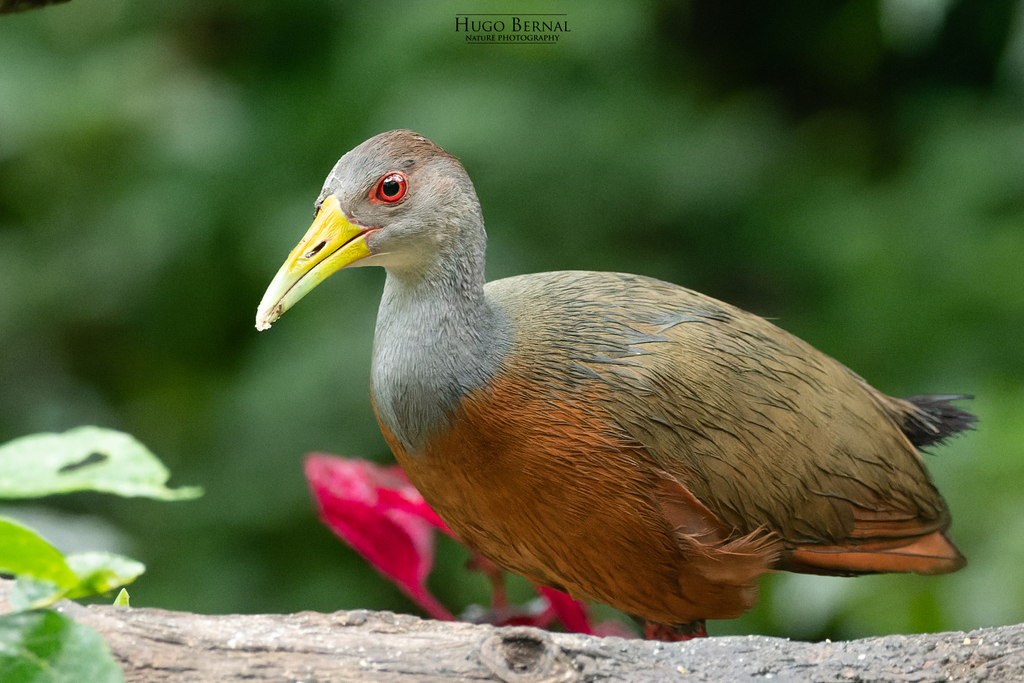
Grey-cowled Wood Rail
Photo © Hugo Bernal Hernández
Photo © Hugo Bernal Hernández — CC BY 4.0 — Source: iNaturalist photo #196913142Identification
The grey-cowled wood rail is one of the largest members of the wood rail family, measuring 33–40 centimetres in length. Its most distinctive features are its medium-grey head and neck, which blend into a brown patch at the back of the head in the nominate subspecies. The upperparts are olive-green to dark brown, while the chest and flanks display warm rufous tones. The belly, rump, and tail are black, providing striking contrast. Look for its bright coral-red legs and distinctive bright greenish-yellow bill, complemented by striking red eyes—a combination that makes this bird unmistakable once seen. Males and females are similar in appearance, though juveniles are noticeably duller with dusky legs and bills.
The subspecies A. c. avicenniae, found in southeastern Brazil, is smaller than the nominate and lacks the brown patch on the back of the neck. Its lower back and underparts are also slightly paler, with more greenish-grey upper wing-coverts. The similar but smaller rufous-necked wood rail can be distinguished by its reddish head and neck paired with a grey upper back.
Range & Habitat
This species inhabits forests, mangroves, and swamps across Central and South America. The nominate subspecies ranges from Costa Rica to Colombia, eastward through Venezuela and Trinidad to Brazil, and south to northern Argentina and Uruguay. The subspecies avicenniae is restricted to coastal southeastern Brazil. Grey-cowled wood rails typically occur at elevations from sea level to 2,000 metres, though occasional records exist from higher altitudes.
The species' large extent of occurrence and stable population have resulted in its classification as least-concern by the International Union for Conservation of Nature. In some regions, it is occasionally hunted and kept for food, though this does not appear to significantly impact overall population numbers.
Behaviour & Diet
Grey-cowled wood rails are monogamous birds that remain paired throughout the year. During the breeding season from March to August, pairs construct nests on flat branches and in thickets, typically at heights between 1 and 3 metres above ground. Each clutch contains three to seven eggs, which are incubated by both sexes. The chicks that hatch are precocial, meaning they are mobile and relatively independent shortly after hatching.
This adaptable forager feeds on a wide range of foods, including molluscs and seeds. Remarkably, it is also known to feed on the faeces of giant otters, a behaviour that reveals its opportunistic feeding strategy. The bird is vocal, particularly at dawn and dusk, producing loud, repetitive cackling calls.
Best Time & Places to See It
The best opportunities to observe grey-cowled wood rails occur during dawn and dusk hours when they are most vocal and active. The breeding season from March to August may offer additional viewing opportunities, as pairs are conspicuous while attending nests and caring for young. Given the species' wide range across Central and South America, it can be encountered in appropriate wetland and forest habitats throughout its distribution.
Look for this rail in forested swamps, mangrove areas, and wet woodland where dense vegetation provides cover. Its preference for staying near water in humid habitats makes it a rewarding subject for patient observers willing to move quietly through these environments.
Photography Tips
The bright colours of the grey-cowled wood rail—particularly the coral-red legs, greenish-yellow bill, and red eyes—make it a photogenic subject once located. Early morning and late afternoon light will enhance these vivid plumage tones. Aim to photograph birds in or near their preferred wetland and mangrove habitats, where natural water reflections can add depth to images.
Since this rail is most vocal and active at dawn and dusk, schedule photo sessions around these times. The bird's large size for a rail and distinctive coloration mean that even modest optical equipment can yield satisfying results. Be prepared for the dense vegetation it frequents by using a telephoto lens to maintain distance while capturing clear details of the head markings, eye colour, and leg colouration that define the species.
Corcovado National Park
Puerto Jiménez, Costa Rica
+444 birds+48 mammals
Where the Osa Peninsula juts into the Pacific, rainforest descends almost to the tide line, and Corcovado National Park protects one of Central America's most intact…
VIEW NATIONAL PARKManuel Antonio National Park
Quepos, Costa Rica
+426 birds+22 mammals
Where tropical rainforest descends steeply to a rocky Pacific coastline, Manuel Antonio National Park distills Central American biodiversity into one of Costa Rica's most compressed and…
VIEW NATIONAL PARKPiedras Blancas National Park
Golfito, Costa Rica
+386 birds+24 mammals
Where the Golfo Dulce meets the southwestern Pacific coast of Costa Rica, Piedras Blancas National Park protects a dramatic transition zone where lowland rainforest descends toward…
VIEW NATIONAL PARKYasuní National Park
Aguarico, Ecuador
+601 birds+43 mammals
Where the western Amazon basin converges with Ecuador's Orellana Province, lowland rainforest reaches toward the horizon in an unbroken canopy of staggering botanical density. Yasuní National…
VIEW NATIONAL PARKSaint-Hilaire/Lange National Park
Brazil
+225 birds
Subtropical Atlantic forests rise and fall across the plateaus of inland Paraná, where Saint-Hilaire/Lange National Park protects nearly 578 square kilometres of Brazil's most biodiverse woodland…
VIEW NATIONAL PARKPantanal Matogrossense National Park
Brazil
+322 birds+17 mammals
Where the flooded forests of central Brazil meet vast seasonally inundated grasslands, Pantanal Matogrossense National Park sprawls across nearly 2,900 square kilometers of one of the…
VIEW NATIONAL PARKBrasília National Park
Plano Piloto, Brazil
+338 birds+15 mammals
Cerrado grassland and scattered woodland sweep across the central Brazilian plateau where this national park sprawls across more than a thousand square kilometres of the Federal…
VIEW NATIONAL PARKManu National Park
Manu, Peru
+892 birds+26 mammals
Across the eastern slopes of the Peruvian Andes, tropical rainforest descends into the Amazon basin with a complexity that few terrestrial ecosystems match. Manu National Park…
VIEW NATIONAL PARKBaru Volcano National Park
Cerro Punta, Panama
+402 birds+6 mammals
Where the land rises sharply toward the Caribbean's western spine, Baru Volcano National Park sprawls across roughly 220 square kilometres of southwestern Panama, anchored by the…
VIEW NATIONAL PARKEl Palmar National Park
Distrito Sexto, Argentina
+244 birds+14 mammals
Across the Paraná River floodplain in northeastern Argentina, palms rise from wetland and grassland in a landscape shaped by water and time. El Palmar National Park…
VIEW NATIONAL PARKEl Rey National Park
Municipio de Las Lajitas, Argentina
+317 birds+4 mammals
Where the eastern slopes of the Andes descend into northwestern Argentina's subtropical transition zone, El Rey National Park unfolds across 841 square kilometers of dramatically varied…
VIEW NATIONAL PARKChaco National Park
Municipio de Presidencia de la Plaza, Argentina
+258 birds+7 mammals
Across the humid subtropical lowlands of northeastern Argentina, where the Paraná River basin feeds vast seasonal wetlands and gallery forests, Chaco National Park protects one of…
VIEW NATIONAL PARKCahuita National Park
Talamanca, Costa Rica
+359 birds+15 mammals
Where the Caribbean shoreline dissolves into mangrove creeks and coral gardens, Cahuita's mosaic of habitats unfolds across the Limón coast. The park's signature feature—a living coral…
VIEW NATIONAL PARKMarino Ballena National Park
Bahía Ballena, Costa Rica
+336 birds+8 mammals
Where mangrove forests meet coral-fringed shorelines along Costa Rica's southern Pacific coast, Marino Ballena National Park encompasses a marine and terrestrial mosaic that ranks among Central…
VIEW NATIONAL PARKGandoca-Manzanillo National Wildlife Refuge
Manzanillo, Costa Rica
+394 birds+18 mammals
Where the Caribbean coastal plain surrenders to water-logged forest and mangrove tangles, Gandoca-Manzanillo Wildlife Sanctuary shelters one of Costa Rica's most biodiverse lowland wetland ecosystems. The…
VIEW WILDLIFE SANCTUARYNo community photos yet. Log in to add the first one.
No community observations of this species yet.