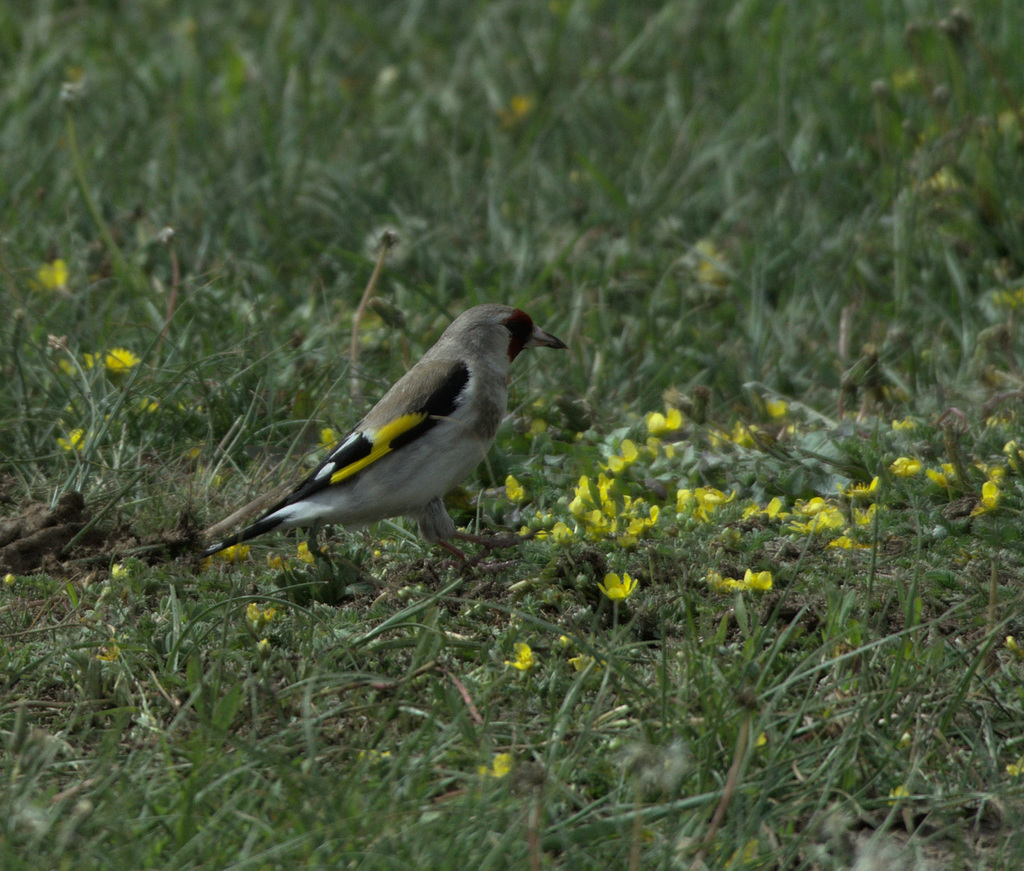
Grey-crowned Goldfinch
Photo © Pavel Komkov
Photo © Pavel Komkov — CC BY 4.0 — Source: iNaturalist #83150180Identification
The grey-crowned goldfinch is a small finch measuring 10.5–14 cm in length with a wingspan of 21.5–25.5 cm, weighing approximately 15–21 g. As its name suggests, the species is characterized by a distinctive grey crown, which sets it apart from its close relative, the European goldfinch, which lacks this feature. Males display brighter and more extensive red on the face and brighter yellow on the wings compared to females—the only notable plumage difference between the sexes. Both sexes sport a pinkish bill. Juveniles lack facial red coloring, showing instead faint streaking on the breast and buffish tips to wing coverts, along with duller legs than adults.
Range & Habitat
The grey-crowned goldfinch is distributed throughout Central Asia and the Himalayas, breeding from southern and eastern Iran eastward through Afghanistan, northern and western Pakistan, northwestern India, and western Nepal, extending northeast to far western Xinjiang in China. This species is an altitudinal migrant, breeding at elevations of 2,400–4,200 meters (occasionally as low as 1,500 m) and descending in winter to 1,900–2,400 meters (rarely to 75 m). Similar altitudinal migration patterns occur in Kazakhstan.
The species favors open and sparse deciduous woodland, mixed deciduous and conifer forests, forest edges, orchards, parks, and gardens at altitudes between 2,100 and 3,600 meters. Notably, it typically inhabits higher altitudes than its European cousin, the European goldfinch.
Behaviour & Diet
Grey-crowned goldfinches are highly social birds, gathering in flocks of four to several dozen individuals, sometimes mixing with other finch species. They typically forage on the ground and form larger flocks during autumn and winter months. Their diet consists primarily of seeds from various flowering plants including thistles, sunflowers, zinnias, chinar trees, and dandelions, though they also consume arthropods.
The breeding season extends from April to August, with the species nesting in groups that may include up to five nests in a single tree. Females construct neat cup-shaped nests from mosses and grasses, positioned as high as 18 meters or more in pine, willow, fruit, and birch trees. Clutches typically contain 4–5 bluish-white eggs speckled with red and brown. The female incubates eggs for 9–12 days, and chicks remain in the nest for 13–18 days before fledging, receiving parental care for up to 10 days after leaving the nest.
Best Time & Places to See It
To encounter grey-crowned goldfinches, visit their breeding grounds in the Himalayas and Central Asia during April to August, when birds are actively nesting and most visible. The species breeds at higher elevations (2,400–4,200 m), though they descend to lower altitudes (1,900–2,400 m) during winter, making them more accessible in the nonbreeding season. Key regions include western and northern Pakistan, northwestern India, western Nepal, Afghanistan, and parts of Iran. The species occasionally appears as a vagrant in Beijing and has been recorded in Japan.
Photography Tips
Photographing grey-crowned goldfinches requires patience and positioning at the correct elevation. Scout orchards, parks, and deciduous woodland edges at 2,100–3,600 meters where these birds forage on the ground and in flocks. Dawn and early morning provide optimal lighting for capturing the subtle grey crown and red facial markings that distinguish males from females. The bright yellow wing patches are particularly striking in direct sunlight. Since these birds often forage in flocks, observe their behavior and anticipate their movements to capture dynamic flock images. Their melodious, chaffinch-like song provides an audio cue to their presence, helping photographers locate groups in dense vegetation.
Langtang National Park
Helambu, Nepal
+364 birds+14 mammals
Where the southern slopes of the Himalayan highlands descend toward the subtropical valleys of central Nepal, Langtang National Park sprawls across one of the subcontinent's most…
VIEW NATIONAL PARKGangotri National Park
Bhatwari, India
+119 birds+1 mammals
Where the Bhagirathi River carves through the western Himalayas in northern Uttarakhand, Gangotri National Park rises across steep alpine terrain that defines the boundary between temperate…
VIEW NATIONAL PARKNanda Devi National Park
Garpak, India
+218 birds+5 mammals
Where the Himalayas surge into their most dramatic alpine amphitheater, a wilderness of raw geological power unfolds across 624 square kilometers of pristine terrain. Nanda Devi,…
VIEW NATIONAL PARKValley of Flowers National Park
Ghangaria, India
+117 birds+1 mammals
Where alpine meadows explode with color each monsoon season, the Himalayan slopes of Uttarakhand rise to create one of Earth's most extraordinary floral displays. Perched between…
VIEW NATIONAL PARKHemis National Park
Raigahar Dhar, India
+131 birds+13 mammals
Where granite gorges cleave through the Himalayas at dizzying altitudes, a vast wilderness of alpine desert unfolds across the rain shadow of Ladakh. Hemis sprawls across…
VIEW NATIONAL PARKAltai Tavan Bogd National Park
Tsengel, Mongolia
+146 birds+3 mammals
Where the Altai Mountains rise in jagged defiance along Mongolia's western frontier, the terrain transforms into a realm of alpine tundra, rocky plateaus, and glacier-carved valleys…
VIEW NATIONAL PARKNo community photos yet. Log in to add the first one.
No community observations of this species yet.