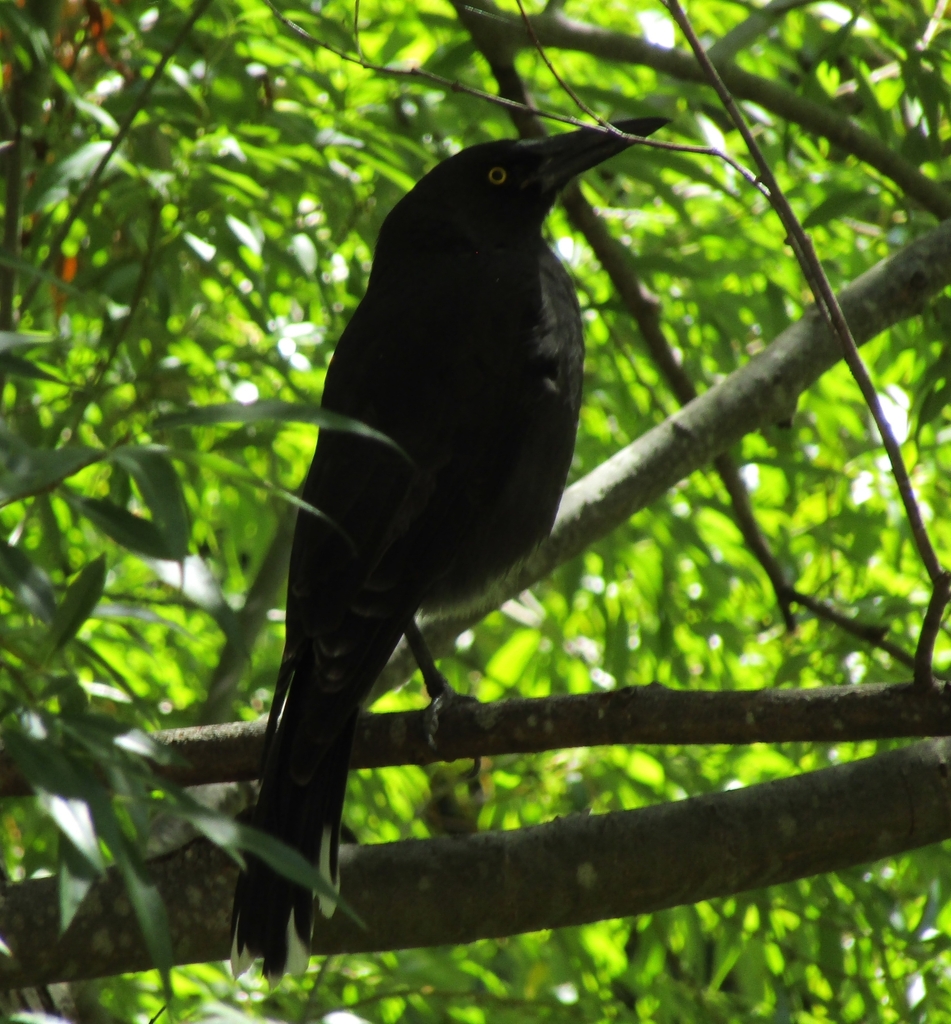
Grey Currawong
Photo © Heath Hunter
Photo © Heath Hunter — CC BY 4.0 — Source: iNaturalist #150805866Identification
The grey currawong is a large passerine bird, averaging around 48 cm in length, with a distinctly crow-like appearance. It is characterized by dark plumage, striking yellow irises, a heavy bill, and diagnostic white patches on the undertail and wings. Males and females are similar in appearance. Six subspecies are recognized across Australia, varying considerably in overall plumage colour from slate-grey in the nominate New South Wales and eastern Victoria populations to sooty black in the Tasmanian clinking currawong and Kangaroo Island forms. All grey currawongs share a loud, distinctive ringing or clinking call that serves as an excellent field identification tool.
Range & Habitat
The grey currawong is native to southern Australia, including Tasmania, where it is generally sedentary within its range, though it acts as a winter visitor to the southeastern corner of the country. It inhabits all kinds of forested areas as well as scrubland in drier regions. Unlike the more arboreal pied currawong, this species is less dependent on trees and spends considerably more time foraging on the ground, making it more visible to observers in suitable habitat.
Behaviour & Diet
Comparatively little studied, much of the grey currawong's behaviour remains poorly known, partly because it builds its nests high in trees, limiting research on breeding habits. The species is omnivorous, feeding on a varied diet that includes berries, invertebrates, and small vertebrates. It has adapted poorly to human impact compared to related species and has declined in much of its range, though it is not currently considered endangered.
Best Time & Places to See It
Southern Australia's forested and scrubland regions offer the best opportunities to encounter this species. Winter visitors to southeastern Australia may have increased chances of sightings during that season. Listen for the loud, distinctive ringing or clinking call—an excellent guide to locating these birds, particularly in their preferred ground-foraging habitats.
Photography Tips
The grey currawong's dark plumage and distinctive white wing and tail patches make it visually striking, though its preference for ground foraging and semi-open habitats can present composition challenges. The striking yellow irises provide excellent focal points for close-up shots. Early morning light will enhance the visibility of white markings against dark feathers. patience and attention to vocalizations will improve your chances of positioning yourself for productive photography in this less common species.
Alpine National Park
Belair National Park
Ben Boyd National Park
Blue Mountains National Park
Budawang National Park
Budj Bim National Park
Chiltern-Mt Pilot National Park
Cleland National Park
Coffin Bay National Park
Nothing matches these filters.
No community photos yet. Log in to add the first one.
No community observations of this species yet.