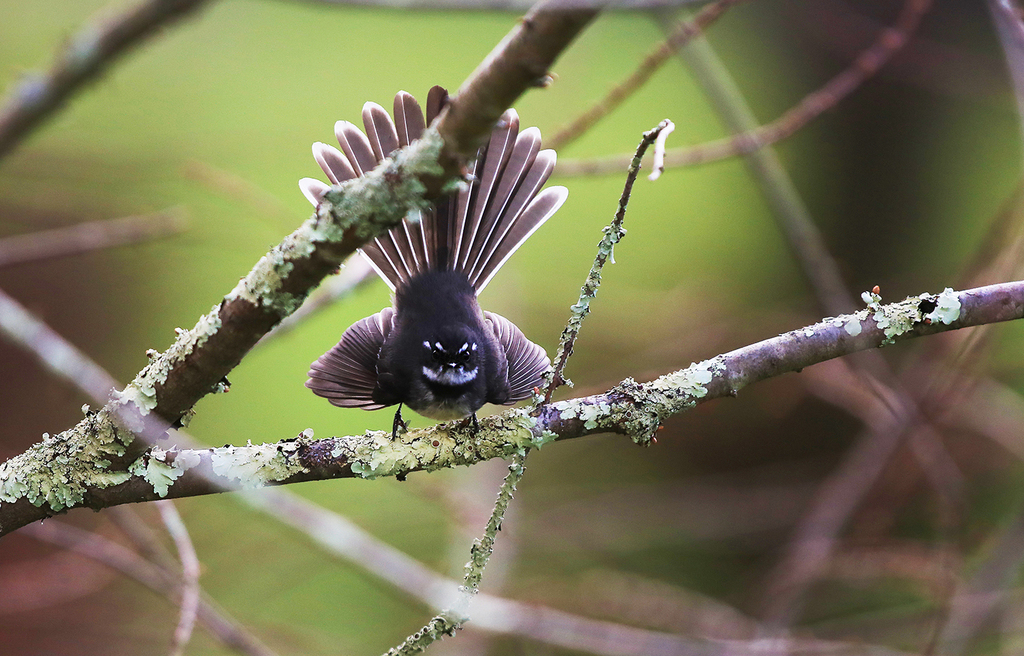
Grey Fantail
Photo © Shane Walker
Photo © Shane Walker — CC BY 4.0 — Source: iNaturalist photo #53221233Identification
The grey fantail is a small insectivorous bird measuring 16 cm in length, with the distinctive tail making up half of its body. It displays mid-to-dark grey or grey-brown plumage above and lighter colouration—often yellowish or orange—below, with a characteristic white throat and white markings over the eye. The outer tail feathers are light-coloured while the centre feathers are dark, a pattern that becomes striking when the bird fans its tail, as it frequently does. There is no sexual dimorphism between males and females. Some subspecies, such as keasti, display notably darker plumage than others, reflecting the variation across different populations.
Range & Habitat
The grey fantail is a common species found across Australia, the Solomon Islands, Vanuatu, and New Caledonia. Within Australia, five subspecies are distributed geographically, with populations separated by biogeographical barriers such as the Nullarbor Plain, which has shaped their morphological diversity. The species thrives in diverse wooded environments including eucalypt forest, rainforest, mangroves, heath, and suburban gardens where trees are present.
Behaviour & Diet
The grey fantail is an active, restless insect-hunter that is almost never still during waking hours. It flits rapidly from perch to perch—predominantly on tree twigs but also on the ground and convenient objects—constantly scanning for flying insects. The bird is remarkably acrobatic, executing intricate aerial chases to capture prey in flight. It is notably unafraid of humans and will often flit within metres of people, particularly in forested areas and gardens, sometimes exploiting insects disturbed by human activities such as walking or digging.
The grey fantail is territorial and seasonal breeder, typically raising several broods per season. It is predominantly monogamous within breeding seasons, with clutches usually containing three or four cream eggs spotted with grey and brown. Both parents share incubation duties over approximately two weeks and collaborate in feeding young. The bird's call is an almost metallic "cheek" sound, delivered either singly or more commonly as a repeated chatter.
Best Time & Places to See It
The grey fantail is easily observed while walking through suitable habitat, particularly eucalypt forests, rainforests, mangroves, and heathland. Its constant activity and lack of shyness make it a reliable sighting in these environments and in suburban gardens with adequate tree cover. The breeding season brings increased visibility as birds become more active in territorial and nesting behaviour.
Photography Tips
Photograph grey fantails in their preferred perching spots on tree twigs and branches where they pause between feeding flights. The bird's fanned tail display—showing the contrasting light outer feathers against dark centre feathers—provides compelling visual opportunities and should be anticipated. Position yourself quietly near eucalypt forest or mangrove areas where the species is most active. Early morning during waking hours offers the best chances to capture the bird's constant movement and characteristic behaviours. The small size and rapid, acrobatic flight require a fast shutter speed and patient observation to obtain sharp images.
Alpine National Park
Bald Rock National Park
Barrington Tops National Park
Belair National Park
Ben Boyd National Park
Blue Mountains National Park
Boodjamulla National Park
Bouddi National Park
Bribie Island National Park
Nothing matches these filters.
No community photos yet. Log in to add the first one.
No community observations of this species yet.