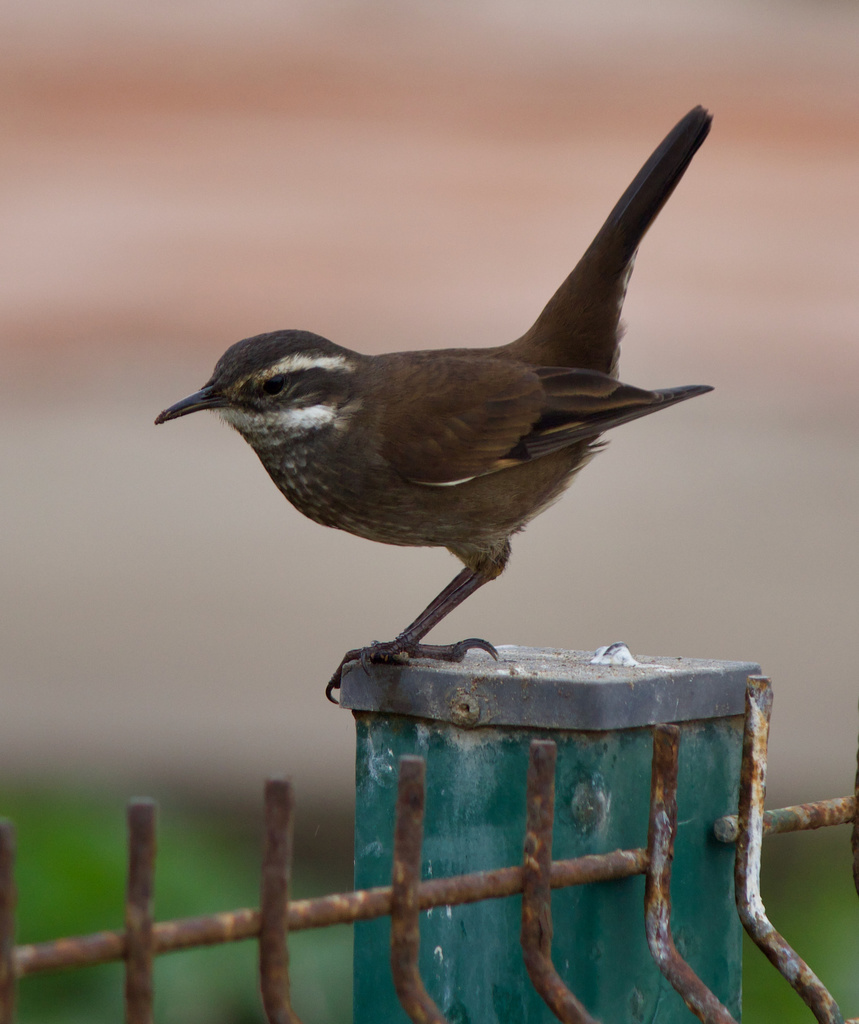
Grey-flanked Cinclodes
Photo © Ben Lyle Bedard
Photo © Ben Lyle Bedard — CC BY 4.0 — Source: iNaturalist photo #134053222Identification
The grey-flanked cinclodes is a small member of the ovenbird family, measuring 17 to 18 cm long and weighing between 22 to 31 grams. It is characterized by a medium-length, slightly decurved bill and a distinctive plumage pattern. The nominate subspecies displays a buff supercilium with speckles at its front, blackish-brown lores and ear coverts, and a whitish malar area with dark scallops. The crown is dark grayish-brown while the upperparts are rich dark brown, with rufous tones visible across the base of the flight feathers and on the tail's outer feathers.
The underparts show a white throat with dark scallops at its base, transitioning to a dull dark gray-brown breast with pale spots above and streaks below. The belly is paler and browner with a white center, while the flanks and undertail coverts are rich dark brown with some whitish feather tips. The sexes share identical plumage. The iris is dark brown to black, the bill blackish or blackish horn, and the legs and feet are blackish-brown. The other two subspecies show variations: C. o. hornensis is less richly colored with darker gray upperparts, while C. o. baeckstroemii adds a rufous tinge to the sides and flanks.
Range & Habitat
The grey-flanked cinclodes is endemic to South America, found in Argentina and Chile. The nominate subspecies occurs on the mainland from Chile's Antofagasta Region and western Argentina's Mendoza Province southward to the Strait of Magellan. Subspecies C. o. hornensis inhabits Chile's Desolación Island, Tierra del Fuego (both Chilean and Argentine sectors), and the Cape Horn Archipelago, while C. o. baeckstroemii is restricted to Alejandro Selkirk Island in the Juan Fernández Archipelago.
This species favors open grassy and rocky landscapes, with a particular affinity for montane areas near streams. Its elevational range extends from sea level to 4,200 meters, making it adaptable to diverse terrain throughout its range.
Behaviour & Diet
The grey-flanked cinclodes is primarily a year-round resident throughout most of its range, though individuals move to lower elevations during winter months. Subspecies C. o. hornensis exhibits partial migration, with some birds moving north onto the mainland following the breeding season. The species feeds on arthropods and presumed invertebrates, foraging singly or in pairs by gleaning prey directly from the ground, mud, and rocks.
Breeding occurs during the austral spring and summer, with activity documented through at least October. The species is assumed to be monogamous and nests in burrows excavated at the end of tunnels in earth banks, often along streamside locations. Nest chambers are lined with plant fibers and hair, and clutches typically contain two eggs. The species produces a distinctive song described as "a fast dry twittery trill rising in pitch, introduced by a few single notes," along with a dry "tsick" call.
Best Time & Places to See It
The grey-flanked cinclodes is considered uncommon to fairly common throughout its range. It is most reliably encountered during the austral spring and summer breeding season (including October onward), when birds are more vocal and active. The species' preference for open, rocky, and grassy landscapes with minimal human disturbance makes it most likely to be found in relatively undisturbed terrain.
Mountainous regions with streams and watercourses are particularly productive, as the species often forages near water. The wide elevational range means that suitable habitat exists from sea level to high mountain passes, though visitors should focus their search on areas matching these microhabitat preferences rather than expecting to find the species in closed vegetation or heavily disturbed zones.
Photography Tips
Photographing the grey-flanked cinclodes requires patience and attention to habitat. The bird's small size and cryptic plumage blend well with rocky and grassy terrain, so slow, careful movement through open areas is essential. Early morning and late afternoon often provide the best lighting for capturing the bird's subtle plumage details, particularly the rich dark brown upperparts and distinctive facial markings.
Since the species forages on the ground and gleaning from rocks and mud, positioning yourself low and still near suitable habitat may yield opportunities. The bird's habit of vocalizing during breeding season makes sound an invaluable aid in locating individuals. Focus on capturing the distinctive buff supercilium, facial pattern, and the contrasting pale breast spotting to document this understudied species for scientific and travel documentation purposes.
Chiloé National Park
Dalcahue, Chile
+122 birds+6 mammals
Temperate rainforest cloaks the Chiloé archipelago's northwestern reaches, where granite ridges thrust through dense, moisture-laden canopy and freshwater streams carve ravines toward the Pacific. Across approximately…
VIEW NATIONAL PARKCabo de Hornos National Park
Cape Horn, Chile
+88 birds+9 mammals
Where the Andes plunge into the Southern Ocean and the Drake Passage churns between two continents, Cabo de Hornos National Park sprawls across one of Earth's…
VIEW NATIONAL PARKPan de Azúcar National Park
Chañaral, Chile
+74 birds+4 mammals
Where the Atacama Desert plunges toward the Pacific, Pan de Azúcar National Park sprawls across 727 square kilometres of one of Earth's most extreme transitions—a landscape…
VIEW NATIONAL PARKCorcovado National Park
Chaitén, Chile
+39 birds+1 mammals
Where temperate rainforest meets the raw Pacific coastline of Chilean Patagonia, Corcovado National Park sprawls across 6,585 square kilometres of some of South America's most pristine…
VIEW NATIONAL PARKTorres del Paine National Park
Torres del Paine, Chile
+143 birds+10 mammals
Where granite spires pierce the Patagonian sky, Torres del Paine commands one of South America's most dramatic landscapes. Across 4,106 square kilometres of southern Chile, jagged…
VIEW NATIONAL PARKLaja National Park Lagoon
Antuco, Chile
+123 birds+1 mammals
Where the Andes descend into the Biobío Region's temperate forests, a vast lagoon fills the caldera of the extinct Antuco volcano, cradled by steep native woodland…
VIEW NATIONAL PARKPuyehue National Park
Puyehue, Chile
+110 birds+4 mammals
Across the volcanic spine of the Los Lagos Region, where the Andes descend toward temperate rainforest, Puyehue National Park encompasses nearly 2,600 square kilometers of one…
VIEW NATIONAL PARKVicente Pérez Rosales National Park
Puerto Varas, Chile
+109 birds+8 mammals
Where the Andes descend toward the temperate rainforests of Chile's Lake District, nearly 4,641 square kilometers of pristine wilderness unfolds across Vicente Pérez Rosales National Park.…
VIEW NATIONAL PARKPatagonia National Park
Cochrane, Chile
+133 birds+8 mammals
Where the Andes meet the Patagonian steppe, vast grasslands and shrublands sweep across rolling terrain carved by ancient glaciation, their contours softened by distance and dramatic…
VIEW NATIONAL PARKReserva Nacional Magallanes
Punta Arenas, Chile
+78 birds+2 mammals
Where windswept steppe meets sub-Antarctic forest near the southern tip of continental South America, Reserva Nacional Magallanes unfolds across roughly 352 square kilometres of profound ecological…
VIEW NATIONAL PARKParque Provincial Península de Magallanes
Argentina
+125 birds+4 mammals
Granite peaks and windswept steppe converge across this 415-square-kilometre peninsula jutting into the cold Atlantic waters of southern Patagonia, where the Magallanes landscape embodies the raw,…
VIEW NATIONAL PARKLos Glaciares National Park
Argentina
+121 birds+3 mammals
Where granite peaks and sprawling ice fields dominate the landscape, Los Glaciares National Park encompasses over ten thousand square kilometres of Patagonian wilderness in southern Argentina.…
VIEW NATIONAL PARKNahuel Huapi National Park
Argentina
+124 birds+11 mammals
Where the Andes descend toward Patagonia, vast glacial lakes cut through a landscape of southern beech forest and granite peaks, creating one of South America's most…
VIEW NATIONAL PARKLanín National Park
Argentina
+128 birds+7 mammals
Where the volcanic spine of the Andes plunges into Patagonian steppe, Lanín National Park sprawls across nearly 4,700 square kilometers of one of Argentina's most visually…
VIEW NATIONAL PARKLago Puelo National Park
Argentina
+109 birds+1 mammals
Where temperate forests descend to crystalline waters in the foothills of the Andes, Lago Puelo National Park sprawls across nearly 300 square kilometers of pristine wilderness…
VIEW NATIONAL PARKLos Alerces National Park
Argentina
+84 birds+3 mammals
Where the temperate rainforests of southern Patagonia sweep down towards crystalline lakes, Los Alerces National Park unfolds across nearly 3,000 square kilometres of one of South…
VIEW NATIONAL PARKNo community photos yet. Log in to add the first one.
No community observations of this species yet.