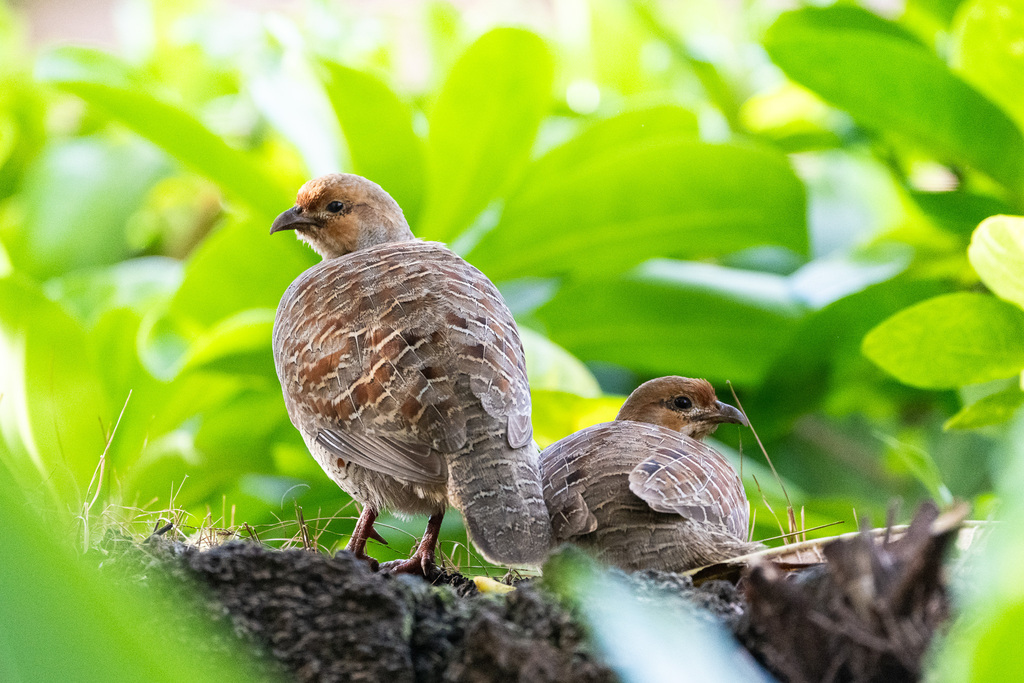
Grey Francolin
Photo © cello caruso-turiello
Photo © cello caruso-turiello — CC BY 4.0 — Source: iNaturalist photo #343417631Identification
The grey francolin is a medium-sized francolin, with males averaging 11.6–13.4 inches (29–34 cm) and females slightly smaller at 10.2–11.9 inches (26–30 cm). Both sexes are barred throughout their plumage, with a distinctive pale face bordered by a thin black line around the pale throat. Males can possess up to two spurs on their legs, while females typically lack them. In flight, the chestnut tail and dark primaries are clearly visible, and the bird is a weak flier that typically covers only short distances before diving into undergrowth to escape.
Three subspecies are recognized across the bird's range. The nominate race from southern India features a darker rufous throat and supercilium with richer brown coloring. Subspecies O. p. interpositus from northern India is darker and intermediate in appearance. Subspecies O. p. mecranensis, found in the arid northwestern regions, is the palest of the three. The only similar species is the painted francolin, which can be distinguished by its rufous vent.
Range & Habitat
The grey francolin is found across the plains and drier parts of the Indian subcontinent and Iran. Its range extends south of the Himalayan foothills, westward to the Indus Valley and eastward to Bengal, with populations also occurring in northwestern Sri Lanka. The species is rarely found above 500 meters elevation in India, though it reaches 1,200 meters in Pakistan. Introduced populations exist on the Andaman and Chagos Islands, as well as in Nevada and Hawaii in the United States.
These are ground-dwelling birds that prefer open cultivated lands, scrub forest, and bare or low grass-covered ground in open country. They roost communally in low, thorny trees and are usually encountered in small groups while foraging on the ground.
Behaviour & Diet
The grey francolin is highly vocal, particularly in early morning hours. Its loud, repeated call—a distinctive "Ka-tee-tar...tee-tar"—is so characteristic that the local name "teetar" derives directly from these vocalizations. Pairs sometimes engage in duets, with females producing a "tee...tee...tee" or "kila..kila..kila" call, while the challenge call "kateela..kateela..kateela" is performed as a duet between birds. During the breeding season from April to September, calling males attract challengers, a behavior historically exploited by people using decoys to trap birds for fighting purposes.
The diet consists primarily of seeds and grains supplemented by insects, particularly termites and beetles from the families Tenebrionidae and Carabidae. Occasionally, they consume larger prey such as snakes. Nests are typically hidden scrapes on the ground, though sometimes placed in niches in walls or rocks above ground level. Clutches normally contain six to eight eggs, though larger clutches have been documented, potentially indicating intraspecific brood parasitism.
Best Time & Places to See It
Early morning is the best time to encounter grey francolins, when their loud calls are most commonly heard. The breeding season from April to September offers opportunities to observe calling birds and territorial behavior. The species is most active in open, scrubby habitats and cultivated lands across its range in the Indian subcontinent and Iran, where small groups can be spotted foraging on bare or low grass-covered ground.
Photography Tips
Patience and early morning visits will reward photographers seeking to capture these vocal birds. Their weak flying ability means they typically remain close to the ground, offering relatively accessible subjects for ground-level photography. The pale facial markings, barred plumage, and chestnut tail are key features to capture. The species' graceful running gait—described historically as almost gliding—provides dynamic photo opportunities when birds move across open ground between patches of cover. Group roosting in thorny trees at dusk and dawn may also provide photographic chances, though the low vegetation presents compositional challenges.
Indravati National Park
Bijapur, India
+41 birds
Where the Indravati River cuts through the elevated plateaus of central India, a landscape of deciduous forest and open woodland unfolds across Bijapur district in Chhattisgarh.…
VIEW NATIONAL PARKHawaiʻi Volcanoes National Park
Hawaiʻi County, United States
+84 birds+2 mammals
Where volcanic slopes descend toward the Pacific across more than five thousand square kilometers, Hawaiʻi Volcanoes National Park presents one of Earth's most dynamic laboratories of…
VIEW NATIONAL PARKKanha Tiger Reserve
Kanha Kisli F.V., India
+321 birds+23 mammals
Where sal forests give way to emerald meadows and crystalline streams carve through ancient valleys, one of India's finest wilderness reserves unfolds across the Maikal Range.…
VIEW NATIONAL PARKTadoba National Park
Palasgaon Singru, India
+270 birds+20 mammals
Where sal forests meet open grasslands and rocky outcrops rise from red laterite soil, central India's landscape unfolds in raw, untamed beauty. Ancient teak woodlands and…
VIEW NATIONAL PARKBandhavgarh National Park
Garhpuri, India
+285 birds+17 mammals
Where granite ridges rise dramatically above sal and bamboo forests, one of India's most pristine tiger reserves unfolds across the Vindhyan plateau. Ancient rock formations tower…
VIEW NATIONAL PARKPanna National Park
Badgadi Kalan, India
+271 birds+17 mammals
Where granite gorges slice through central India's Vindhyan plateau, a landscape of stark beauty unfolds across nearly six hundred square kilometers. The Ken River carves through…
VIEW NATIONAL PARKKeoladeo National Park
Shreenagar Rural, India
+326 birds+14 mammals
Where shallow wetlands shimmer beneath vast Rajasthani skies, one of Asia's finest bird sanctuaries pulses with extraordinary life. This former maharaja's hunting reserve, now spanning 29…
VIEW NATIONAL PARKPeriyar National Park
Mlappara, India
+232 birds+4 mammals
Dawn breaks over mist-shrouded ridges where the Western Ghats tumble toward Kerala's spice-scented lowlands. Here, ancient tropical forests envelope a glittering artificial lake, creating a mosaic…
VIEW NATIONAL PARKPampadum Shola National Park
Vattavada, India
+258 birds+14 mammals
Where misty shola forests cling to the high plateaus of the Nilgiri Mountains, ancient evergreen remnants create a world apart. This 2,316-hectare reserve protects one of…
VIEW NATIONAL PARKBandipur National Park
Hirehalli, India
+302 birds+19 mammals
Where the Western Ghats descend into the Deccan plateau, ancient deciduous forests blanket a landscape carved by the Nugu River. Bandipur unfolds across 880 square kilometres…
VIEW NATIONAL PARKNagarahole Tiger Reserve
Nalkeri Forest, India
+323 birds+23 mammals
Where granite escarpments rise above dense deciduous forests and the Kabini River carves through pristine wilderness, one of India's most biodiverse landscapes unfolds across the Western…
VIEW NATIONAL PARKHaleakalā National Park
Maui County, United States
+66 birds+4 mammals
Ascending from sea level to over 10,000 feet across a mere thirty miles, Haleakalā National Park commands one of the Pacific's most dramatic elevation gradients, where…
VIEW NATIONAL PARKKīlauea Point National Wildlife Refuge
Kilauea, United States
+79 birds+1 mammals
At the northernmost tip of Kauai, where the Pacific trades collide with volcanic rock, Kīlauea Point National Wildlife Sanctuary crowns a dramatic headland overlooking one of…
VIEW WILDLIFE SANCTUARYNo community photos yet. Log in to add the first one.
No community observations of this species yet.