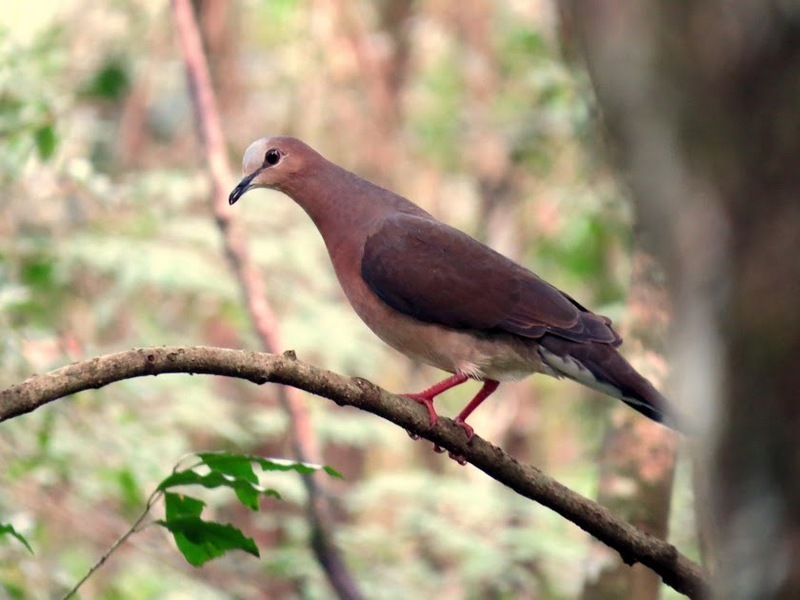
Grey-fronted Dove
Photo © Diego Carús
Photo © Diego Carús — CC0 1.0 — Source: iNaturalist photo #27166919Identification
The grey-fronted dove is a large tropical dove, approximately 28 cm (11 inches) long and weighing 115 to 183 grams. Adult males display a distinctive grayish to bluish forehead and crown, with a grayish-purple nape and hindneck showing subtle iridescence. The eye is yellow or brown, surrounded by bare red skin and pale pinkish-white feathers. The throat is pinkish white, while the rest of the face is buff to pinkish-buff. The upperparts are olive-brown with faint bronze or purplish tones on the mantle. Central tail feathers are olive-brown; outer feathers are blackish with white tips. The breast and neck sides are greyish-pink, fading to white on the belly. The bill is black and the legs and feet are red. Females are browner overall with an olive-tinged cast to the flanks and greenish upperparts. Juveniles resemble females but show rusty and drab-brown barring on the breast with rusty-edged feathers above.
Range & Habitat
Found across mainland South America east of the Andes, from Colombia and Venezuela through the Guyanas and into Brazil, extending south to Paraguay, Uruguay, and northeastern Argentina. Also present on Trinidad. The species inhabits humid forest environments, occurring in both interior forests and at forest edges and clearings. In Colombia, it frequents várzea, terra firme, and gallery forests. Elevations range from sea level to 550 meters in Venezuela, though locally reaching 2,200 meters in southeastern Brazil.
Behaviour & Diet
This dove forages on the forest floor, feeding primarily on seeds and small fruits such as berries, supplemented with insects including small butterflies and moths and various invertebrates. It has adapted to eating bananas and rice at feeding stations. The grey-fronted dove breeds almost year-round on Trinidad, with shorter breeding seasons elsewhere. It constructs a simple platform nest of twigs in bushes, trees, or palms, typically laying one or two white eggs. The species is vocal, producing a distinctive and mournful song described as a single monotonous note—'wooOOOoo'—that fades gradually in and out.
Best Time & Places to See It
The grey-fronted dove is a resident species throughout its range, making it potentially observable year-round, though breeding activity is nearly continuous in Trinidad. Look for this dove on the forest floor in humid lowland forests, particularly where fallen fruit and seeds are abundant. It frequents forest clearings and edges as well as forest interiors. Early morning and late afternoon are prime times for observation, when the dove is most active in foraging and vocalizing.
Photography Tips
Photograph this species on the forest floor or in low vegetation where it forages. The pale eye-ring and reddish orbital skin provide distinctive features to capture. Early morning light is ideal for revealing the subtle iridescence on the nape and the blue-gray tones of the crown and forehead. Since the dove forages quietly on the ground, approach slowly and remain still to avoid flushing. Listen for the distinctive mournful call to locate birds before attempting photography. A telephoto lens is recommended to maintain distance while capturing fine plumage details.
Amacayacu National Park
Amazônia National Park
Antisana National Park
Araucárias National Park
Bahuaja Sonene National Park
Brasília National Park
Campos Amazónicos National Park
Cantão State Park
Carlos Botelho State Park
Nothing matches these filters.
No community photos yet. Log in to add the first one.
No community observations of this species yet.