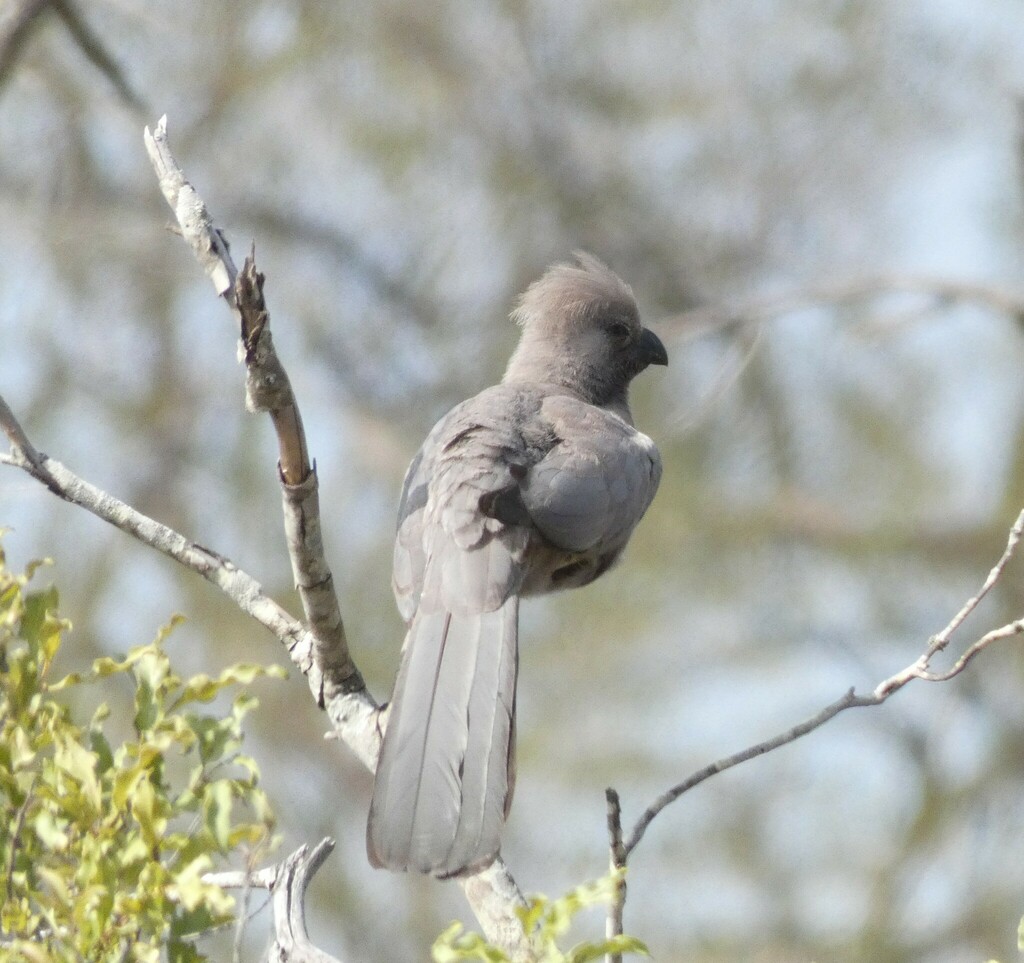
Grey Go-away-bird
Photo © agujaceratops
Photo © agujaceratops — CC BY 4.0 — Source: iNaturalist #135144857Identification
The grey go-away-bird is a striking and unmistakable turaco measuring 47–51 cm in length and weighing 200–300 g. It is characterized by almost uniform smoky-grey plumage with a distinctive wispy, back-swept crest of 6–7 cm that can be raised almost vertically when the bird is excited. The sexes are similar in appearance. Most notably, the bird sports a strong, decurved black beak contrasted by a striking pink gape and tongue. The plumage is darkest on the chin and throat, gradually becoming paler around the eyes and belly, with a slight olive wash on the breast. Within its range, the grey go-away-bird's unique appearance and habits make it virtually impossible to confuse with other bird species.
Range & Habitat
The grey go-away-bird is native to southern Angola, southern DRC, Zambia, southern Tanzania, Malawi, Mozambique, Namibia, Botswana, Zimbabwe, South Africa and Eswatini. It occupies arid to moist, relatively open savanna woodlands, with a particular preference for areas where Acacia trees are present. The species frequents the edges of miombo woodland and occurs commonly along water courses, in dry riparian forest, and in Acacia woodland on alluvium.
These birds are also adaptable to human-modified landscapes, occurring commonly on farms and in suburban gardens and parks. They require water and disperse along tributaries of desert rivers when water flows. Rather than undertaking regular migrations, they wander irregularly in search of food and water. They are absent from areas lacking suitable fruiting trees and tend to desert areas where woody plant encroachment occurs.
Behaviour & Diet
Despite having rather slow and laboured flight, grey go-away-birds can cover long distances. However, once in open tree tops, they display impressive agility, running along limbs and jumping from branch to branch with the dexterity characteristic of their family. They regularly form groups and parties numbering even 20–30 individuals that move about together in search of fruit and insects near the tree tops. They are bold and common birds that make their presence loudly known, especially when disturbed, with characteristically loud and nasal "kweh" or "go-way" calls, with the last syllable typically a descending drawl.
Their diet is mainly fruit, including wild figs and berries from plants in the genera Ficus, Viscum, Loranthus, Diospyros, Lannea, Ziziphus, Salvadora and Flueggea, supplemented with flowers, buds, leaves, termites, and snails. They also feed on fruit of exotic invasive plants like seringa, and in doing so help disperse their seeds.
Best Time & Places to See It
The grey go-away-bird is present year-round throughout its range, though breeding seasons vary by location: July to August in Angola, April to November in Malawi, August to September in Zambia, September and December to April in Namibia, and all months in Zimbabwe and South Africa. Look for them in open savanna woodlands with Acacia trees, particularly near surface water and along riparian corridors. They are common enough that patient observers should encounter them in suitable habitat, often giving away their location through their distinctive, loud calls.
Photography Tips
The grey go-away-bird's bold nature and loud vocalizations make it relatively approachable for photography. Its distinctive features—the prominent crest, pink gape and tongue, and uniform grey plumage—are most striking in good light. Photograph these birds in the tree tops where they spend most of their foraging time, displaying their characteristic agility as they move among branches. The contrast between their grey plumage and colorful facial features makes them rewarding photographic subjects, particularly when the crest is raised during moments of excitement or disturbance.
Mapungubwe National Park
Musina Local Municipality, South Africa
+358 birds+29 mammals
Where the Limpopo River cuts through sandstone ridges at the convergence of South Africa, Botswana, and Zimbabwe, Mapungubwe National Park preserves a landscape of profound ecological…
VIEW NATIONAL PARKChobe National Park
Botswana
+446 birds+45 mammals
Where the Chobe River cuts a sinuous path through northern Botswana, the landscape transforms into one of Africa's most dynamic wetland-savanna mosaics. This national park encompasses…
VIEW NATIONAL PARKNxai Pan National Park
Botswana
+226 birds+16 mammals
Across the northwestern reaches of Botswana stretches a landscape of profound seasonal transformation—a sprawling pan system where shallow depressions fill and empty with the rains, creating…
VIEW NATIONAL PARKKhaudum National Park
Botswana
+213 birds+13 mammals
Where the Okavango's northern tributaries meander through miombo woodland and riverine forest, Khaudum National Park unfolds across a landscape of profound ecological richness and isolation. This…
VIEW NATIONAL PARKNo community photos yet. Log in to add the first one.
No community observations of this species yet.