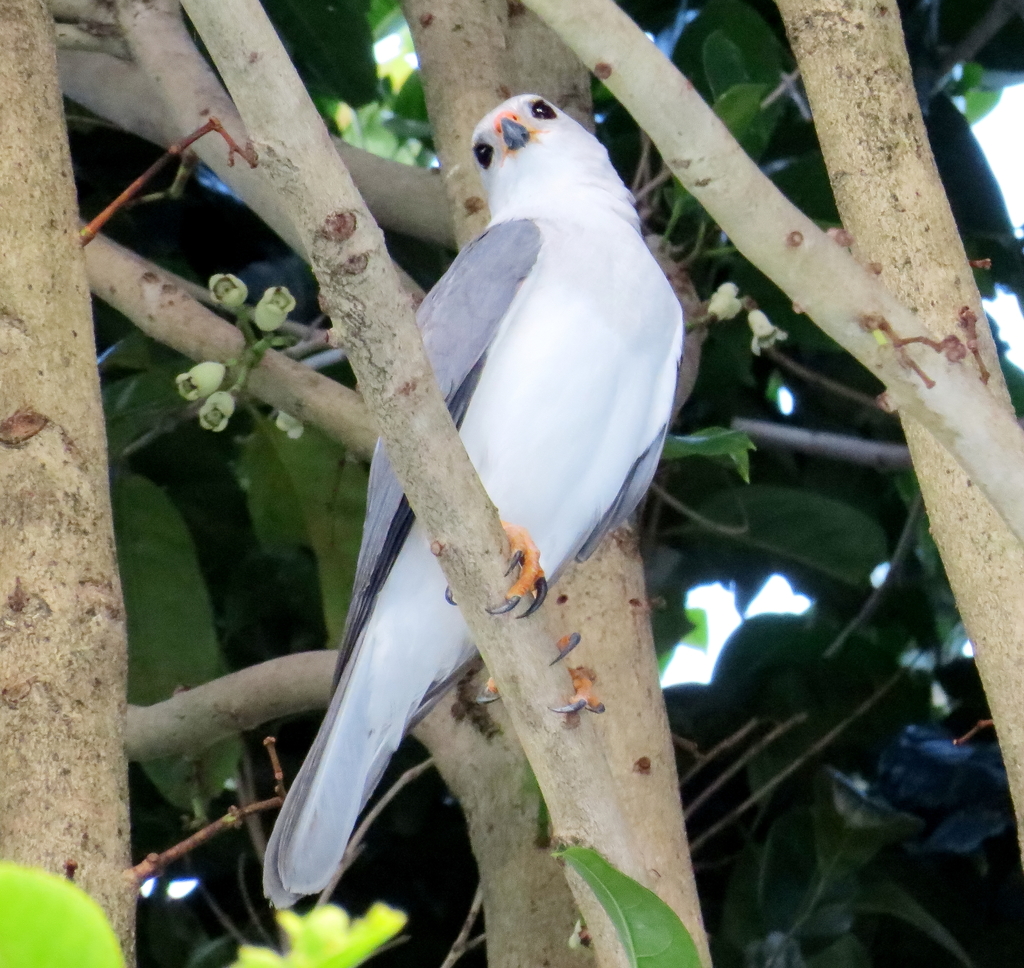
Grey Goshawk
Photo © Graham Winterflood
Photo © Graham Winterflood — CC BY-SA 4.0 — Source: iNaturalist #45137623Identification
The grey goshawk is a strongly built, medium-sized bird of prey with two distinct colour morphs. The grey morph displays a pale grey head and back, dark wingtips, barred grey breast and tail, and white underparts. The white morph, known as the white goshawk, is entirely white—one of only two birds of prey in the world to achieve this striking plumage (the other being the closely related variable goshawk). Grey goshawks are the largest Tachyspiza on mainland Australia, measuring 40 to 55 centimetres in length with wingspans of 70 to 110 centimetres. There is marked sexual dimorphism: females are considerably larger than males, averaging 720 grams (occasionally reaching 990 grams), while males average 355 grams.
Range & Habitat
The grey goshawk is found along the coasts of northern, eastern, and south-eastern Australia, Tasmania, and rarely Western Australia. It favours forests, tall woodlands, and timbered watercourses, showing a preference for well-vegetated habitats that provide both hunting grounds and nesting sites.
Behaviour & Diet
Grey goshawks are opportunistic hunters that employ stealth when pursuing prey, though they are also willing to engage in direct pursuit before striking with their talons. While birds remain their most frequent prey—including pigeons, parrots, currawongs, gamebirds, and herons—they also take mammals such as rabbits, possums, echidnas, and bats, along with small reptiles, amphibians, insects, and occasionally carrion. Sexual differences in hunting are pronounced: males typically select small to mid-sized passerines, while females hunt larger prey. Compared to co-occurring brown goshawks, grey goshawks are less agile in twisting aerial pursuits but compensate with greater power, allowing them to tackle larger quarry. Grey and white goshawks interbreed freely and form lifelong partnerships, breeding from July to December. Pairs nest in tall trees, constructing a platform of sticks and twigs lined with green leaves. Females lay clutches of 2 or 3 eggs, incubating them for approximately 35 days, with chicks fledging 35–40 days after hatching. The female typically handles incubation and chick feeding while the male undertakes most hunting duties.
Best Time & Places to See It
The breeding season from July to December offers excellent opportunities to observe grey goshawks, particularly near tall trees where nesting activity may be visible. Eastern and northern coastal regions of Australia, along with Tasmania, provide the most reliable sightings. Forested and timbered areas near watercourses should be prioritised when searching for this species.
Photography Tips
The contrasting plumage of the grey morph—pale upperparts against dark wingtips and barred markings—photographs beautifully in clear light. The white morph presents a striking subject but demands careful exposure metering to avoid blown highlights. In-flight photography is challenging due to the species' less agile aerial manoeuvres compared to other goshawks, but perched birds offer excellent opportunities. Position yourself with natural forest backdrop to complement the bird's woodland habitat. Early morning light during the breeding season may reveal hunting behaviour or nest-provisioning activities, providing dynamic storytelling opportunities for your portfolio.
Nerang National Park
Gold Coast, Australia
+126 birds+13 mammals
Steep subtropical rainforest clads the hinterland ridges of southeast Queensland's Gold Coast, where Nerang National Park sprawls across 34 square kilometres of protected bushland between the…
VIEW NATIONAL PARKBunya Mountains National Park
Australia
+149 birds+11 mammals
Where subtropical rainforest meets open eucalyptus woodland on the elevated plateau of southeastern Queensland, Bunya Mountains National Park unfolds across 483 square kilometres of some of…
VIEW NATIONAL PARKDaintree National Park
Dedin, Australia
+362 birds+37 mammals
Daintree National Park is one of the world’s oldest and most biologically diverse tropical rainforests, protecting an extraordinary landscape where ancient forests meet the Great Barrier…
VIEW NATIONAL PARKSpringbrook National Park
Australia
+195 birds+25 mammals
Subtropical rainforest meets open eucalypt woodland across a mountainous terrain where the McPherson Range rises sharply from the Queensland coast, creating a patchwork of microclimates and…
VIEW NATIONAL PARKLamington National Park
Australia
+227 birds+24 mammals
Where subtropical rainforest rises steeply from the Queensland coast, Lamington National Park spreads across 541 square kilometres of one of Australia's most biodiverse mountain landscapes. The…
VIEW NATIONAL PARKRoyal National Park
Sydney, Australia
+296 birds+46 mammals
Where sandstone ridges plunge toward the Tasman Sea, Royal National Park unfolds across 343 square kilometres of southeastern Australian coastal wilderness. The park's defining character emerges…
VIEW NATIONAL PARKMorton National Park
Australia
+253 birds+57 mammals
Across nearly 4,800 square kilometers of New South Wales's Southern Tablelands, rugged sandstone plateaus rise above sheltered valleys where cool-climate eucalypt woodland meets grassy heath and…
VIEW NATIONAL PARKNoosa National Park
Marcus Beach, Australia
+216 birds+8 mammals
Subtropical eucalypt woodland and open forest meet coastal heathland along the Noosa Peninsula, where the temperate waters of the Tasman current moderate the Queensland climate into…
VIEW NATIONAL PARKBlue Mountains National Park
Australia
+220 birds+43 mammals
Dramatic sandstone cliffs rise in tiers across this mountainous plateau west of Sydney, their rust-coloured faces weathered into amphitheatres and gorges where eucalyptus forest clings to…
VIEW NATIONAL PARKGreat Otway National Park
Australia
+255 birds+42 mammals
Temperate rainforest and wet eucalyptus woodland cloak the ridges and gullies of Victoria's Great Otway National Park, where persistent moisture and mild year-round temperatures sustain a…
VIEW NATIONAL PARKNo community photos yet. Log in to add the first one.
No community observations of this species yet.