Grey Hawk
Photo © Annika Lindqvist
Photo © Annika Lindqvist — CC BY 4.0 — Source: iNaturalist photo #179081526Identification
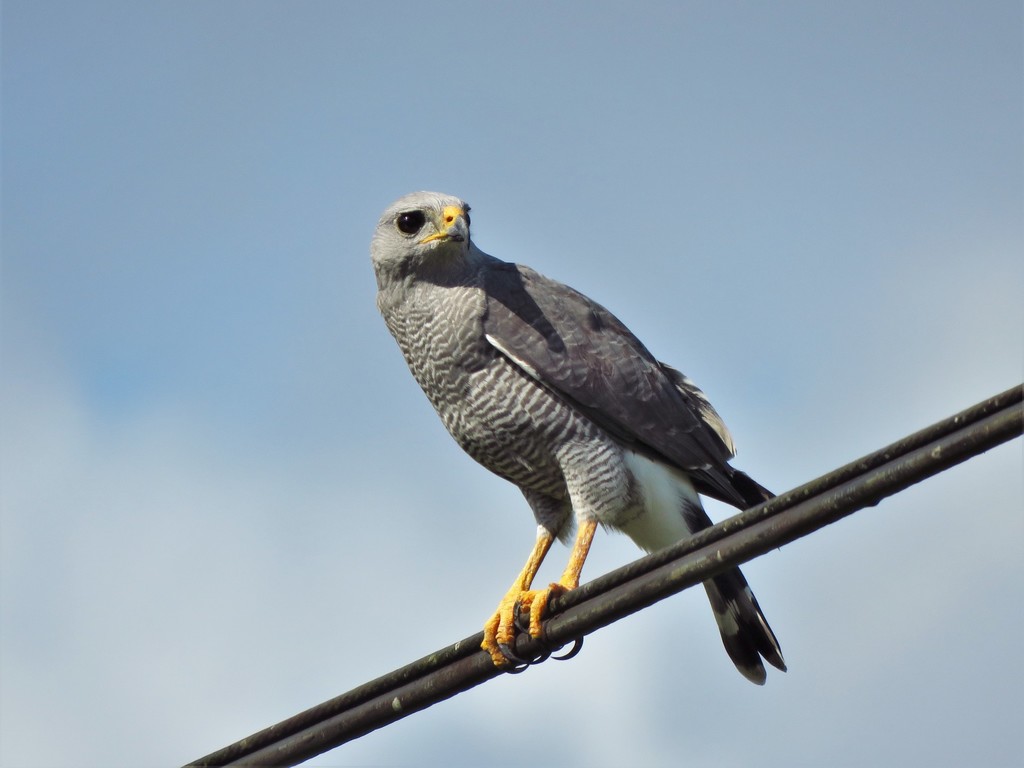
The Grey Hawk is a compact raptor measuring 46–61 cm (18–24 inches) in length, weighing an average of 475 grams. Adults are strikingly distinctive with smooth pale gray plumage on the upper parts and lighter gray and white underparts. The tail is particularly diagnostic: black with three white bands in a striking horizontal striped pattern. Orange-yellow legs complete the adult's elegant appearance. Both sexes are similar in coloration. The Grey Hawk has relatively short, broad rounded wings and a long tail compared to larger relatives like the Red-tailed Hawk, giving it a compact silhouette.
Immature birds are quite different and often confuse observers. They display dark brown upperparts with heavily spotted and streaked white underparts, and their tail features numerous dark bands rather than clear white ones. Young birds also show bold facial stripes and white upper tail coverts. This dramatic plumage difference serves as camouflage during their vulnerable juvenile period. The species has a shrill, distinctive call: a whistled "kleee-ooo" that often betrays its presence.
Range & Habitat
The Grey Hawk's range extends from southern Arizona and southern New Mexico south through the southwestern United States, Mexico, Central America, and into northern Costa Rica. The species inhabits open country and forest edges, showing a preference for areas including river edges, savanna, agricultural land, and cleared areas. In its tropical range, the Grey Hawk favors dry second-growth forest, adapting well to human-modified landscapes alongside native habitats.
Behaviour & Diet
This agile predator feeds primarily on lizards and snakes, supplementing its diet with large insects, small rodents, frogs, and occasional birds. The Grey Hawk typically hunts from an open, high perch where it can swoop on unsuspecting prey, though it will also hunt from a low glide just above the canopy, particularly in brushy areas. Its short wings and long tail make it surprisingly nimble for a Buteo hawk, enabling rapid, agile flight through complex terrain.
The Grey Hawk is monogamous, building stick nests high in trees. The typical clutch consists of one to three eggs, usually two, colored white to pale blue. Young fledge in approximately six weeks. Migration patterns vary by geography: northern populations breeding in the southwestern United States migrate in spring and return south by mid-October, while southern populations tend to remain year-round residents, with only occasional individuals overwintering in southern Texas.
Best Time & Places to See It
Grey Hawks are most reliably encountered in open country and at forest edges throughout their range. Northern populations are present during breeding season (spring through early autumn), while year-round viewing is possible in Mexico and Central America. River valleys and agricultural areas adjacent to suitable forest habitat offer good viewing opportunities. Listen for the distinctive shrill "kleee-ooo" call, which often helps locate birds perched in open positions.
Photography Tips
The Grey Hawk's preference for open perches makes it more approachable than many forest raptors. The pale gray plumage of adults provides excellent contrast for photography, particularly in bright tropical light. Focus on capturing the diagnostic black tail with white bands and the orange legs. Photographing perched birds from a distance using a telephoto lens will yield the best results. Early morning light often illuminates perched birds beautifully, enhancing the subtle gray tones of their plumage. Patience in scanning open areas and forest edges will be rewarded with opportunities to document this elegant small raptor.
Manuel Antonio National Park
Quepos, Costa Rica
+426 birds+22 mammals
Where tropical rainforest descends steeply to a rocky Pacific coastline, Manuel Antonio National Park distills Central American biodiversity into one of Costa Rica's most compressed and…
VIEW NATIONAL PARKArenal Volcano National Park
Peñas Blancas, Costa Rica
+551 birds+21 mammals
Straddling the border between Alajuela and Guanacaste in northwestern Costa Rica, this national park rises dramatically around one of Central America's most active volcanic systems. The…
VIEW NATIONAL PARKTortuguero National Park
Roxana, Costa Rica
+420 birds+23 mammals
Canals and lagoons thread through a labyrinth of lowland rainforest where the Caribbean coast of Costa Rica meets the wetland frontier. This is terrain shaped by…
VIEW NATIONAL PARKBraulio Carrillo National Park
Las Horquetas, Costa Rica
+547 birds+18 mammals
Where the Caribbean slope descends from the central volcanic cordillera toward the humid lowlands of Heredia, Braulio Carrillo National Park preserves one of Costa Rica's most…
VIEW NATIONAL PARKSanta Rosa National Park
Santa Elena, Costa Rica
+359 birds+30 mammals
Where Pacific-facing slopes descend from volcanic uplands toward the Guanacaste lowlands, Santa Rosa National Park unfolds across a mosaic of tropical dry forest, gallery woodland, and…
VIEW NATIONAL PARKGuanacaste National Park
Santa Elena, Costa Rica
+461 birds+17 mammals
Where the Pacific slopes of northwestern Costa Rica rise toward the Continental Divide, dry tropical forest gives way to cloud-laden peaks and misty ridges—a landscape that…
VIEW NATIONAL PARKVolcán Poás National Park
Toro Amarillo, Costa Rica
+237 birds+4 mammals
Where volcanic slopes rise sharply from the Central Valley floor, Volcán Poás National Park protects one of Costa Rica's most active and accessible volcanic systems. The…
VIEW NATIONAL PARKBig Bend National Park
Brewster County, United States
+345 birds+34 mammals
Where the Chisos Mountains rise abruptly from the Sonoran Desert floor, Big Bend National Park spans over 7,300 square kilometers of one of North America's most…
VIEW NATIONAL PARKSaguaro National Park
Rincon Valley, United States
+354 birds+40 mammals
Where the Sonoran Desert meets sky-island mountains, two geographically separated districts of Saguaro National Park sprawl across nearly two thousand square kilometers of Arizona's most iconic…
VIEW NATIONAL PARKCarlsbad Caverns National Park
Eddy County, United States
+309 birds+18 mammals
Beneath the Chihuahuan Desert floor of southern New Mexico lies one of North America's most spectacular subterranean landscapes. Carlsbad Caverns National Park encompasses over 518 square…
VIEW NATIONAL PARKDzibilchantún National Park
Barcelona, Mexico
+144 birds+2 mammals
Across the limestone plains of Yucatán, where cenotes pierce the bedrock and tropical forest clings to shallow soils, lies Dzibilchantún—a modest yet ecologically vital national park…
VIEW NATIONAL PARKLagunas de Montebello National Park
Laguna de Montebello, Mexico
+360 birds+2 mammals
Where turquoise lagoons pierce the limestone plateau of southeastern Chiapas, the Lagunas de Montebello National Park unfolds across roughly 174 square kilometers of spectral water and…
VIEW NATIONAL PARKSian Ka’an
Chunyaxché, Mexico
+350 birds+16 mammals
Where the Yucatán Peninsula dissolves into wetland and mangrove, a vast mosaic of forest, lagoon, and coastal margin creates one of Mexico's most biodiverse strongholds. Across…
VIEW BIOSPHERE RESERVESierra de Tamaulipas
El Porvenir, Mexico
+98 birds+19 mammals
Where limestone peaks thrust skyward through dense subtropical forest, Mexico's northeastern frontier reveals one of the continent's most biodiverse mountain ranges. Canyons carved by perennial rivers…
VIEW NATURE RESERVEParque Nacional Grutas de Cacahuamilpa
Pilcaya, Mexico
+97 birds+12 mammals
Where limestone ridges rise abruptly from the tropical deciduous forests of central Guerrero, the Grutas de Cacahuamilpa National Park shelters one of Mexico's most extensive cave…
VIEW NATIONAL PARKMontes Azules
Candelaria, Mexico
+395 birds+47 mammals
Where jungle-clad limestone plateaus plunge into canyon systems carved by the Usumacinta River, Mexico's most pristine rainforest reserve unfolds across the Lacandón region of Chiapas. Montes…
VIEW BIOSPHERE RESERVETikal National Park
Tikal, Guatemala
+399 birds+16 mammals
Dense rainforest canopy rises above the limestone plateau of Petén, where archaeological wonder and ecological richness merge seamlessly across one of Central America's most biodiverse landscapes.…
VIEW NATIONAL PARKLaguna del Tigre National Park
Petén, Guatemala
+399 birds+29 mammals
Where the Petén lowlands dissolve into wetland and forest, Laguna del Tigre National Park protects one of Guatemala's most ecologically vital landscapes. This sprawling reserve encompasses…
VIEW NATIONAL PARKSierra del Lacandón National Park
Petén, Guatemala
+348 birds+7 mammals
Where the Petén rainforest rises into limestone ridges and deep ravines, Sierra del Lacandón National Park protects one of Central America's most intact tropical wilderness zones.…
VIEW NATIONAL PARKGuadalupe Mountains National Park
Culberson County, United States
+262 birds+14 mammals
Where fossil-laden limestone ridges thrust skyward above the Chihuahuan Desert floor, Guadalupe Mountains National Park reveals a landscape sculpted by ancient seas and relentless aridity. These…
VIEW NATIONAL PARKBosque del Apache National Wildlife Refuge
Socorro County, United States
+345 birds+17 mammals
Where the Rio Grande emerges from its desert canyon in central New Mexico, a narrow ribbon of riparian woodland defies the arid landscape that surrounds it.…
VIEW WILDLIFE SANCTUARYLaguna Atascosa National Wildlife Refuge
Cameron County, United States
+365 birds+19 mammals
Where coastal prairie meets shallow lagoon along the southernmost tip of Texas, Laguna Atascosa National Wildlife Sanctuary sprawls across a landscape sculpted by salt spray and…
VIEW WILDLIFE SANCTUARYSanta Ana National Wildlife Refuge
Hidalgo County, United States
+349 birds+12 mammals
Where the Rio Grande delta meets the semi-arid scrublands of South Texas, Santa Ana National Wildlife Sanctuary preserves a rare mosaic of wetland and thornforest habitat…
VIEW WILDLIFE SANCTUARYNo community photos yet. Log in to add the first one.
No community observations of this species yet.