Grey-headed Bushshrike
Photo © alanbedfordshaw
Photo © alanbedfordshaw — CC BY-SA 4.0 — Source: iNaturalist photo #716970351Identification
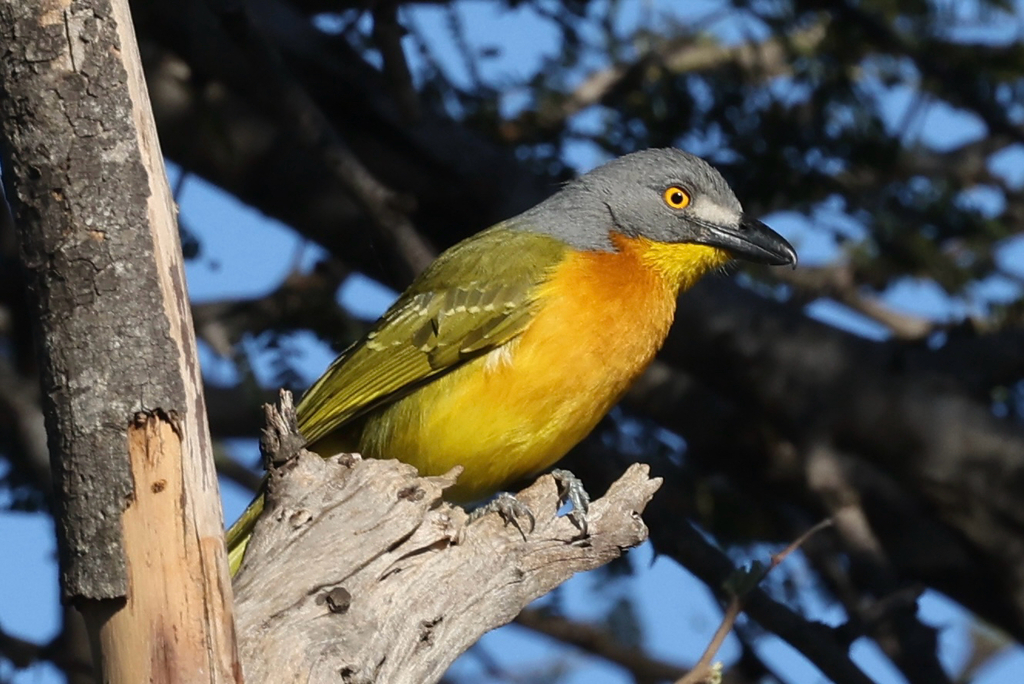
The grey-headed bushshrike, colloquially known as the ghostbird, is a distinctive passerine measuring 22.6 to 25.2 cm from bill to tail. Its most striking features are a formidable black bill and rich yellow iris, creating a memorable facial expression. The sexes are alike in plumage. Immatures are generally paler, while juveniles display pale yellow chest plumage with brown barring or mottling over the crown, distinguished further by brown eyes and brownish horn bills. Six or seven subspecies are recognized across its range, with plumage variations including chestnut on the breast and flanks in some populations and lemon yellow throat plumage in others.
The grey-headed bushshrike can be confused with the smaller orange-breasted bushshrike, which has more gracile features and occurs in sympatry across much of the range. However, the grey-headed's larger size and heavier bill should distinguish it from this and other related bushshrike species.
Range & Habitat
This species is widespread throughout sub-Saharan Africa, though relatively absent in Central Africa and the interior of southern Africa. It is the most widespread species of its genus. The grey-headed bushshrike occurs sparsely across a range of wooded habitats, typically preferring denser vegetation within dry or moist savannah. In Zimbabwe, it shows a close association with miombo woodland, while occurring more sparsely in semi-arid savannah. It is also found in riparian vegetation, tall Acacia, lowland evergreen thicket and forest, and riparian ground-water forest.
The species is found from sea level to 1,500 metres, reaching 1,600 metres in Zimbabwe and locally up to 3,000 metres in tropical areas. It avoids areas with annual rainfall below 500 mm and is absent from Kalahari woodlands. In the Okavango Delta, it is largely replaced by the orange-breasted bushshrike, though the two species occur in sympatry in many areas. Monogamous pairs are sedentary but undertake limited post-breeding movements, occupying woodland with sufficient cover.
Behaviour & Diet
The grey-headed bushshrike is best known for the male's uncanny, mechanical-sounding series of hooting notes, particularly during the pre-breeding period. These prolonged sessions of measured, mournful notes may continue for an hour or more and are delivered from a high perch, sometimes preceded by cluck or tic sounds. Calling ceases once the female begins incubating, when the male provides her with food items. Various softer sounds, abrupt clicks, ticks and clinks, along with harsh alarm notes and duetting calls, can also be heard.
Their diet consists mostly of insects, but they are also skilled predators of mice, which they swallow whole, as well as small birds, snakes, lizards and chameleons. Grey-headed bushshrikes breed in spring and summer, with pairs building well-hidden nests in 10 days, placed in the mid to upper tree stratum within thicker foliage, tangles or mistletoes. Females incubate clutches of 2 to 4 cream-coloured, elongate eggs for 17 days, with chicks fledging in three weeks.
Best Time & Places to See It
The grey-headed bushshrike is most vocal and therefore most readily detected during the pre-breeding season in spring and summer, when males deliver their mournful, hooting calls repeatedly from high perches. In Zimbabwe, miombo woodland habitats offer good opportunities for encountering this species. The bird occurs sparsely in suitable habitats across sub-Saharan Africa, with densities in subtropical regions of approximately one pair per 200 hectares. Although it can be easily overlooked in wooded areas, its frequent and distinctive call notes make it reliably detectable when present.
Gardens with adequate woody vegetation and native trees provide accessible viewing opportunities, where the bird is more commonly encountered than in plantations of alien species. The species shows a preference for areas with sufficient cover and moisture, so riparian zones and denser savannah woodlands are particularly productive habitats.
Photography Tips
The grey-headed bushshrike's habit of calling from high perches during the pre-breeding season provides the best photographic opportunities. Position yourself early in the morning or during peak calling periods in spring and summer, when males are most vocal and visible. The bird's distinctive black bill and bright yellow iris are key features to capture, showcasing its formidable appearance and characteristic expression.
Since this species prefers denser vegetation and the mid to upper stratum of trees, patience and careful scanning of suitable woodland habitats are essential. The bird's preference for calling from exposed perches means that during vocal periods, a photographer can often predict its position. Overcast conditions may help reduce harsh shadows on the facial markings that make this species so visually distinctive.
Serengeti National Park
Tanzania
+558 birds+57 mammals
Across Tanzania's northern plateau, where volcanic soils meet acacia woodland and open grassland, unfolds one of Earth's most dynamic ecosystems. The Serengeti National Park sprawls across…
VIEW NATIONAL PARKArusha National Park
Tanzania
+555 birds+16 mammals
Where the slopes of Mount Mawenzi rise above the Arusha region, a compact yet ecologically rich national park unfolds across montane forest, moorland, and alpine zones.…
VIEW NATIONAL PARKMapungubwe National Park
Musina Local Municipality, South Africa
+358 birds+29 mammals
Where the Limpopo River cuts through sandstone ridges at the convergence of South Africa, Botswana, and Zimbabwe, Mapungubwe National Park preserves a landscape of profound ecological…
VIEW NATIONAL PARKBwindi Impenetrable National Park
Kanyashogi, Uganda
+603 birds+26 mammals
Steep ridges cloaked in montane forest rise from Uganda's southwestern borderlands, where the landscape grows so dense and tangled that early explorers named it impenetrable. At…
VIEW NATIONAL PARKKidepo Valley National Park
Uganda
+478 birds+24 mammals
Where the Narus and Kidepo rivers carve through northeastern Uganda's semi-arid lowlands, a landscape of sparse acacia woodland, grassland, and riverine thickets creates one of East…
VIEW NATIONAL PARKMurchison Falls National Park
Uganda
+608 birds+33 mammals
Where the Victoria Nile compresses through a narrow gorge and explodes across a 45-meter precipice, the landscape speaks in thunder. Murchison Falls National Park sprawls across…
VIEW NATIONAL PARKTsavo East National Park
Athi ward, Kenya
+468 birds+50 mammals
Across the semi-arid lowlands of southeastern Kenya, where acacia woodland fragments into scrubland and the landscape rolls toward the Indian Ocean horizon, lies one of Africa's…
VIEW NATIONAL PARKTsavo West National Park
Mwatate, Kenya
+513 birds+49 mammals
Where volcanic ridges and weathered lava flows meet the semi-arid lowlands of south-central Kenya, Tsavo West National Park unfolds across a landscape sculpted by fire and…
VIEW NATIONAL PARKAmboseli National Park
Etonet/Lenkism ward, Kenya
+501 birds+43 mammals
Where the Amboseli basin opens toward the Tanzanian frontier, a shallow alkaline lake mirrors vast skies across one of East Africa's most iconic savanna landscapes. The…
VIEW NATIONAL PARKMount-Kenya National Park
Abothuguchi west ward, Kenya
+334 birds+11 mammals
Where the slopes of Kenya's second-highest mountain rise steeply from the Meru County foothills, a landscape of profound ecological richness unfolds across Mount Kenya National Park.…
VIEW NATIONAL PARKTarangire National Park
Tanzania
+527 birds+50 mammals
Acacia woodland and grassland sweep across the Manyara Region where the Tarangire River carves through low hills and volcanic soils, creating one of East Africa's most…
VIEW NATIONAL PARKNgorongoro Conservation Area
Tanzania
+626 birds+55 mammals
Volcanic calderas and open grassland dominate this high plateau in northern Tanzania, where the landscape rises above 2,000 metres and ancient geological forces have shaped both…
VIEW WILDLIFE MANAGEMENT AREAQueen Elizabeth National Park
Uganda
+672 birds+30 mammals
Across the southwestern escarpment of Uganda, where the Western Rift Valley descends through ancient volcanic terrain, Queen Elizabeth National Park sprawls across more than 8,300 square…
VIEW NATIONAL PARKPilanesberg National Park
Moses Kotane Local Municipality, South Africa
+364 birds+49 mammals
Granite peaks and volcanic ridges rise unexpectedly from the savanna floor across this 734-square-kilometre expanse in the North West province, creating a landscape of profound ecological…
VIEW NATIONAL PARKKruger National Park
Ba-Phalaborwa Local Municipality, South Africa
+540 birds+91 mammals
Across the low-lying savanna of northeastern South Africa unfolds one of Africa's largest and most ecologically intact protected areas, where acacia woodlands merge into mopane scrub…
VIEW NATIONAL PARKIthala Game Reserve
uPhongolo Local Municipality, South Africa
+328 birds+26 mammals
Rolling thornbush savanna and acacia woodland dominate the landscape of this 494-square-kilometre national park in KwaZulu-Natal's uPhongolo Local Municipality, where granite outcrops punctuate grassland plateaus and…
VIEW NATIONAL PARKMarakele National Park
Modimolle Local Municipality, South Africa
+341 birds+36 mammals
Granite ridges and sprawling grasslands dominate this 1,176-square-kilometre reserve in Limpopo's heartland, where bushveld transitions between rocky outcrops and open savanna. The park's rugged topography creates…
VIEW NATIONAL PARKZiwa Rhino and Wildlife Ranch
Nakasongola, Uganda
+359 birds+11 mammals
Where papyrus wetlands merge into sprawling savanna, Uganda's central landscape opens into one of East Africa's most vital rhino recovery zones. Ziwa Rhino and Wildlife Ranch…
VIEW WILDLIFE SANCTUARYNkasa Rupara National Park
Namibia
+283 birds+17 mammals
Where the Zambezi's floodplains spill across the border between Namibia and Botswana, Nkasa Rupara National Park unfolds across 518 square kilometers of wetland and woodland mosaic.…
VIEW NATIONAL PARKBwabwata National Park
Namibia
+377 birds+35 mammals
Where the Kavango River winds through northeastern Namibia, vast floodplains and dense riparian woodland create one of southern Africa's most ecologically dynamic protected landscapes. Spanning 14,249…
VIEW NATIONAL PARKAbijata-Shalla Lakes National Park
Ethiopia
+438 birds+7 mammals
Two crater lakes of contrasting chemistry define this remote corner of Ethiopia's Rift Valley, where soda lakes and freshwater basins create a mosaic of distinct aquatic…
VIEW NATIONAL PARKBale Mountains National Park
Ethiopia
+397 birds+20 mammals
Where the Ethiopian highlands rise above 4,000 metres, the Bale Mountains create a landscape of stunning ecological extremes—from afroalpine grasslands swept by wind and mist to…
VIEW NATIONAL PARKNech Sar National Park
Arba Minch, Ethiopia
+191 birds+10 mammals
Where the East African Rift Valley plateaus drop dramatically toward the shore of Lake Abaya, a mosaic of habitats unfolds across sun-scorched savanna and acacia woodland.…
VIEW NATIONAL PARKYabelo Wildlife Sanctuary
Bedewera, Ethiopia
+359 birds+5 mammals
Where acacia woodlands meet volcanic plateaus in southern Ethiopia, a landscape of austere beauty unfolds across nearly 2,500 square kilometers. Yabelo Wildlife Sanctuary sprawls across semi-arid…
VIEW WILDLIFE SANCTUARYNairobi National Park
Nairobi, Kenya
+515 birds+35 mammals
Just minutes from Kenya's capital, where the Nairobi River winds through acacia woodland and open grassland, lies one of Africa's most paradoxical wildlife sanctuaries. The park's…
VIEW NATIONAL PARKLake Nakuru National Park
Nakuru West, Kenya
+494 birds+32 mammals
Alkaline waters ringed by acacia woodland and grassland create one of East Africa's most distinctive wetland ecosystems, where the interplay of geology and climate sustains a…
VIEW NATIONAL PARKMeru National Park
Igembe Central, Kenya
+408 birds+38 mammals
Granite outcrops and acacia woodland rise across the northern reaches of Meru, where semi-arid savanna transitions into drier scrubland under the fierce equatorial sun. The park's…
VIEW NATIONAL PARKHell’s Gate National Park
Olkaria ward, Kenya
+388 birds+18 mammals
Volcanic scarps and geothermal vents dominate the floor of Hell's Gate, where the East African Rift has carved a dramatic gorge through crystalline rock formations. The…
VIEW NATIONAL PARKSaiwa Swamp National Park
Sinyerere ward, Kenya
+255 birds+4 mammals
Where papyrus and sedge marshes stretch across a highland plateau in western Kenya, Saiwa Swamp National Park shelters one of East Africa's most productive freshwater wetland…
VIEW NATIONAL PARKChyulu Hills National Park
Kibwezi East, Kenya
+232 birds+30 mammals
Volcanic cones rise abruptly from the Kenyan savanna floor, their flanks clothed in dense acacia woodland and grassland that transforms the Chyulu Hills into an ecological…
VIEW NATIONAL PARKArabuko Sokoke Forest Reserve
Kilifi, Kenya
+383 birds+29 mammals
Coastal forest rises from the Indian Ocean plains of Kilifi County, where sandy soils and seasonal rainfall have sculpted a woodland ecosystem unlike anywhere else on…
VIEW NATURE RESERVEWatamu Marine National Park
Dabaso ward, Kenya
+328 birds+12 mammals
Where mangrove channels meet coral gardens and sandy shallows blend into the warm waters of the Indian Ocean, Watamu Marine National Park unfolds across the Kilifi…
VIEW NATIONAL PARKNo community photos yet. Log in to add the first one.
No community observations of this species yet.