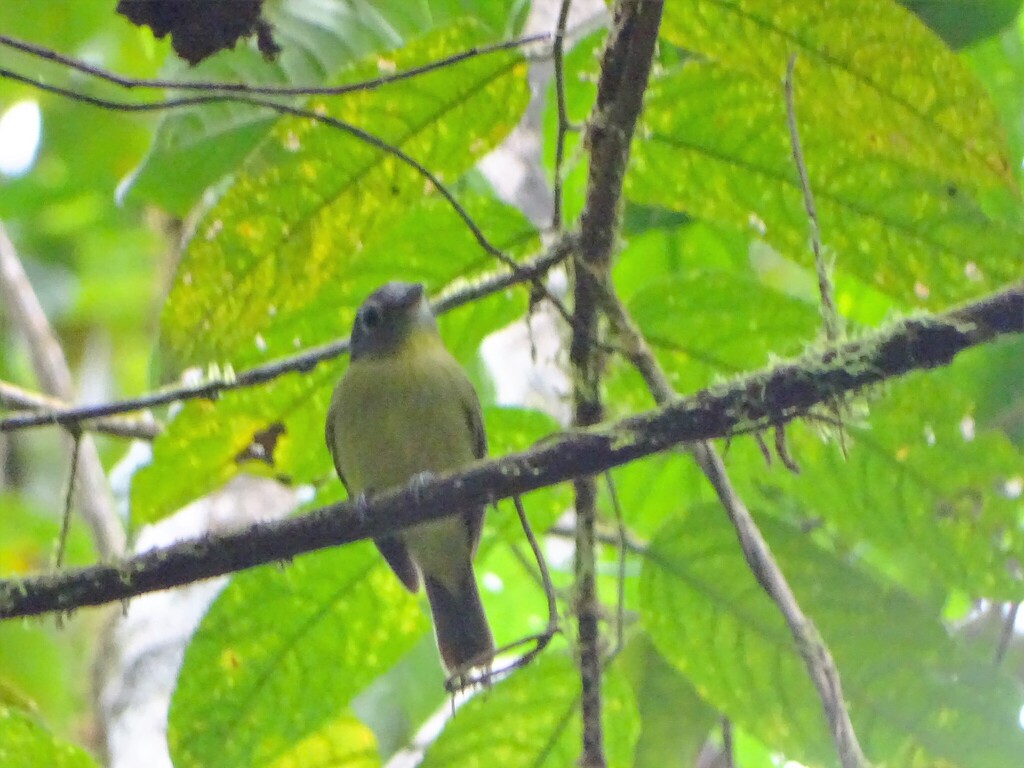
Grey-headed Piprites
Photo © Alfonso Auerbach
Photo © Alfonso Auerbach — CC0 1.0 — Source: iNaturalist #337702856The grey-headed piprites (Piprites griseiceps) is a species of bird in subfamily Pipritinae of family Tyrannidae, the tyrant flycatchers. It is found in Costa Rica, Guatemala, Honduras, Nicaragua, and Panama. Prior to genetic studies in 2009, it was placed in the family Pipritinae with the manakins. == Taxonomy and systematics == The grey-headed piprites is monotypic. It shares genus Piprites with the wing-barred piprites (P. chloris) and the black-capped piprites (P. pileata). The grey-headed and wing-barred piprites form a superspecies. Genetically, it is particularly close to the wing-barred piprites. == Description == The grey-headed piprites is 12 to 13 cm (4.7 to 5.1 in) long and weighs about 16 g (0.56 oz). It is considered as having an especially long tail among similar species. The sexes have the same plumage. Adults have a slate-gray head with a bold white eyering. Their upperparts, wings, and tail are olive-green with yellow-green edges on their flight feathers. Their underparts are yellowish olive that is lightest on their throat and belly. They have a dark iris, a blackish maxilla, a paler mandible, and gray legs and feet. == Distribution and habitat == The grey-headed piprites is found on the Caribbean slope of Central America…
Braulio Carrillo National Park
Las Horquetas, Costa Rica
+547 birds+18 mammals
Where the Caribbean slope descends from the central volcanic cordillera toward the humid lowlands of Heredia, Braulio Carrillo National Park preserves one of Costa Rica's most…
VIEW NATIONAL PARKBarra del Colorado National Wildlife Refuge
Tortuguero, Costa Rica
+462 birds+36 mammals
Where the Caribbean's restless waters meet the Limón Province coastline, Barra del Colorado National Wildlife Sanctuary unfolds across a landscape of extraordinary ecological complexity. This equatorial…
VIEW WILDLIFE SANCTUARYNo community photos yet. Log in to add the first one.
No community observations of this species yet.