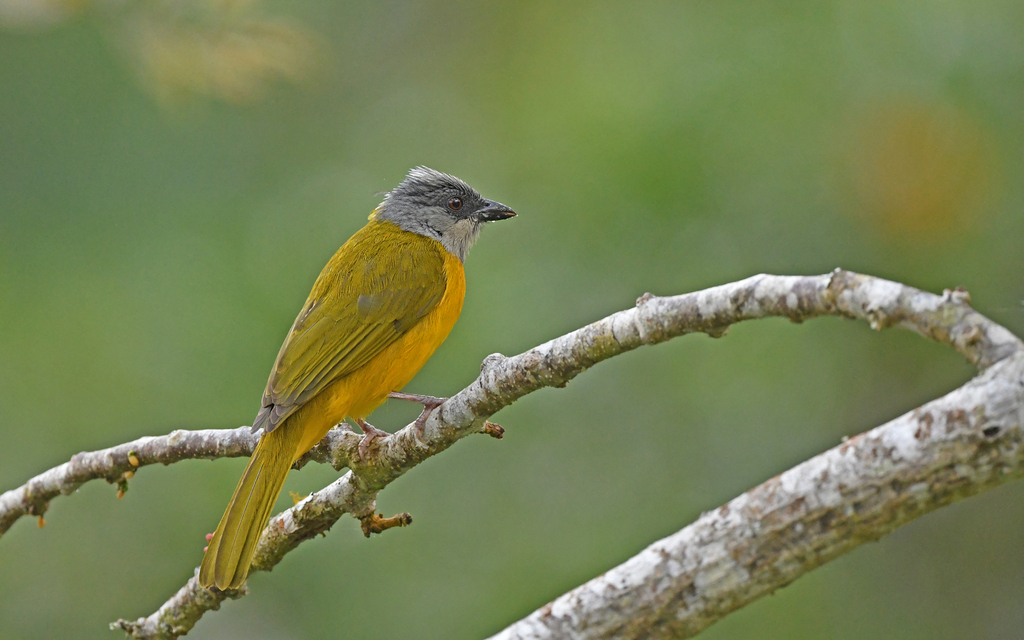
Grey-headed Tanager
Photo © Christoph Moning
Photo © Christoph Moning — CC BY 4.0 — Source: iNaturalist photo #291959000Identification
The Grey-headed Tanager is a small songbird, measuring 16–17 cm in length and weighing 22.5–35.0 g. Its most distinctive feature is the grey head crowned with a crest of grey-tipped white feathers, which is typically raised only when the bird is agitated. The species exhibits bright reddish-brown eyes and pale brown legs across all individuals. Males and females are identical in plumage.
Plumage varies subtly among the seven subspecies, but the nominate race E. p. penicillata—the most widespread—displays olive-yellow upperparts, yellowish-olive wings and pale brown tail, a white throat, and bright yellow underparts. The bird has a distinctive conical bill with a large rounded notch on the upper mandible. Other subspecies show variations including deeper orange-yellow or greenish-olive tones, longer or shorter crests, and different throat colorations, though field identification often requires knowledge of the subspecies' range.
Range & Habitat
The Grey-headed Tanager occupies a vast range across tropical lowland regions from southern Mexico through Central America and into South America, found in Mexico, every Central American country except El Salvador, and every mainland South American country except Argentina, Chile, French Guiana, and Uruguay. Seven subspecies are recognized, each with distinct geographic distributions spanning both Pacific and Caribbean slopes.
This species inhabits tropical lowland evergreen forest, gallery forest, river-edge forest, and secondary forest. In the Amazon Basin it favours várzea forest and woodland near water sources. Across Central America it occupies rainforest, mature secondary forest, and semi-deciduous forest. Elevation preferences vary by region: mostly below 600 m throughout its range, though it reaches up to 1,250 m in Mexico and Central America, 1,800 m in Colombia, and 1,200 m in Venezuela.
Behaviour & Diet
The Grey-headed Tanager is a year-round resident throughout its range, never undertaking long-distance migrations. It is primarily insectivorous, feeding on a wide variety of insects while incorporating small amounts of fruits and seeds. The species employs at least two distinct foraging strategies, including following army ant swarms to capture displaced prey—a behaviour common among tanagers in tropical forests.
Though details of its complete behavioural repertoire remain to be fully documented, the species' presence in mixed-species feeding flocks and its dependence on forest structure suggest it is an active and social forager within its preferred lowland forest habitats.
Best Time & Places to See It
As a year-round resident, the Grey-headed Tanager can be encountered throughout the year within its range. The species is most readily found in humid lowland forest regions, particularly near river systems and in areas of mature secondary growth where insect prey is abundant. In Central America, protected rainforest reserves and national parks offer the most reliable opportunities for observation.
Birders and naturalists should focus searches in primary and mature secondary forest habitats below 600 m elevation, particularly in areas with gallery forest or forest edges bordering rivers and streams. Early morning hours typically provide the best viewing conditions, when the bird is most active in foraging.
Photography Tips
The Grey-headed Tanager's small size and preference for the canopy and mid-storey of forest vegetation present challenges for photographers. Use a telephoto lens of at least 400–600 mm to capture detail from distance. The bird's bright yellow underparts and contrasting grey head provide excellent subject contrast, but the dappled light of forest interiors requires fast film speeds or high ISO settings to maintain adequate shutter speeds.
The distinctive raised crest appears only during moments of agitation, so patience is essential for capturing this signature feature. Position yourself near fruiting trees or known army ant swarms where the species concentrates its feeding activity. Early morning light filtering through the canopy offers the most flattering illumination for the bird's yellow and olive tones. The bright reddish-brown iris is a striking detail worth capturing in close-ups.
Amacayacu National Park
Anavilhanas National Park
Baru Volcano National Park
Brasília National Park
Caño Negro National Wildlife Refuge
Carara National Park
Chagres National Park
Chapada dos Guimarães National Park
Chapada dos Veadeiros National Park
Nothing matches these filters.
No community photos yet. Log in to add the first one.
No community observations of this species yet.