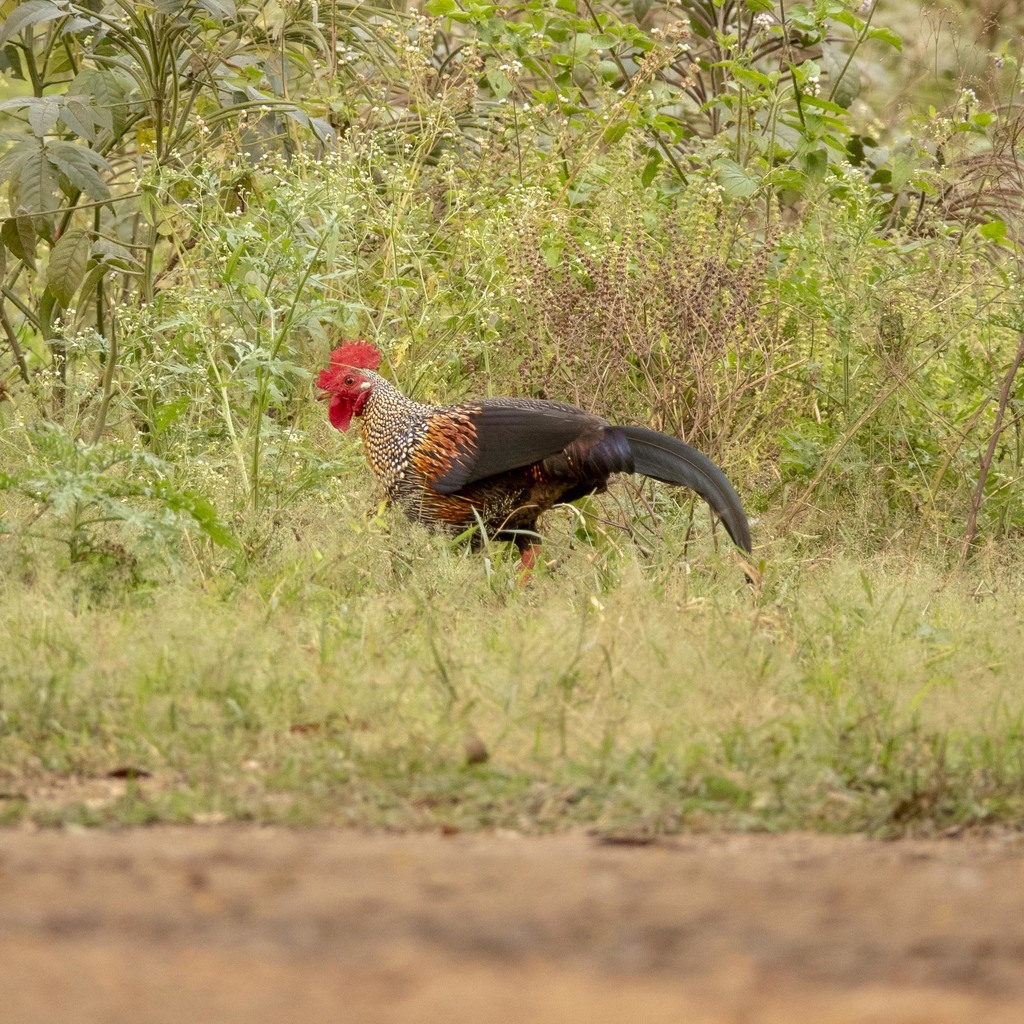
Grey Junglefowl
Photo © Paulmathi Vinod
Photo © Paulmathi Vinod — CC BY 4.0 — Source: iNaturalist #110650678Identification
The grey junglefowl is a striking gamebird and one of the wild ancestors of the domestic chicken. Males are substantially more colourful than females, displaying a black cape with ochre spots overlaid on fine grey patterning across the body. A distinctive feature of males is their elongated, dark neck feathers that terminate in small, hard yellowish plates—these feathers are prized for making high-grade artificial fishing flies. Males also sport red wattles and combs, though less prominently developed than in the closely related red junglefowl, along with red legs equipped with spurs. During summer, males undergo an eclipse moult, shedding their colourful neck feathers during or after the breeding season. Females are considerably duller, with black and white streaking on the underparts and yellow legs that typically lack spurs. The central tail feathers in both sexes are notably long and sickle-shaped.
Range & Habitat
Endemic to India, the grey junglefowl is found primarily in peninsular India, with populations extending toward the northern boundary through Gujarat, Madhya Pradesh, and southern Rajasthan. The species inhabits thickets, forest floors, and open scrub, with largely non-overlapping ranges compared to the red junglefowl, which favours the Himalayan foothills. A zone of overlap occurs in the Aravalli range. A disputed subspecies, wangyeli, has been named from the Mount Abu region of Rajasthan, where birds reportedly produce different calls and display notably paler plumage than their southern counterparts.
Behaviour & Diet
The grey junglefowl is vocal and conspicuous, especially during dawn and dusk, when males produce loud and distinctive calls described as "Ku-kayak-kyuk-kyuk." Unlike the red junglefowl, males do not flap their wings before calling. Breeding occurs from February to May, with females laying 4 to 7 pale creamy eggs in a simple scrape; eggs hatch in approximately 21 days. Although primarily terrestrial foragers, these birds readily fly into trees to roost or escape predators. They forage in small groups of mixed or single-sex composition, feeding on grains (including bamboo seeds), berries, insects, and termites. The species is hunted for its meat and for the long neck hackle feathers valued in fly-tying.
Best Time & Places to See It
The breeding season from February to May offers excellent opportunities to encounter grey junglefowl, when males are most vocal during early mornings and dusk. Peninsular India remains the most reliable region, particularly in suitable habitats of thickets, forest floors, and open scrub. The Aravalli range and surrounding areas of Rajasthan, Gujarat, and Madhya Pradesh provide viable locations, though the species may be encountered across its broader Indian range wherever appropriate habitat persists.
Photography Tips
Early morning and dusk visits will maximize your chances of observing and photographing vocal males. The distinctive plumage of males—particularly the patterned grey body and the striking black cape with ochre spots—photograph well in soft, directional light. Since birds forage in small groups on the ground but readily flee to trees, positioning yourself quietly near suitable habitat with good sightlines offers the best opportunity to capture both ground behaviour and flight shots. The long, sickle-shaped tail feathers and the peculiar yellowish plates on the neck feathers are distinctive details worth capturing at closer range.
Eravikulam National Park
Devikulam, India
+192 birds+7 mammals
High in the Western Ghats of Kerala, where monsoon mists cling to slopes that rise above 2,000 metres, Eravikulam National Park preserves one of South India's…
VIEW NATIONAL PARKTadoba National Park
Palasgaon Singru, India
+270 birds+20 mammals
Where sal forests meet open grasslands and rocky outcrops rise from red laterite soil, central India's landscape unfolds in raw, untamed beauty. Ancient teak woodlands and…
VIEW NATIONAL PARKPeriyar National Park
Mlappara, India
+232 birds+4 mammals
Dawn breaks over mist-shrouded ridges where the Western Ghats tumble toward Kerala's spice-scented lowlands. Here, ancient tropical forests envelope a glittering artificial lake, creating a mosaic…
VIEW NATIONAL PARKPampadum Shola National Park
Vattavada, India
+258 birds+14 mammals
Where misty shola forests cling to the high plateaus of the Nilgiri Mountains, ancient evergreen remnants create a world apart. This 2,316-hectare reserve protects one of…
VIEW NATIONAL PARKBandipur National Park
Hirehalli, India
+302 birds+19 mammals
Where the Western Ghats descend into the Deccan plateau, ancient deciduous forests blanket a landscape carved by the Nugu River. Bandipur unfolds across 880 square kilometres…
VIEW NATIONAL PARKNagarahole Tiger Reserve
Nalkeri Forest, India
+323 birds+23 mammals
Where granite escarpments rise above dense deciduous forests and the Kabini River carves through pristine wilderness, one of India's most biodiverse landscapes unfolds across the Western…
VIEW NATIONAL PARKNo community photos yet. Log in to add the first one.
No community observations of this species yet.