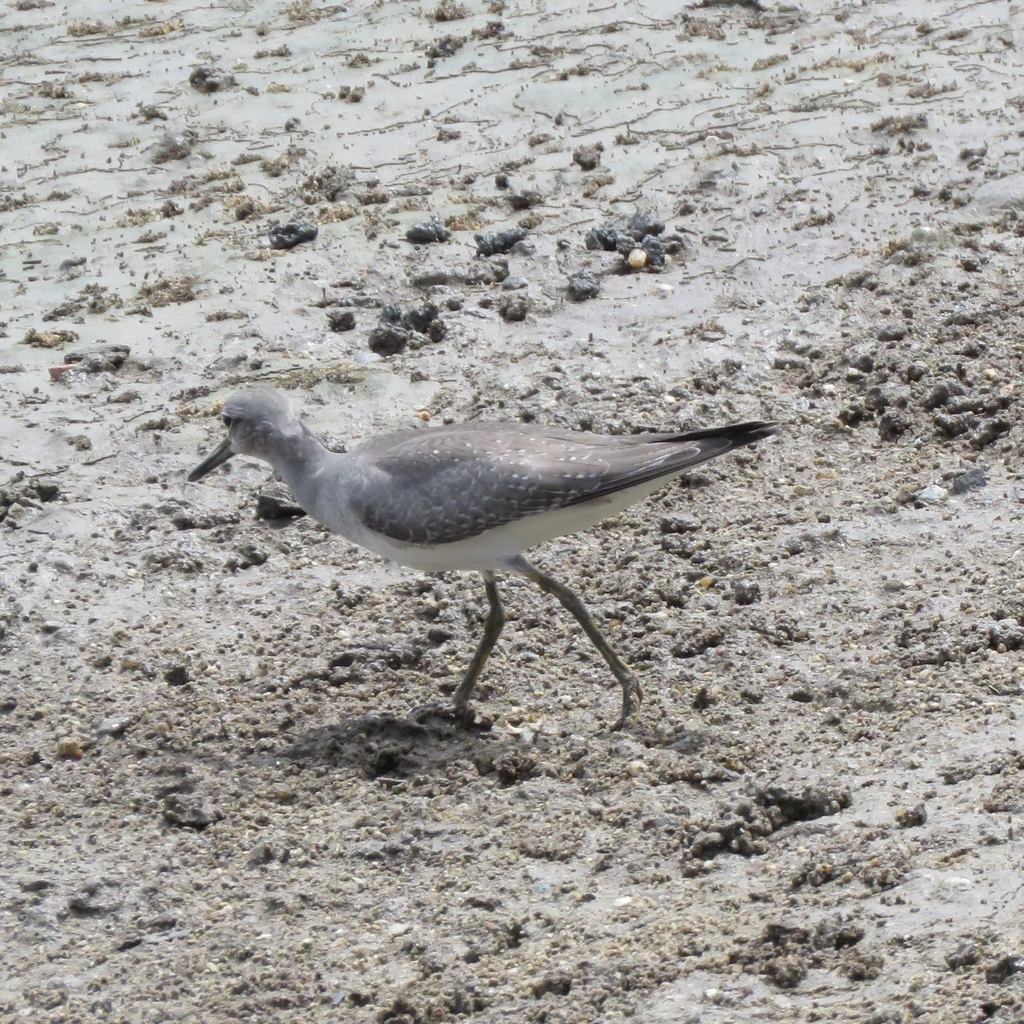
Grey-tailed Tattler
Photo © Pirataber
Photo © Pirataber — CC BY 4.0 — Source: iNaturalist #253900498Identification
The grey-tailed tattler is a small shorebird closely related to North America's wandering tattler, and the two are notoriously difficult to distinguish. Both species are unique among Tringa sandpipers for their unpatterned, greyish wings and back. In breeding plumage, they display a distinctive scaly breast pattern extending onto the belly, paired with a rather prominent supercilium. The grey-tailed tattler resembles a common redshank in overall shape and size, with grey upper parts, underwings, face and neck contrasting against a white belly. Look for short yellowish legs and a bill with a pale base darkening to a dark tip, along with a weak supercilium. The most reliable field distinction from the wandering tattler is vocal: the grey-tailed tattler utters a disyllabic whistle, whereas its American cousin produces a rippling trill. Other subtle differences include details of the nasal groove length and scaling patterns on the tarsus.
Range & Habitat
This tattler breeds in stony riverbeds across northeast Siberia. After the breeding season, it undertakes a dramatic migration to winter grounds spanning from southeast Asia to Australia, making it one of the most impressive long-distance migrants among small shorebirds. During winter, the species favours muddy and sandy coasts. It is a very rare vagrant to western North America and western Europe, making sightings in these regions particularly noteworthy for birders. In Australia, grey-tailed tattlers are listed as critically endangered on the state level in Victoria, though they retain a stable conservation status nationally.
Behaviour & Diet
Grey-tailed tattlers are strongly migratory birds that breed on the ground in their Siberian range, though they will readily perch in trees and sometimes appropriate old nests built by other species. These are not particularly gregarious birds and are seldom encountered in large flocks except at communal roosts. They forage on the ground or in shallow water, hunting by sight and picking up prey items methodically. Their diet consists of insects, crustaceans, and other invertebrates gleaned from coastal substrates and shallow water margins.
Best Time & Places to See It
Grey-tailed tattlers are most reliably encountered during their winter months on coastal mudflats and sandy shores throughout southeast Asia and Australia. These regions offer the best opportunities for observation, particularly on sheltered coasts with suitable foraging habitat. Winter is the prime season for encountering this species outside its Siberian breeding grounds. The species' preference for solitary or small-group foraging, rather than large flocks, means patient observation of suitable habitat is often necessary for successful sightings.
Photography Tips
Photograph grey-tailed tattlers in good light to capture the subtle grey tones of their plumage and the delicate supercilium that aids identification. The pale base of the bill and yellowish legs provide useful diagnostic features to include in your frame. If possible, obtain recordings of the disyllabic whistle call to document vocalizations alongside visual records. Coastal locations at low tide, when mudflats are exposed and birds are actively foraging, offer the best opportunities for close approach and sharp imagery. Patient observation from a distance, using a blind or remaining motionless, will yield better results than active pursuit of these wary birds.
Aketajawe Lolobata National Park
Alaska Maritime National Wildlife Refuge
Baikal National Park
Bako National Park
Ben Boyd National Park
Bribie Island National Park
Cape Range National Park
Coorong National Park
Daintree National Park
Nothing matches these filters.
No community photos yet. Log in to add the first one.
No community observations of this species yet.