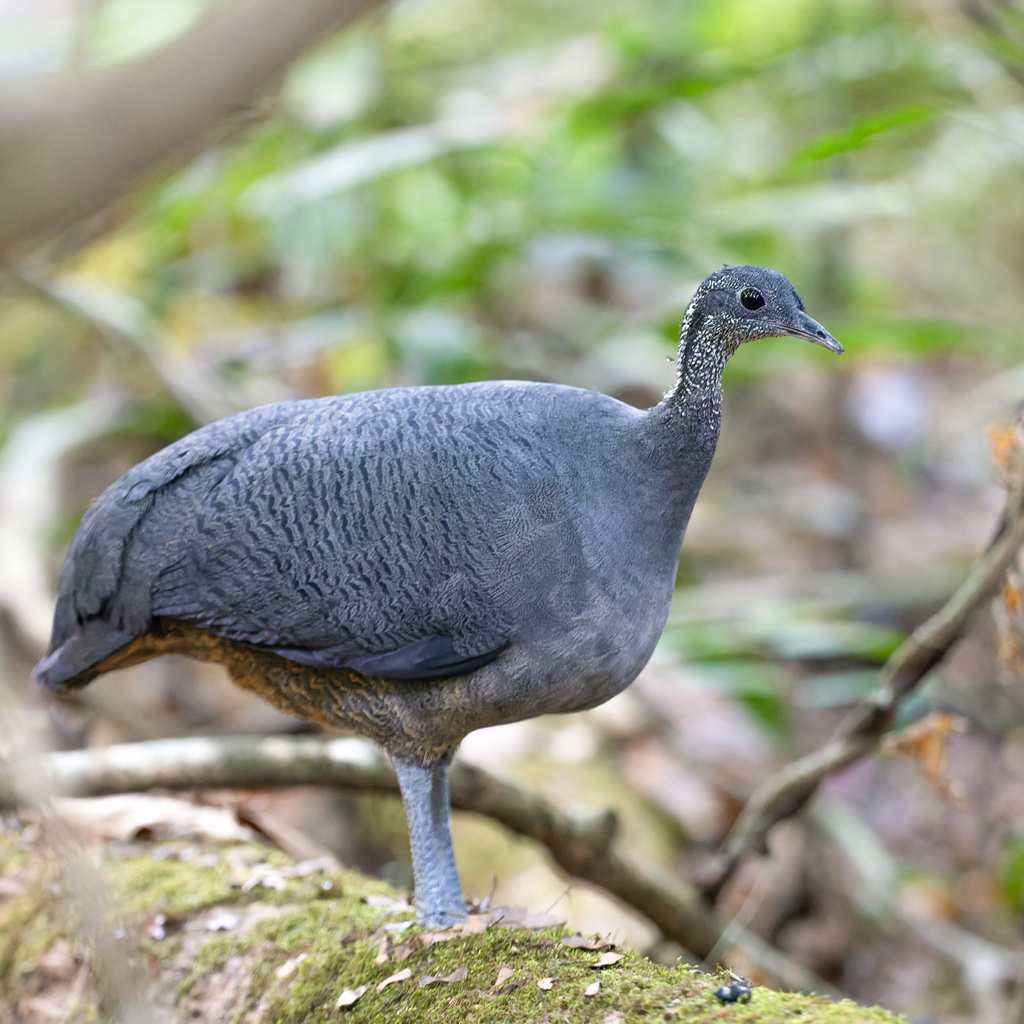
Grey Tinamou
Photo © Paulo Mascaretti
Photo © Paulo Mascaretti — CC0 1.0 — Source: iNaturalist #133773793Identification
The grey tinamou is believed to be the largest species among the tinamous, measuring 41.5 to 49 cm in total length, and possibly up to 53 cm. Males typically weigh between 1,325 and 1,863 grams, while females range from 1,430 to 2,080 grams, occasionally reaching as much as 2,300 grams. True to its name, the bird is predominantly grey in coloration, with the back and head distinctly barred blackish. A cinnamon-coloured vent provides a warm contrast, while white spotting extends along the head and down the neck, creating a subtly striking appearance for those patient enough to observe this elusive species.
Range & Habitat
The grey tinamou inhabits western and northern Brazil, eastern Ecuador, eastern Peru, Colombia east of the Andes, northern Venezuela, northern Bolivia, and Guyana. The species occupies humid lowland forests across most of its range, though in the northern and far western portions it favours montane forests. Remarkably, this tinamou has demonstrated adaptability to forests that have been cleared by logging, showing an ability to persist in disturbed habitats where other species might struggle.
Four subspecies are recognised: T. t. larensis occurs in the montane forests of central Colombia and northwestern Venezuela; T. t. kleei ranges across south-central Colombia, eastern Ecuador, eastern Peru, eastern Bolivia, and western Brazil; T. t. septentrionalis inhabits northeastern Venezuela and possibly northwestern Guyana; and T. t. tao is found in north-central Brazil, far eastern Peru, and far northwestern Bolivia.
Behaviour & Diet
The grey tinamou is predominantly a ground feeder, consuming fruit and seeds gathered from the ground and low bushes. Like other tinamous, breeding males take sole responsibility for incubating the eggs, which are laid in a nest situated in heavy brush on the ground. After the chicks hatch, the male continues to raise them for a short period until they become independent. Despite being relatively common within its range, the species remains shy and is infrequently seen; however, its distinctive song is commonly heard throughout its forest habitat, often betraying its presence to attentive listeners.
Best Time & Places to See It
To encounter this species, visit the humid lowland and montane forests of western Amazonia. Early morning hours offer the best chance of hearing the bird's characteristic song, which may lead to a sighting. The grey tinamou's range spans vast forest regions from northern South America through the Amazon Basin, making it potentially available to travellers visiting protected areas and forest lodges throughout Colombia, Venezuela, Ecuador, Peru, Bolivia, Brazil, and Guyana. Patience and early rising are essential, as the bird's shy nature and preference for dense cover make visual encounters rare despite its vocal presence.
Photography Tips
Photographing the grey tinamou presents a significant challenge due to its shy demeanour and preference for heavy brush cover. Success depends on locating birds by their calls and approaching carefully and slowly to avoid disturbing them further into dense vegetation. Early morning light is ideal, and a telephoto lens will be essential for capturing distant subjects from a safe, non-intrusive distance. Exercise patience and respect for this vulnerable species—allow plenty of escape space and never pursue a bird into thick cover. The subtle barring on the back and head, along with white neck spotting, provides good photographic detail if a clear view can be obtained.
Podocarpus National Park
Zamora, Ecuador
+496 birds+6 mammals
Where the Andes descend toward the Amazon basin, Podocarpus National Park sprawls across nearly 2,800 square kilometres of the most biodiverse terrain in Ecuador's southern highlands.…
VIEW NATIONAL PARKNatural el Cocuy National Park
Güicán, Colombia
+313 birds+3 mammals
Where the Andes rise to their highest peaks in Colombia's eastern cordillera, El Cocuy National Park sprawls across more than 6,600 square kilometers of some of…
VIEW NATIONAL PARKEl Tamá National Park
Toledo, Colombia
+435 birds
Where the Andes descend toward the Caribbean coastal lowlands of northern Colombia, El Tamá National Park sprawls across nearly 3,800 square kilometres of montane forest, cloud…
VIEW NATIONAL PARKNatural Sierra de la Macarena National Park
Vista Hermosa, Colombia
+566 birds+15 mammals
Across nearly 20,000 square kilometres of Colombia's Meta Department, the terrain rises from lowland savanna into Andean foothills through a mosaic of gallery forests, palm-fringed wetlands,…
VIEW NATIONAL PARKChapada dos Guimarães National Park
Brazil
+450 birds+1 mammals
Where weathered sandstone plateaus rise above the cerrado grasslands of central Brazil, Chapada dos Guimarães National Park protects 624 square kilometres of ecological transition zone that…
VIEW NATIONAL PARKAmazônia National Park
Brazil
+439 birds+6 mammals
Where the Rio Amazonas and its tributaries weave through the heart of Pará state, a vast tapestry of rainforest stretches across 23,611 square kilometers of unbroken…
VIEW NATIONAL PARKMapinguari National Park
Brazil
+354 birds
Vast tracts of western Amazonian rainforest blanket the remote terrain of this 56,827 square kilometre national park in Amazonas state, where seasonal rivers wind through dense…
VIEW NATIONAL PARKPacaás Novos National Park
Brazil
+279 birds+1 mammals
Across the border between Rondônia and Amazonas, vast tracts of humid tropical forest rise and fall in gentle undulations, carved by clear-flowing rivers that feed into…
VIEW NATIONAL PARKCampos Amazónicos National Park
Amazonas, Brazil
+434 birds+7 mammals
Sprawling across the southwestern Amazon basin in Amazonas state, this 27,263-square-kilometre national park encompasses some of the region's most pristine lowland rainforest, where terra firme forest…
VIEW NATIONAL PARKYanachaga–chemillén National Park
Palcazu, Peru
+639 birds+6 mammals
Where the eastern slopes of Peru's central cordillera plunge into cloud forest, Yanachaga–Chemillén National Park protects nearly three thousand square kilometres of montane wilderness that few…
VIEW NATIONAL PARKManu National Park
Manu, Peru
+892 birds+26 mammals
Across the eastern slopes of the Peruvian Andes, tropical rainforest descends into the Amazon basin with a complexity that few terrestrial ecosystems match. Manu National Park…
VIEW NATIONAL PARKBahuaja Sonene National Park
San Pedro de Putina Punco, Peru
+602 birds+8 mammals
Where the Madre de Dios and Heath rivers converge in southeastern Peru rises one of South America's most biodiverse wilderness regions: a vast protected realm of…
VIEW NATIONAL PARKIchigkat Muja – Cordillera del Cóndor National Park
Río Santiago, Peru
+101 birds
Where the Andes descend into the western Amazon, the Río Santiago carves through a landscape of profound biological complexity. Ichigkat Muja – Cordillera del Cóndor National…
VIEW NATIONAL PARKTingo Maria National Park
Mariano Dámaso Beraún, Peru
+423 birds
Where the eastern slopes of the Peruvian Andes descend toward the Amazon basin, the landscape fractures into a maze of limestone ridges, humid gorges, and cloud-wrapped…
VIEW NATIONAL PARKNo community photos yet. Log in to add the first one.
No community observations of this species yet.