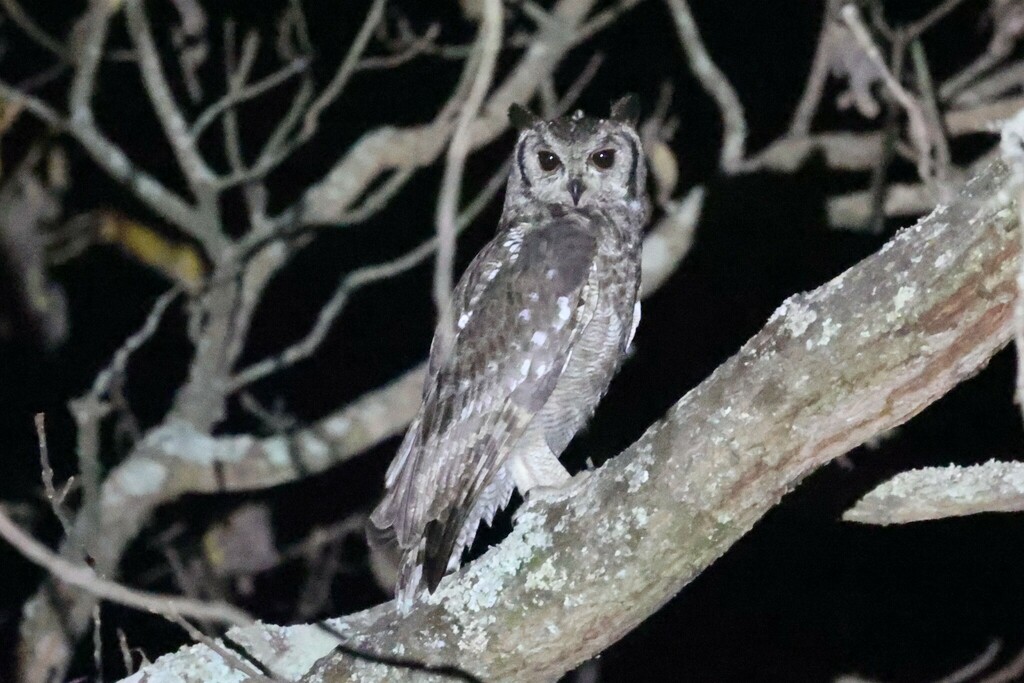
Greyish Eagle-Owl
Photo © Tommy Andriollo
Photo © Tommy Andriollo — CC BY 4.0 — Source: iNaturalist photo #257424957Identification
The greyish eagle-owl is a rather large owl, measuring about 43 cm (17 in) long and weighing approximately 500 g (18 oz). It shares the mottled plumage of its southern relative, the spotted eagle-owl, with dark brown, buff, and white upperparts combined with finely barred underparts that give the bird its characteristic greyish-brown appearance. However, several key features distinguish it: notably dark brown eyes (rather than yellow), a brownish facial disk with a heavy brown circle around each eye, and slightly shorter tarsi, though it is somewhat lighter overall than the spotted eagle-owl despite being roughly the same length.
Range & Habitat
This northern species is found across the northern part of sub-Saharan Africa, ranging from Mauritania and Liberia in the west eastward to Sudan and Somalia. The greyish eagle-owl shows remarkable habitat flexibility, inhabiting dry rocky deserts and open savannah throughout much of its range, while also utilizing lowland forests in Somalia. It roosts during daylight hours in well-hidden locations that vary widely: rocky natural sites such as cliff crevices and boulders, bushes and trees, and even man-made structures.
Behaviour & Diet
This nocturnal hunter employs a sit-and-wait hunting technique, typically hunting from a perch, though it is also capable of hawking insects and occasionally bats in flight. Its diet consists of larger insects and other large arthropods as well as vertebrate prey. Breeding biology is presumed similar to that of the spotted eagle-owl, with females laying 2 or 3 eggs either in a scrape on the ground, among rocks, or in sheltered cliff sites. Notably, the species will sometimes take advantage of old platform-like nests built by larger birds in trees.
Best Time & Places to See It
The greyish eagle-owl is a nocturnal species best located after dark. Within its range across West Africa, the Sahel region, and the Horn of Africa, suitable habitats include rocky desert regions and open savannah landscapes where rocky outcrops provide roosting sites. In Somalia, lowland forest areas also offer opportunities for encounter. Early evening hours when the owl becomes active, or listening for its distinctive call, offer the best chances for observation.
Photography Tips
Photographing this species requires patience and nocturnal capability. The heavy facial markings and dark eye rings are distinctive features worth capturing in detail. Use infrared or thermal equipment for night photography, or employ red-light headlamps to avoid disturbing the bird. Focus on the characteristic facial disk and eye coloration that differentiate it from the spotted eagle-owl. Roosting birds during daylight hours, when located in rocky outcrops or trees, may provide opportunities for daytime photography without disturbance.
Murchison Falls National Park
Queen Elizabeth National Park
Abijata-Shalla Lakes National Park
Awash National Park
Fathala Wildlife Reserve
Kiang West National Park
Kidepo Valley National Park
Meru National Park
Niokolo-Koba National Park
Nothing matches these filters.
No community photos yet. Log in to add the first one.
No community observations of this species yet.