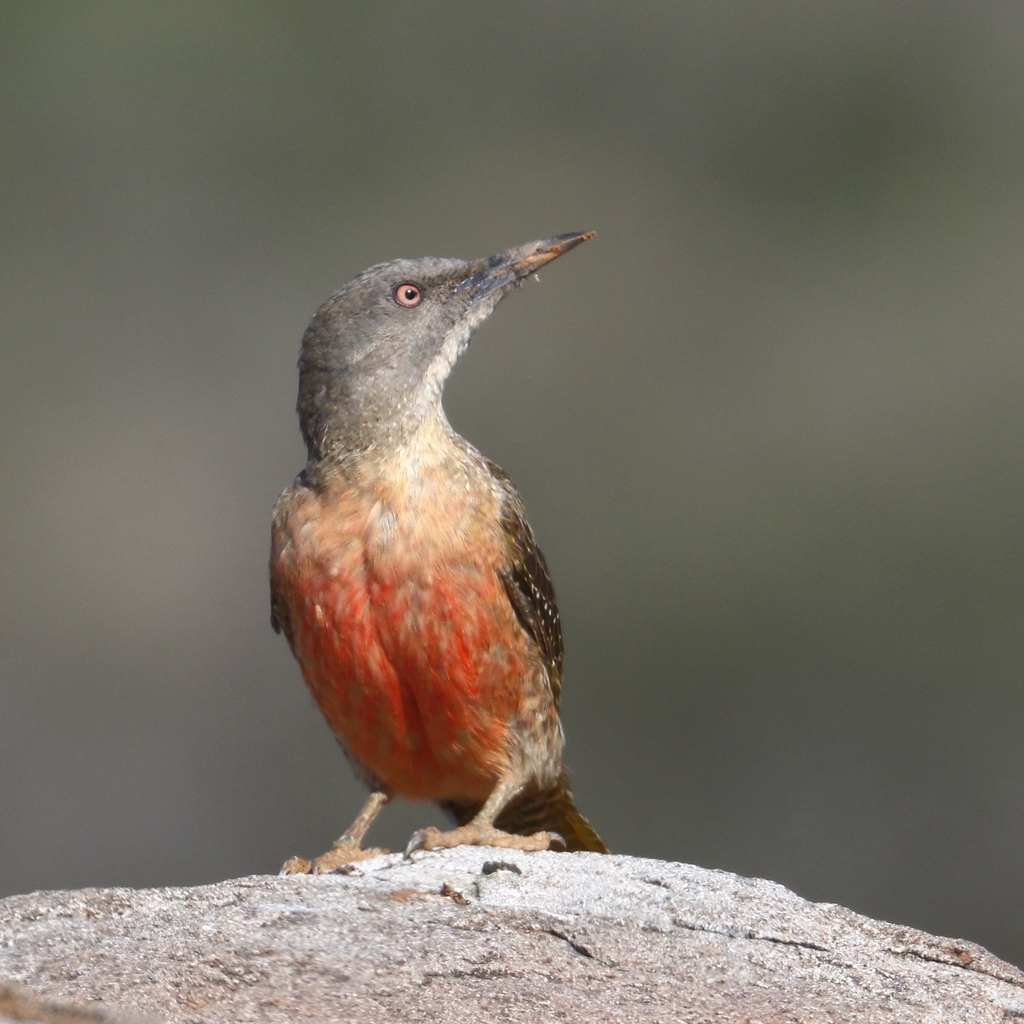
Ground Woodpecker
Photo © Alan Manson
Photo © Alan Manson — CC BY 4.0 — Source: iNaturalist #271076118The ground woodpecker (Geocolaptes olivaceus) is one of only three ground-dwelling woodpeckers in the world (the others are the Andean and campo flickers). It inhabits rather barren, steep, boulder-strewn slopes in relatively cool hilly and mountainous areas of South Africa, Lesotho and Eswatini and has yet to be recorded outside of Southern Africa. It is found in a broad swath running from southwest to northeast, from the Cape Peninsula and Namaqualand to Mpumalanga. It is closely related to the woodpeckers of the genus Campethera, some of which also employ terrestrial foraging strategies. == Taxonomy == The ground woodpecker was described in 1782 by the English ornithologist John Latham from a specimen collected from the Cape of Good Hope in South Africa. He used the English name "Crimson woodpecker" but did not introduce a Latin name. When the German naturalist Johann Friedrich Gmelin updated Carl Linnaeus's Systema Naturae for the 13th edition in 1788 he included a short description of the ground woodpecker, cited Latham's work and coined the binomial name Picus olivaceus. The ground woodpecker is now placed in the genus Geocolaptes that was introduced by the English naturalist William Swainson in 1832 to accommodate the ground woodpecker. The generic…
Garden Route National Park
George, South Africa
+353 birds+54 mammals
Sweeping across the Western Cape's coastal and mountainous terrain, this sprawling national park encompasses over five thousand square kilometers of extraordinarily diverse landscape—from coastal limestone cliffs…
VIEW NATIONAL PARKCederberg Wilderness Area
Cederberg Local Municipality, South Africa
+136 birds+12 mammals
Where ancient sandstone ridges rise dramatically from the semi-arid lowlands of Western Cape, the Cederberg Wilderness Area spreads across nearly 1,700 square kilometres of some of…
VIEW NATIONAL PARKKruger National Park
Ba-Phalaborwa Local Municipality, South Africa
+540 birds+91 mammals
Across the low-lying savanna of northeastern South Africa unfolds one of Africa's largest and most ecologically intact protected areas, where acacia woodlands merge into mopane scrub…
VIEW NATIONAL PARKSehlabathebe National Park
South Africa
+60 birds+1 mammals
Where the Drakensberg escarpment rises to meet the sky, Sehlabathebe National Park unfolds across a landscape of dramatic basalt cliffs, rolling alpine grassland, and crystal-clear mountain…
VIEW NATIONAL PARKTankwa-Karoo National Park
Hantam Local Municipality, South Africa
+201 birds+20 mammals
Across the semi-arid heartland of the Northern Cape, where winter rains carve ephemeral watercourses through endless ochre plains, Tankwa-Karoo National Park sprawls across more than 3,100…
VIEW NATIONAL PARKMountain Zebra National Park
Inxuba Yethemba Local Municipality, South Africa
+265 birds+35 mammals
Across the windswept plateaus and deeply incised valleys of the Eastern Cape's interior, Mountain Zebra National Park unfolds as a landscape of geological drama and ecological…
VIEW NATIONAL PARKAddo Elephant National Park
Sundays River Valley Local Municipality, South Africa
+388 birds+55 mammals
Where the Eastern Cape's semi-arid scrublands meet transitional woodland, Addo sprawls across 13,478 square kilometres of one of southern Africa's most biodiverse landscapes. The terrain rises…
VIEW NATIONAL PARKIthala Game Reserve
uPhongolo Local Municipality, South Africa
+328 birds+26 mammals
Rolling thornbush savanna and acacia woodland dominate the landscape of this 494-square-kilometre national park in KwaZulu-Natal's uPhongolo Local Municipality, where granite outcrops punctuate grassland plateaus and…
VIEW NATIONAL PARKCamdeboo National Park
Camdeboo Local Municipality, South Africa
+272 birds+24 mammals
Granite ridges and weathered sandstone cliffs rise across a semi-arid landscape where the Karoo transitions into the eastern escarpment of South Africa, creating Camdeboo National Park's…
VIEW NATIONAL PARKNo community photos yet. Log in to add the first one.
No community observations of this species yet.