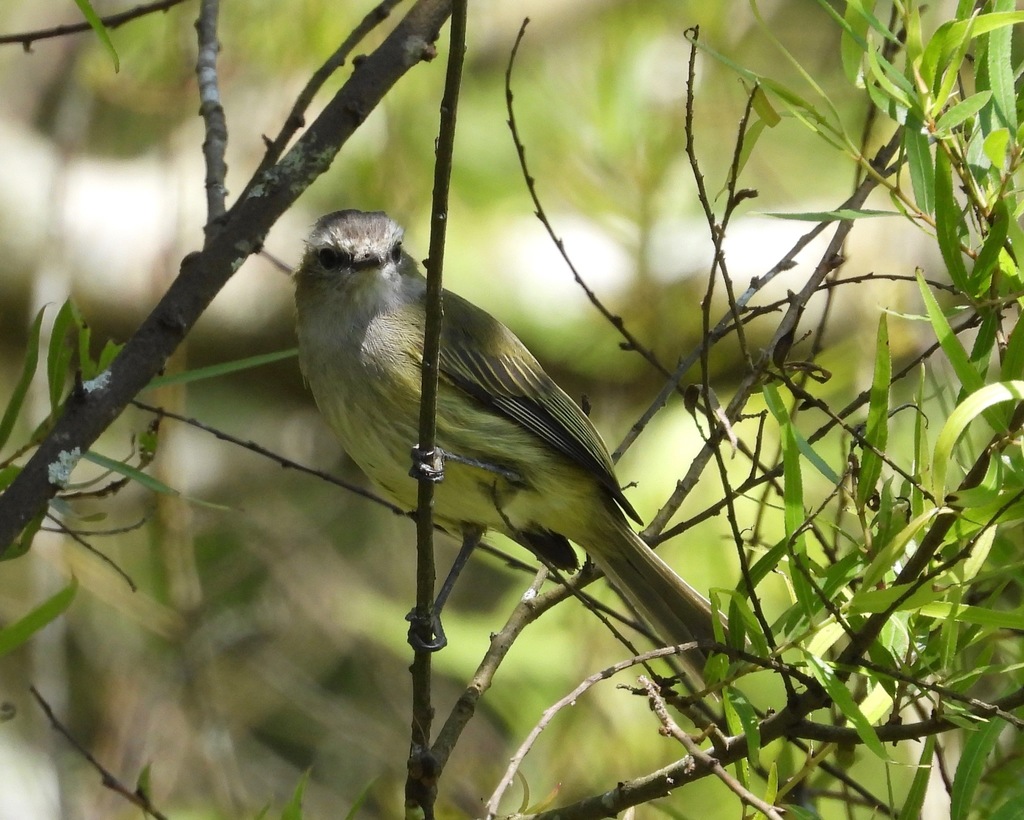
Guatemalan Tyrannulet
Photo © Grete Pasch
Photo © Grete Pasch — CC BY 4.0 — Source: iNaturalist #69167115Identification
The Guatemalan tyrannulet is a tiny passerine measuring just 10–12 cm in length, making it one of the smallest tyrant flycatchers in its range. Adults are straightforward to identify: look for a grayish crown contrasting with a short whitish supercilium, olive-green upperparts, and mostly off-white underparts with faint streaking on the breast. The wings and tail are olive-green with distinctive yellow edging on the wing coverts, flight feathers, and tail feathers. Both sexes are identical in plumage, featuring a short dark bill, light brown to brownish-black iris, and long dark legs. Immature birds show more green in the crown and darker irides, which can help separate them from adults in the field.
Range & Habitat
This species is endemic to Central America, found from southern Chiapas in Mexico eastward through Guatemala, into southern Belize, and south through El Salvador. The Guatemalan tyrannulet inhabits a variety of wooded environments, from the interior and edges of evergreen forest to more open forest, plantations, and fields with scattered trees and shrubs. It has a notable affinity for areas where mistletoes grow, making these plants important to its ecology. Elevation-wise, the species ranges between 500 and 2,500 meters, adapting well to both humid highlands and lowland forests.
Behaviour & Diet
Generally a year-round resident throughout its range, the Guatemalan tyrannulet shows some post-breeding altitudinal movement, with individuals descending to lower elevations after the breeding season. The species forages singly or in pairs, gleaning food from perches and making short sallies to catch prey. It hunts at all forest levels but favors the mid-story to canopy zone. Its diet comprises mistletoe berries, other fruits, and insects, reflecting its opportunistic feeding strategy. While detailed breeding biology remains undocumented, it is presumed to follow patterns similar to related tyrannulets, with females constructing oval nests from moss and plant fibers bound with spider silk, typically positioned 2–15 meters high in hanging moss or lichen masses.
Best Time & Places to See It
The Guatemalan tyrannulet's status as a year-round resident means it can be encountered throughout the year, though autumn and winter post-breeding movements may affect local abundance. The species is common across a wide variety of habitats, including highly modified agricultural areas around farms and towns, making it surprisingly accessible to travelers. Highland forest fragments in Guatemala and Chiapas offer reliable sightings, particularly in areas with mistletoe-laden trees. Its adaptability to human-modified landscapes means that even coffee plantations and forest edges near settlements can yield rewarding encounters.
Photography Tips
The Guatemalan tyrannulet's small size and tendency to stay high in the canopy present genuine challenges for photographers. Position yourself beneath fruiting mistletoes during early morning, when the bird is most active and light is favorable. Its preference for gleaning from foliage means it often pauses on exposed perches—patience and a keen eye will be rewarded. The yellow-edged flight feathers and tail provide striking contrast against the olive-green plumage, so capture flight shots when possible. Use a telephoto lens of at least 400–600 mm, and watch for the bird's characteristic short sallies; these brief, predictable movements offer your best opportunity for sharp, well-composed images of this diminutive flycatcher.
No community photos yet. Log in to add the first one.
No community observations of this species yet.