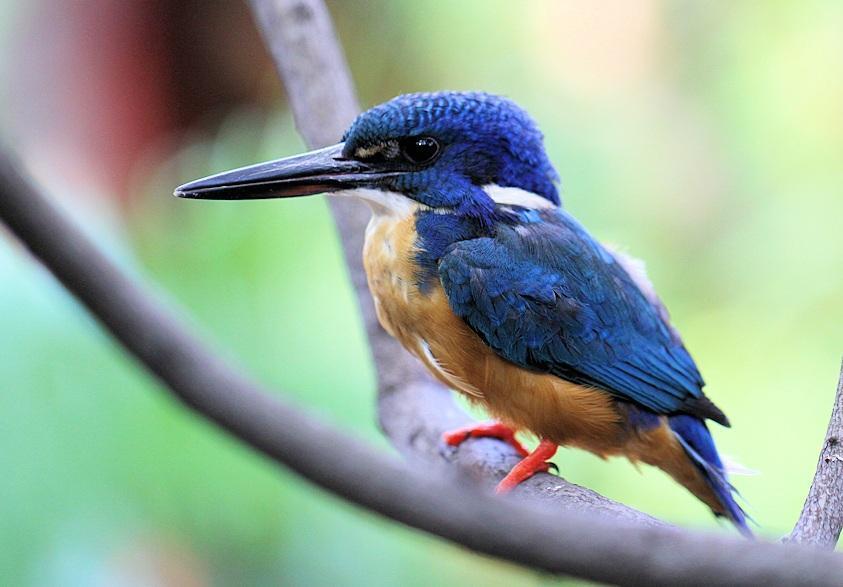
Half-collared Kingfisher
Photo © Wynand Uys
Photo © Wynand Uys — CC BY 4.0 — Source: iNaturalist photo #15303261Identification
The half-collared kingfisher is a medium-sized kingfisher, measuring around 18 cm in length and weighing 35–40 g. Despite its modest size, it is strikingly marked and easily identified. The bird's most distinctive feature is its plumage pattern: bright blue upperparts contrast sharply with a white throat and pale orange underparts. The head displays alternating bands of light blue and dark blue running across the crown, while each side of the neck bears a creamy white stripe. These dark blue patches on either side of the neck form a characteristic half collar, which gives the species its common name. The legs and feet are bright red, adding another splash of colour to this jewel-like bird. The sexes are very similar in appearance, though they can be distinguished by their bills: males have entirely black bills, while females show some red colouration at the base of the lower mandible.
Range & Habitat
The half-collared kingfisher is found in southern and eastern Africa. This is one of eight species in the genus Alcedo and is most closely related to the shining-blue kingfisher. The species is highly dependent on freshwater habitats, frequenting streams, rivers and larger bodies of water. Crucially, it requires areas with dense shoreline vegetation, which provides both shelter and hunting perches from which to spot and pursue prey.
Behaviour & Diet
The half-collared kingfisher feeds almost exclusively on fish, making it a specialist hunter dependent on clean, productive waters. An intriguing behaviour noted in this species is that it sometimes vocalizes while approaching its nest, though the purpose or advantage of this behaviour remains unclear to ornithologists. This vocalization may serve to announce the bird's arrival or presence to its mate, but such questions continue to intrigue bird researchers.
Best Time & Places to See It
To encounter the half-collared kingfisher, head to river systems and streams in southern and eastern Africa, particularly those with well-developed riparian vegetation. The bird's dependence on dense shoreline cover means that pristine, vegetated waterways offer the best chances of sightings. Look for the characteristic bright blue and orange plumage perched on branches overhanging the water, where it hunts for fish.
Photography Tips
The half-collared kingfisher's vivid colouration—brilliant blue, creamy white and orange—makes it a rewarding photographic subject. The bird's small size and preference for densely vegetated areas can present challenges, so patience and a telephoto lens are essential. Early morning light will enhance the iridescent quality of its blue plumage, making for striking images. Position yourself quietly along riverbanks where the bird hunts, and wait for it to perch; approaching its nest may trigger vocalizations that could indicate an opportunity for behavioural photography.
Chobe National Park
Botswana
+446 birds+45 mammals
Where the Chobe River cuts a sinuous path through northern Botswana, the landscape transforms into one of Africa's most dynamic wetland-savanna mosaics. This national park encompasses…
VIEW NATIONAL PARKGarden Route National Park
George, South Africa
+353 birds+54 mammals
Sweeping across the Western Cape's coastal and mountainous terrain, this sprawling national park encompasses over five thousand square kilometers of extraordinarily diverse landscape—from coastal limestone cliffs…
VIEW NATIONAL PARKPilanesberg National Park
Moses Kotane Local Municipality, South Africa
+364 birds+49 mammals
Granite peaks and volcanic ridges rise unexpectedly from the savanna floor across this 734-square-kilometre expanse in the North West province, creating a landscape of profound ecological…
VIEW NATIONAL PARKAddo Elephant National Park
Sundays River Valley Local Municipality, South Africa
+388 birds+55 mammals
Where the Eastern Cape's semi-arid scrublands meet transitional woodland, Addo sprawls across 13,478 square kilometres of one of southern Africa's most biodiverse landscapes. The terrain rises…
VIEW NATIONAL PARKIthala Game Reserve
uPhongolo Local Municipality, South Africa
+328 birds+26 mammals
Rolling thornbush savanna and acacia woodland dominate the landscape of this 494-square-kilometre national park in KwaZulu-Natal's uPhongolo Local Municipality, where granite outcrops punctuate grassland plateaus and…
VIEW NATIONAL PARKMarakele National Park
Modimolle Local Municipality, South Africa
+341 birds+36 mammals
Granite ridges and sprawling grasslands dominate this 1,176-square-kilometre reserve in Limpopo's heartland, where bushveld transitions between rocky outcrops and open savanna. The park's rugged topography creates…
VIEW NATIONAL PARKBwabwata National Park
Namibia
+377 birds+35 mammals
Where the Kavango River winds through northeastern Namibia, vast floodplains and dense riparian woodland create one of southern Africa's most ecologically dynamic protected landscapes. Spanning 14,249…
VIEW NATIONAL PARKAbijata-Shalla Lakes National Park
Ethiopia
+438 birds+7 mammals
Two crater lakes of contrasting chemistry define this remote corner of Ethiopia's Rift Valley, where soda lakes and freshwater basins create a mosaic of distinct aquatic…
VIEW NATIONAL PARKBale Mountains National Park
Ethiopia
+397 birds+20 mammals
Where the Ethiopian highlands rise above 4,000 metres, the Bale Mountains create a landscape of stunning ecological extremes—from afroalpine grasslands swept by wind and mist to…
VIEW NATIONAL PARKAwash National Park
Didiga, Ethiopia
+473 birds+23 mammals
Where the Ethiopian Rift Valley carves through volcanic plateaus, a ribbon of riverine forest winds through acacia scrubland and grassland, creating a mosaic of habitats that…
VIEW NATURAL PARKNech Sar National Park
Arba Minch, Ethiopia
+191 birds+10 mammals
Where the East African Rift Valley plateaus drop dramatically toward the shore of Lake Abaya, a mosaic of habitats unfolds across sun-scorched savanna and acacia woodland.…
VIEW NATIONAL PARKNo community photos yet. Log in to add the first one.
No community observations of this species yet.