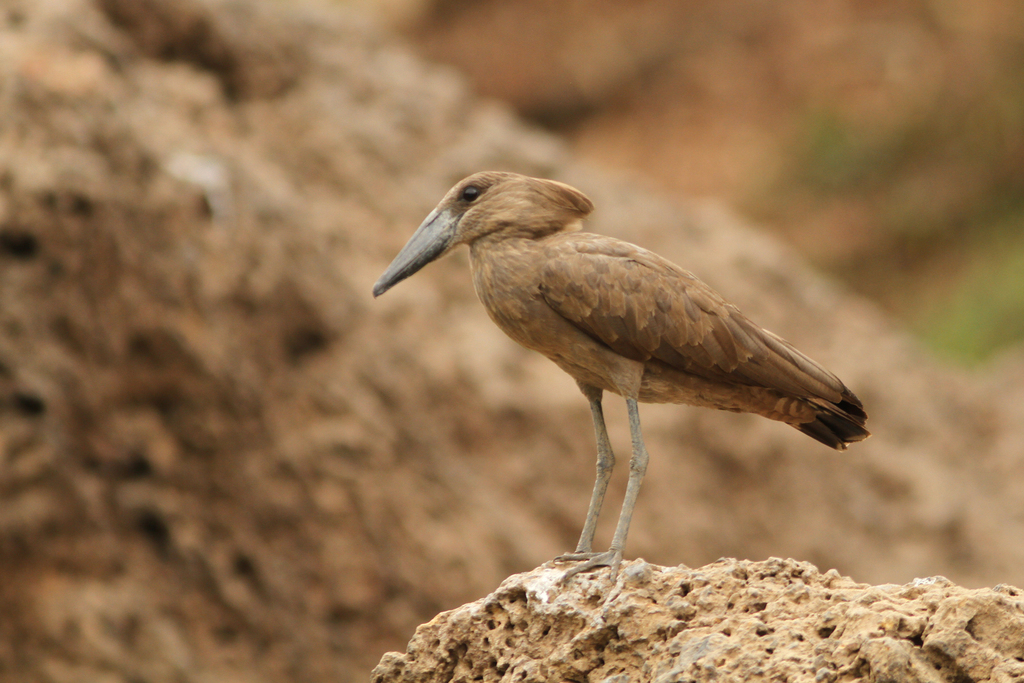
Hamerkop
Photo © Julien Renoult
Photo © Julien Renoult — CC BY 4.0 — Source: iNaturalist photo #56287392Identification
The hamerkop is a medium-sized wading bird standing 56 cm high, instantly recognisable by its distinctive head shape. Its name—Afrikaans for "hammerhead"—refers to the combination of a long, slightly hooked bill and a prominent crest at the back of the head. The plumage is uniformly drab brown, with subtle purple iridescence visible on the back, while the tail is faintly barred with darker brown. The bill is notably compressed and thin, particularly towards the lower mandible, resembling that of a shoebill. Young birds have brown bills that turn black by fledging. The legs are relatively short and feathered only to the upper tibia, with bare black parts below. Unusually for a wading bird, the hamerkop has partially webbed feet.
Range & habitat
The hamerkop is found across mainland Africa south of the Sahara, Madagascar, and coastal south-west Arabia. This adaptable species inhabits virtually all wetland environments, from rivers and streams to seasonal pools, estuaries, marshes, mangroves, and irrigated agricultural land such as rice paddies. It has even recently adapted to feeding on rocky shores in Tanzania. The bird requires shallow water for foraging and is locally abundant throughout much of its range.
Behaviour & diet
The hamerkop is a sedentary bird that occasionally shows local movements. It hunts in shallow water using sight or touch, feeding primarily on fish and amphibians, though it will opportunistically take any available prey. The species is particularly renowned for constructing enormous nests, with pairs building several during the breeding season. Unusually among wading birds, the hamerkop creates nests with an internal chamber where eggs are laid. Both parents share incubation and chick-rearing duties.
Best time & places to see it
The hamerkop is not globally threatened and remains locally abundant in mainland Africa and Madagascar, classified as least concern by the IUCN. Its presence across diverse wetland habitats and its sedentary nature make it a reliable sighting throughout appropriate wetland regions within its range, though specific seasonal patterns vary by locality.
Photography tips
The hamerkop's distinctive silhouette and characteristic head shape make it visually striking in photographs. Its jerky, rapid gait when walking—with constant back-and-forth head movements—offers dynamic action opportunities. Look for the bird hunting in shallow water where its posture and interaction with water can be captured. The iridescent purple sheen on the back may be revealed in good light. Its soaring flight, when it stretches its neck forward, provides different compositional angles than its characteristic hunched posture when flapping.
Bwindi Impenetrable National Park
Lake Mburo National Park
Mabamba Swamp
Murchison Falls National Park
Queen Elizabeth National Park
Aberdare National Park
Abijata-Shalla Lakes National Park
Addo Elephant National Park
Agulhas National Park
Nothing matches these filters.
No community photos yet. Log in to add the first one.
No community observations of this species yet.