Hartlaub’s Spurfowl
Photo © Nathan Van Cooten
Photo © Nathan Van Cooten — CC BY 4.0 — Source: iNaturalist #265814494Identification
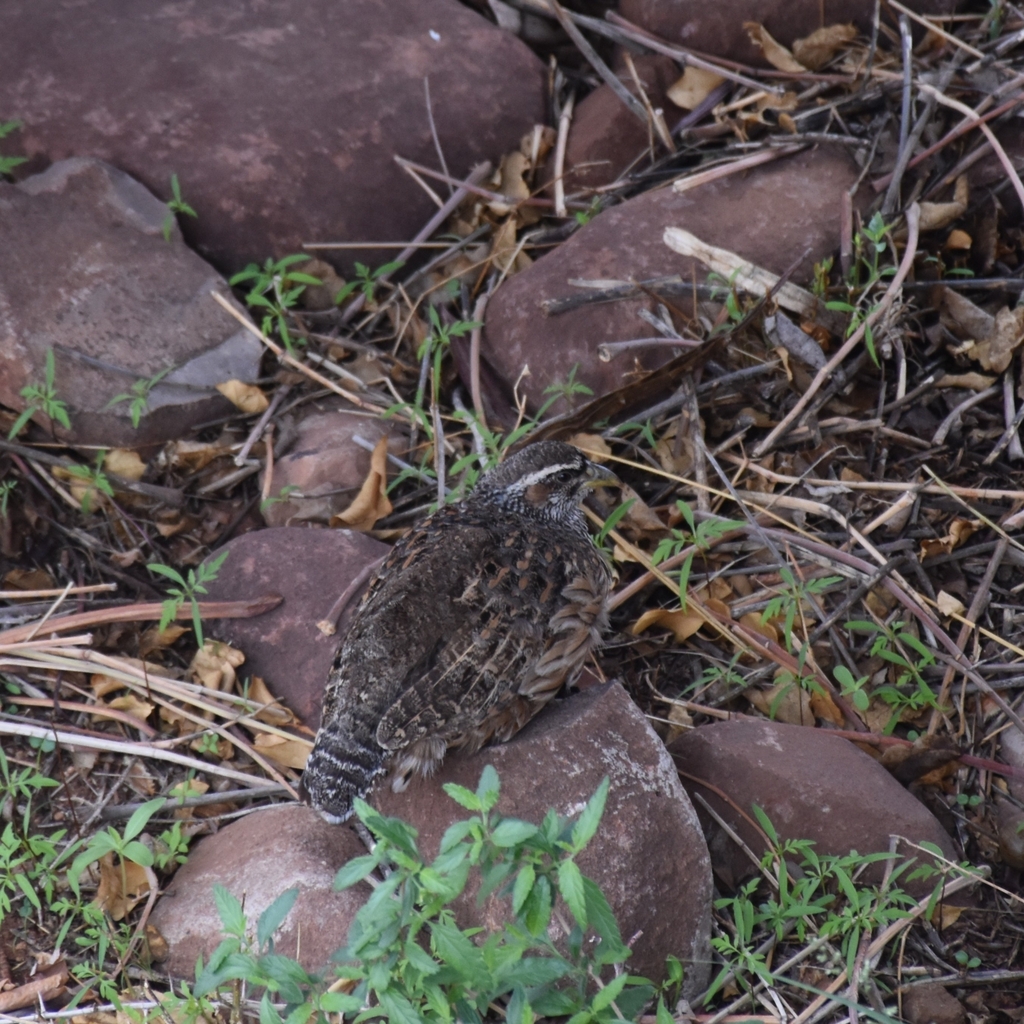
Hartlaub's spurfowl is the smallest African spurfowl, and highly sexually dimorphic in both plumage and size. Males average 28 cm in length and weigh 245–290 g, while females are noticeably smaller at around 25 cm and 210–240 g. Males display a dark brownish forehead, a prominent white eyestripe, and rufous ear coverts, with brown-grey upperparts barred and streaked with darker markings. The underparts are pale grey with extensive dark streaks. Females have similar upperparts to males but lack the brown streaking, instead showing dull rufous underparts, head, and neck. Both sexes have disproportionately large bills, with brownish upper mandibles and yellow lower mandibles. The legs are yellow with flattened spurs. Juveniles closely resemble adults of their respective sex.
Range & Habitat
Hartlaub's spurfowl is endemic to southwest Africa, occurring only in northcentral to northwestern Namibia and a small area of southwestern Angola. This species inhabits medium-altitude arid and semiarid regions between 800–1,600 metres elevation. It favours higher ground, particularly rocky granite and sandstone outcrops—locally known as koppies—surrounded by semidesert steppe. Dense grass and shrubbery invariably associate with these rocky outcrops, providing essential cover. While the red-billed spurfowl and Orange River francolin occur in the same geographic region, they occupy distinct habitats: red-billed spurfowls prefer bush along watercourses, while Orange River francolins inhabit the slopes leading up to the rocky outcrops favoured by Hartlaub's spurfowl.
Behaviour & Diet
Hartlaub's spurfowl pairs are perennially territorial, with multiple boundary call sites marking each territory. Territorial pairs perform daily antiphonal (alternating) duets, particularly shortly after sunrise, using these vocalisations to advertise their presence and maintain pair bonds through ritualised behaviours. Females are notably more vocal than males and employ a wider repertoire of vocalisations. Unmated females call far more frequently than territorial pairs, often throughout the day. Interestingly, this species exhibits sex-role reversed monogamy—unusual for such a sexually dimorphic bird—where females primarily defend perennial territorial resources including food, traditional call-sites, refuge, and nest-sites. Mean territory size for pairs is approximately 40,863 square metres, with population densities ranging from one bird per 0.82 hectares to one bird per 2.04 hectares. Habitat use and feeding patterns are influenced by seasonal food distribution and, during breeding season, by the availability of insects, particularly cryptic termites.
Best Time & Places to See It
Hartlaub's spurfowl is best located by listening for territorial calls, which are most frequent shortly after sunrise. Early morning visits to rocky granite and sandstone outcrops within the escarpment zone of Namibia and Angola offer the best chances of encountering this endemic species. The birds' preference for specific elevated rocky habitats with associated dense grass and shrubby vegetation makes these microhabitats the focus for any search. The species' relatively small range and habitat specificity mean that visiting known call-site areas during the breeding season will maximise sighting opportunities.
Photography Tips
The striking sexual dimorphism of Hartlaub's spurfowl offers rewarding photographic opportunities. Males, with their distinctive white eyestripe, rufous ear coverts, and streaked underparts, present distinctive features for identification and portraiture. Early morning light shortly after sunrise will be most productive for photography, coinciding with peak calling activity when birds are most vocal and active. Photograph birds on and around rocky outcrops to capture their preferred habitat context. The species' small size—the smallest African spurfowl—and tendency to remain within defined territories make it necessary to approach quietly and patiently. Capturing the species' disproportionately large bill and yellow leg spurs in detail will help showcase its unique morphological features.
Etosha National Park
Namibia
+356 birds+58 mammals
Across northern Namibia's stark semi-arid plateau, a vast shallow depression transforms seasonally into one of Africa's most dramatic wildlife theaters. Etosha National Park, encompassing more than…
VIEW NATIONAL PARKWaterberg Plateau National Park
Okambukonde, Namibia
+198 birds+27 mammals
Where ancient sandstone cliffs rise 200 metres above the surrounding bushveld, a fortress of geology creates one of southern Africa's most compelling ecosystems. The plateau's steep…
VIEW NATIONAL PARKNo community photos yet. Log in to add the first one.
No community observations of this species yet.