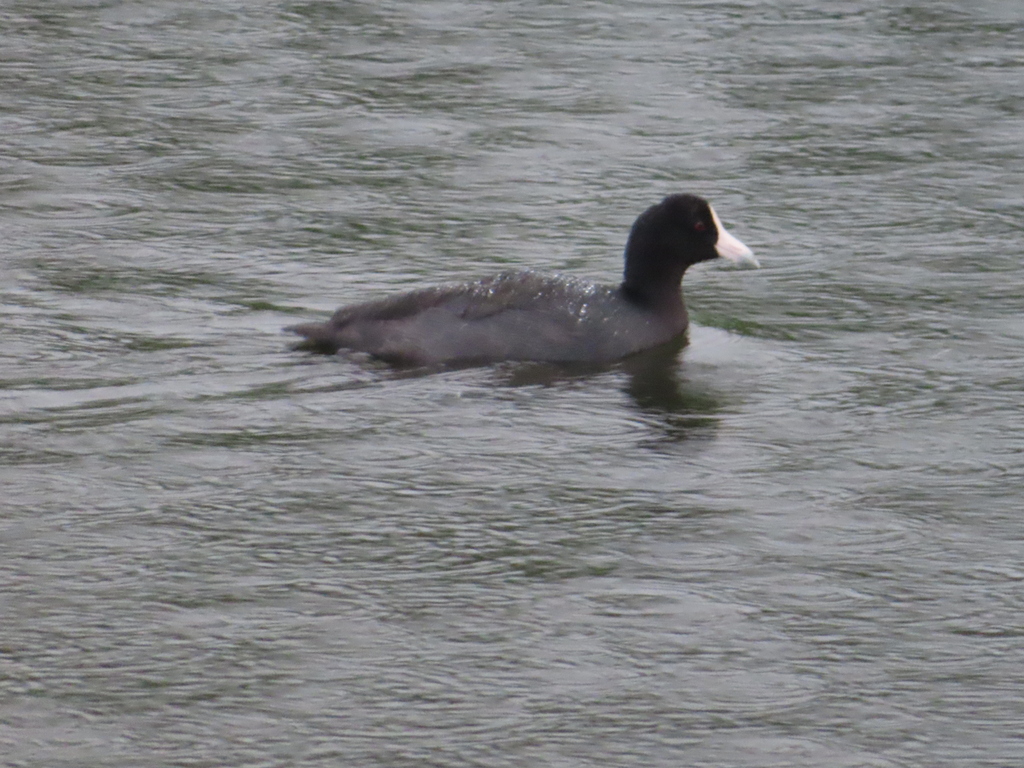
Hawaiian Coot
Photo © Ken Clark
Photo © Ken Clark — CC BY 4.0 — Source: iNaturalist #262087627The ʻAlae keʻokeʻo (Fulica alai), also known as the Hawaiian coot in English, is a bird in the rail family, Rallidae, that is endemic to Hawaii. In Hawaiian, ʻalae is a noun and means mud hen. Keʻo is an adjective for clear or white. It is similar to the American coot at 33–40.6 cm (13–16 in) in length and weighing around 700 g (1 lb 9 oz). It has black plumage and a prominent white frontal shield. Its natural habitats are freshwater lakes, freshwater marshes, coastal saline lagoons, and water storage areas. The bird was federally listed in October 1970 as an endangered species and is considered both endemic and endangered by the state of Hawaiʻi. It is threatened by habitat loss and introduced predators such as the small Asian mongoose. The Makalawena Marsh on the Big Island of Hawaiʻi has been listed as a National Natural Landmark to preserve one of its last nesting areas. == Endangered Species Listing == The ʻAlae keʻokeʻo was federally listed in October 1970 as an endangered species and is considered both endemic and endangered by the state of Hawaiʻi. The United States Fish and Wildlife Service's 5-year review, conducted in 2010, found that…
Hawaiʻi Volcanoes National Park
Hawaiʻi County, United States
+84 birds+2 mammals
Where volcanic slopes descend toward the Pacific across more than five thousand square kilometers, Hawaiʻi Volcanoes National Park presents one of Earth's most dynamic laboratories of…
VIEW NATIONAL PARKHaleakalā National Park
Maui County, United States
+66 birds+4 mammals
Ascending from sea level to over 10,000 feet across a mere thirty miles, Haleakalā National Park commands one of the Pacific's most dramatic elevation gradients, where…
VIEW NATIONAL PARKKīlauea Point National Wildlife Refuge
Kilauea, United States
+79 birds+1 mammals
At the northernmost tip of Kauai, where the Pacific trades collide with volcanic rock, Kīlauea Point National Wildlife Sanctuary crowns a dramatic headland overlooking one of…
VIEW WILDLIFE SANCTUARYNo community photos yet. Log in to add the first one.
No community observations of this species yet.