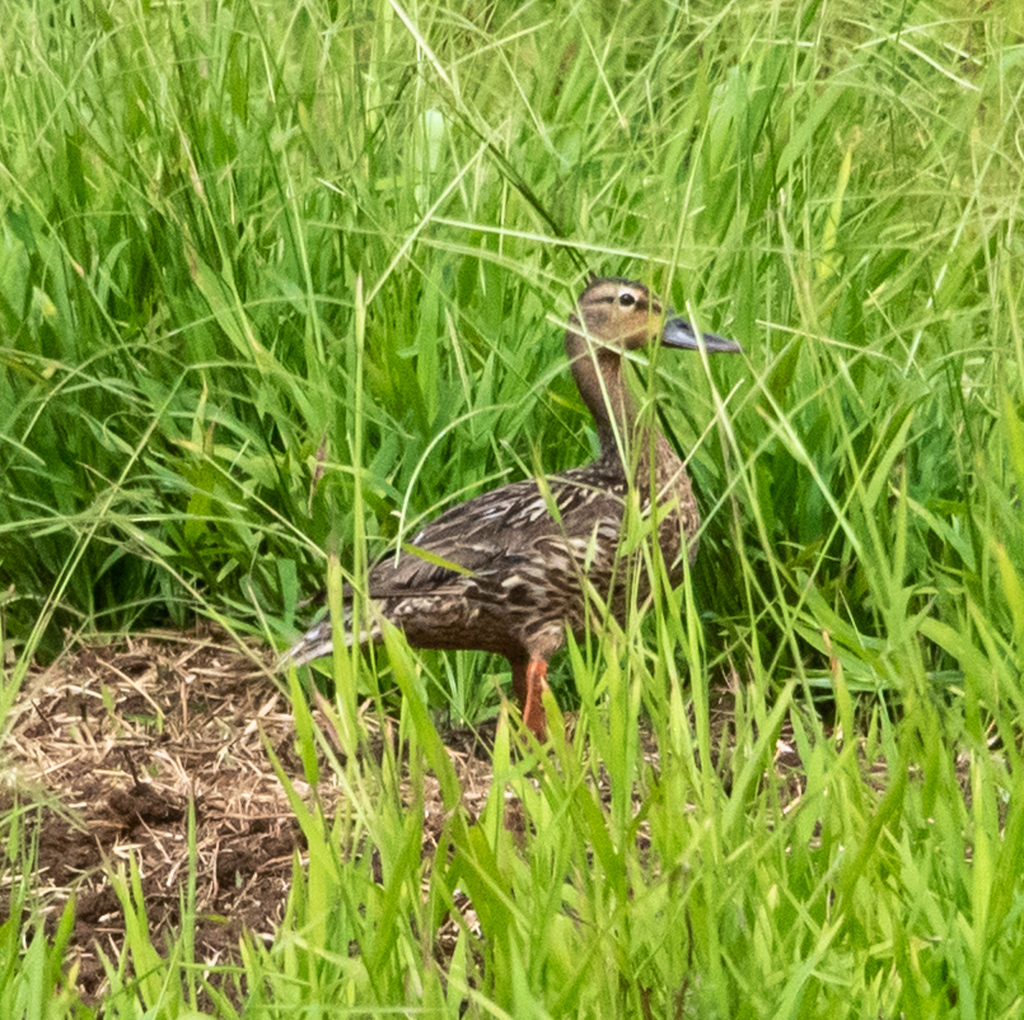
Hawaiian Duck
Photo © Don Loarie
Photo © Don Loarie — CC BY 4.0 — Source: iNaturalist #119495356Identification
The Hawaiian duck, or koloa, is a small dabbling duck that differs markedly from its closest relative, the mallard. Unlike most duck species, Hawaiian ducks are monomorphic—both males and females share similar mottled brown plumage that resembles a female mallard. Males are typically larger than females and have darker heads and necks, while females are generally lighter with plain back feathers. Both sexes display striking green-to-blue speculum feathers bordered by white on each side, and sport orange-to-yellow-orange legs and feet. The male's bill is olive green, while the female's is dull orange with dark markings. The tail is uniformly dark, unlike the distinctive black-and-white tail pattern of mallards. Males average 48–50 cm in length and weigh around 604 grams, while females are noticeably smaller at 40–43 cm and 460 grams. Overall, Hawaiian ducks are about 20–30 percent smaller than mallards.
Identification can be challenging, particularly in areas where hybridization with introduced mallards is prevalent. First-year male Hawaiian ducks closely resemble eclipse-plumaged male mallards, and seasonal variation, individual differences, and island-specific variations add further complexity to field identification. The extent of local hybridization also complicates distinguishing pure Hawaiian ducks from female mallards and their hybrids.
Range & Habitat
The Hawaiian duck is endemic to the large islands of Hawaiʻi, though its range has contracted dramatically over time. Historically, these ducks inhabited all main Hawaiian islands except Lānaʻi and Kaho'olawe, occurring in habitats ranging from hottest coastal ponds to mountain streams at elevations up to 7,000 feet. Genetically-pure populations were historically believed to occur on Kaua'i, Ni'ihau, and the highlands of Hawaiʻi. Today, pure Hawaiian ducks are found almost exclusively on Kaua'i, which supports approximately 2,000 birds, with around 200 remaining on Hawaiʻi. Following extirpation from most islands, reestablishment efforts between the 1950s and 1980s reintroduced ducks to O'ahu, Maui, and Hawaiʻi, though these populations have since hybridized with feral mallards.
These ducks prefer tall wetland grasses, streams, river valleys, and lowland wetland habitats. They are most prominently found near the Kohala volcano on the main island of Hawaiʻi. Wetland loss, particularly in Kaua'i's lowlands, continues to threaten available habitat.
Behaviour & Diet
Hawaiian ducks are notably wary and secretive birds, typically found in pairs rather than large flocks. They are non-migratory and do not associate with other animal species. Their vocalization is distinctly softer than a mallard's quack, and they call less frequently. During the primary breeding season from December to May, pairs engage in spectacular nuptial flights. Clutch sizes typically number eight eggs, though females lay between two and ten eggs in well-concealed nests lined with down and breast feathers. Incubation lasts approximately four weeks, and young fledge at about nine weeks of age, reaching sexual maturity within one year.
As opportunistic feeders, Hawaiian ducks consume a diverse diet of freshwater vegetation, mollusks, and aquatic invertebrates. Documented food items include snails, insect larvae, earthworms, tadpoles, crayfish, mosquito larvae, mosquito fish, grass seeds, rice, and green algae.
Best Time & Places to See It
Kaua'i offers the most reliable opportunity to observe genetically-pure Hawaiian ducks, particularly around Hanalei National Wildlife Refuge, an essential breeding area. The primary breeding season from December to May offers the best viewing prospects, when ducks are actively engaged in nuptial displays and nesting behavior. The main island of Hawaiʻi, particularly near streams and wetland grasses around the Kohala volcano, provides secondary viewing opportunities, though birds here may be hybridized with mallards.
Given the species' wary and secretive nature, patience and quiet observation are essential. These ducks prefer to remain in tall grasses and are not inclined to congregate in open areas or associate with other waterfowl, making them challenging but rewarding subjects for dedicated birdwatchers.
Photography Tips
Photographing Hawaiian ducks requires patience, stealth, and respect for their wariness. Early morning and late afternoon light will best reveal the subtle plumage details—particularly the mottled brown coloration and the striking white-bordered green speculum. A telephoto lens is essential given the species' preference for tall grasses and their tendency to remain concealed in wetland vegetation. Approach slowly and quietly, as sudden movements will cause these secretive ducks to flush immediately.
During the December-to-May breeding season, positioning yourself near nesting areas may yield opportunities to photograph dramatic nuptial flights and pair interactions. Focus particularly on capturing the distinctive bill colors and the contrast between the dark tail and lighter underparts. The size difference between males and females can be effectively highlighted in pair photographs. Exercise caution when working in refuge areas and always follow local regulations and wildlife management guidelines.
No community photos yet. Log in to add the first one.
No community observations of this species yet.