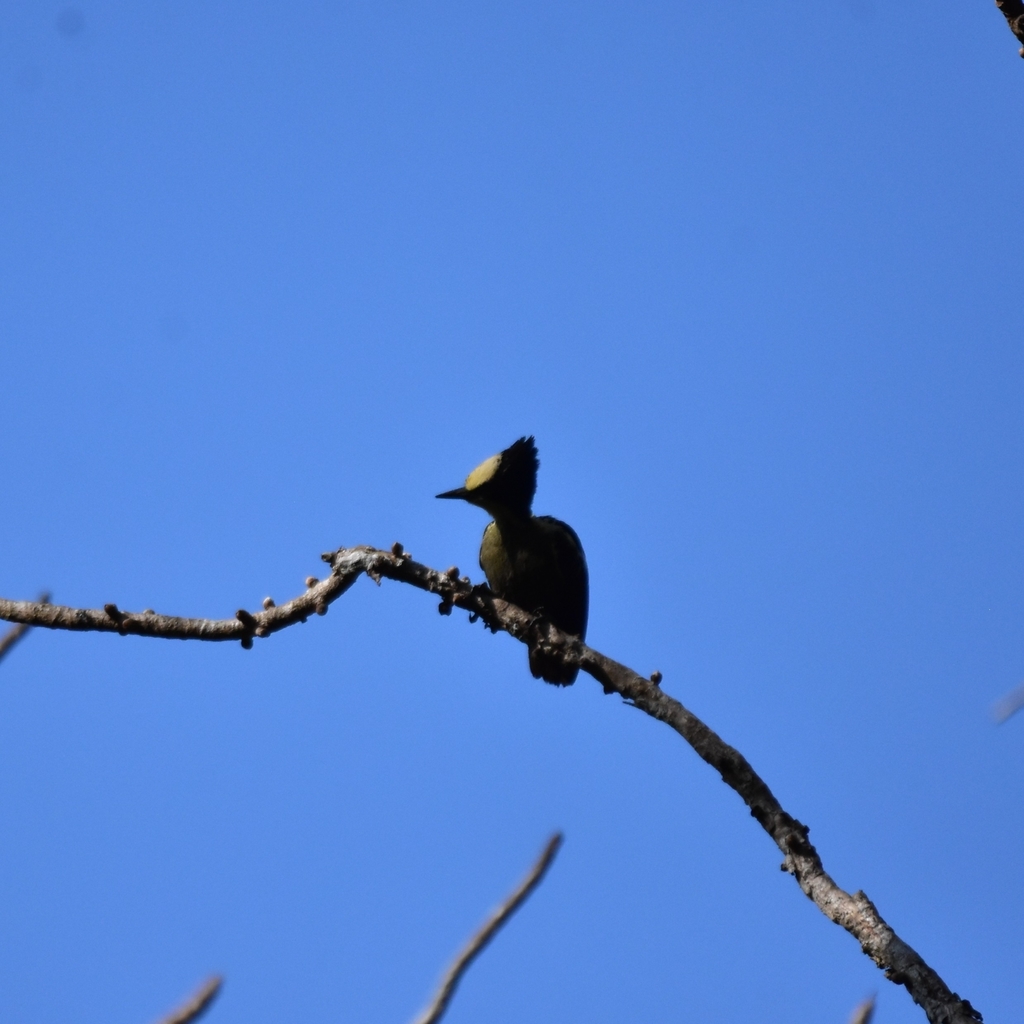
Heart-spotted Woodpecker
Photo © Renjith Jacob Mathews
Photo © Renjith Jacob Mathews — CC BY 4.0 — Source: iNaturalist #105154335Identification
The heart-spotted woodpecker is a small, distinctively proportioned species with a large wedge-shaped head that appears oversized relative to its stubby body and tail. Both males and females display predominantly black plumage contrasted with striking white markings: heart-shaped black spots on white shoulders and broad white scapular patches, along with barring on the flight feathers. The throat is whitish and the underparts are dark olive-grey. Sexual dimorphism is evident in the head: females have a buffy-white forehead and crown, while males are black with small white dots on the crown. A notable feature is a tuft of specialized, lipid-rich feathers on the back that may serve as "cosmetic colouration," giving the rump a sometimes buff appearance.
Range & Habitat
The heart-spotted woodpecker has a wide distribution across Asia, occupying subtropical and tropical moist lowland forests. In India, populations are found in the Himalayan forests, the Western Ghats, and central Indian forests, with these populations slightly separated geographically from populations in Southeast Asia. The species extends its range through Bangladesh, Myanmar, Thailand, Laos, Cambodia, and Vietnam. Northern populations are larger than those closer to the equator, varying clinally in size.
Behaviour & Diet
Heart-spotted woodpeckers forage in pairs or small groups and frequently join mixed-species foraging flocks. They hunt for insects under bark on thin branches, employing a sharply bounding flight that gives them a head-heavy appearance as they move between trees. They have also been observed pecking the pods of Cassia fistula to extract insect larvae. These birds are vocal foragers, with calls including a sharp twee-twee-twee duet call that may lead into a trill, a nasal ki-yeew, and repeated su-sie calls. They drum infrequently during breeding season, with most drumming occurring during winter and before the monsoons.
Best Time & Places to See It
To locate heart-spotted woodpeckers, focus on their frequent calling, which makes them relatively easy to detect despite their small size. Search the forests of the Himalayas, Western Ghats, or central India, or venture into suitable habitat in Southeast Asia including Myanmar, Thailand, Laos, Cambodia, and Vietnam. Their habit of foraging in pairs or small groups and joining mixed-species flocks means patience and careful listening will be rewarded. Winter and the period before the monsoons may offer increased activity from drumming males.
Photography Tips
The heart-spotted woodpecker's contrasting black and white plumage photographs well, but success requires patience and careful positioning. Focus on thin outer branches where these birds forage, keeping a low profile to avoid disturbing pairs or flocks. Their frequent vocalizations provide excellent cues for locating and following individuals. The distinctive head-heavy silhouette and large crest should be captured in profile to showcase the bird's unique proportions. Early morning sessions when birds are most active will provide the best opportunities for sharp, well-lit images.
Eravikulam National Park
Devikulam, India
+192 birds+7 mammals
High in the Western Ghats of Kerala, where monsoon mists cling to slopes that rise above 2,000 metres, Eravikulam National Park preserves one of South India's…
VIEW NATIONAL PARKKhao Yai National Park
Prachantakham District, Thailand
+377 birds+46 mammals
Evergreen dipterocarp forest blankets the rolling terrain of this national park in eastern Thailand, where limestone hills rise abruptly from the forest floor and seasonal streams…
VIEW NATIONAL PARKKhao Laem National Park
Sangkhla Buri District, Thailand
+197 birds
Where the Vajiralongkorn Reservoir sprawls across the forested valleys of Kanchanaburi's northern borderlands, Khao Laem National Park protects a landscape where limestone ridges rise dramatically from…
VIEW NATIONAL PARKPeriyar National Park
Mlappara, India
+232 birds+4 mammals
Dawn breaks over mist-shrouded ridges where the Western Ghats tumble toward Kerala's spice-scented lowlands. Here, ancient tropical forests envelope a glittering artificial lake, creating a mosaic…
VIEW NATIONAL PARKPampadum Shola National Park
Vattavada, India
+258 birds+14 mammals
Where misty shola forests cling to the high plateaus of the Nilgiri Mountains, ancient evergreen remnants create a world apart. This 2,316-hectare reserve protects one of…
VIEW NATIONAL PARKBandipur National Park
Hirehalli, India
+302 birds+19 mammals
Where the Western Ghats descend into the Deccan plateau, ancient deciduous forests blanket a landscape carved by the Nugu River. Bandipur unfolds across 880 square kilometres…
VIEW NATIONAL PARKNagarahole Tiger Reserve
Nalkeri Forest, India
+323 birds+23 mammals
Where granite escarpments rise above dense deciduous forests and the Kabini River carves through pristine wilderness, one of India's most biodiverse landscapes unfolds across the Western…
VIEW NATIONAL PARKNo community photos yet. Log in to add the first one.
No community observations of this species yet.