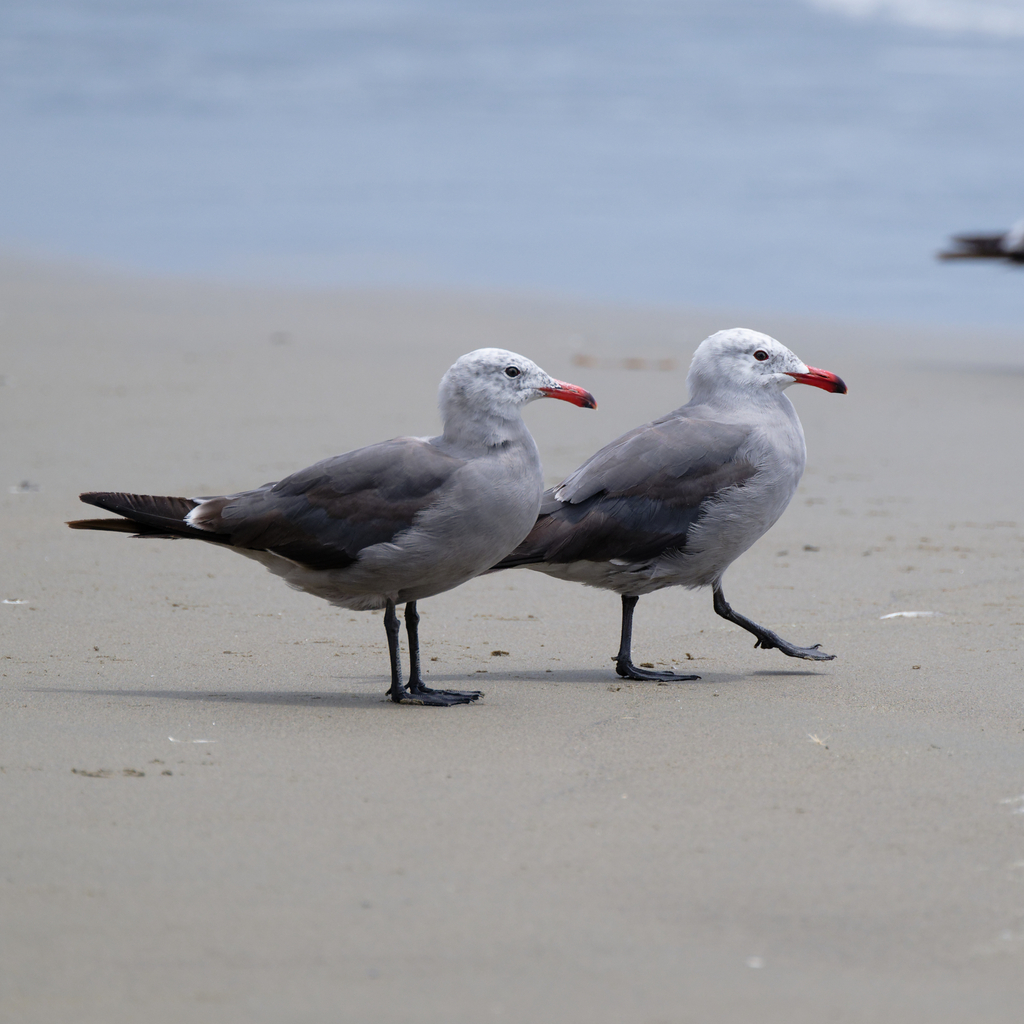
Heermann’s Gull
Photo © Corey Farwell
Photo © Corey Farwell — CC BY 4.0 — Source: iNaturalist #231544385Identification
Heermann's gull is unmistakable among North American west coast gulls. Adults display a distinctive medium gray body with blackish-gray wings and tail edged in white, a bright red bill tipped with black, and a dusky gray head in non-breeding plumage that becomes white during breeding season. Immatures are darker and browner than non-breeding adults, with pink bills until their second winter. Rare individuals—approximately 1 in 200—show white primary coverts that create a striking spot on the upper wing. This is the only white-headed, gray-bodied gull found on the west coast of North America, making field identification straightforward.
Range & Habitat
Nearly the entire global population of approximately 150,000 pairs nests colonially on Isla Rasa in the Gulf of California, with smaller breeding colonies scattered from California south to Nayarit, Mexico. After breeding season, birds disperse widely: commonly to central California, occasionally north to British Columbia, and south to Guatemala. They inhabit coastal waters and open ocean, very rarely venturing inland. A small but established breeding colony persists in Seaside, California, having relocated to rooftops after nesting islands eroded.
Behaviour & Diet
Heermann's gulls nest colonially on the ground at remarkably high densities—up to 110 nests per 100 square meters. Each pair typically lays two or three grayish-buff eggs marked with gray and brown. A notable behavioral trait is their habit of stealing prey from other seabirds, particularly brown pelicans, with which they frequently associate. Their diet comprises small fish, marine invertebrates, lizards, insects, refuse, and carrion, making them highly adaptable foragers.
Best Time & Places to See It
Breeding birds concentrate on Isla Rasa from spring through summer, though the island remains difficult to access. Post-breeding dispersal makes them most visible to travelers along the California coast from late summer onward, particularly in central California waters. The Seaside, California breeding colony offers an accessible opportunity to observe nesting birds. Pelagic trips departing from California ports provide excellent chances to encounter this species at sea during winter months.
Photography Tips
The striking contrast between gray plumage and white head in breeding adults creates compelling photographic subjects. Capture birds in flight to showcase the distinctive white-edged dark wings and tail. Coastal perches and feeding interactions with brown pelicans offer dynamic shooting opportunities. Winter plumage dulls the head coloration, so breeding season visits to accessible colonies yield the most visually distinctive images. The red bill with black tip and rare white wing-covert variants provide excellent details for close-up photography.
Gulf Islands National Park Reserve
Southern Gulf Islands Electoral Area, Canada
+268 birds+26 mammals
Scattered across the Salish Sea in British Columbia's southwestern corner, this national park reserve stitches together a fragmented archipelago of forested islands and rocky outcrops where…
VIEW NATIONAL PARKRedwood National Park
Humboldt County, United States
+343 birds+43 mammals
Where the Pacific fog rolls deep into northern California's coastal valleys, some of the tallest trees on Earth rise from a landscape shaped by tectonic forces…
VIEW NATIONAL PARKOlympic National Park
Jefferson County, United States
+263 birds+35 mammals
Where temperate rainforest meets alpine wilderness, Olympic National Park sprawls across nearly 11,000 square kilometers of the Pacific Northwest's most pristine landscape. The park's three distinct…
VIEW NATIONAL PARKEl Vizcaíno
Laguna San Ignacio, Mexico
+317 birds+29 mammals
Where the Baja California peninsula thins into a tapestry of salt lagoons and coastal desert, one of Mexico's most biodiverse reserves sprawls across half a million…
VIEW BIOSPHERE RESERVEParque Nacional Isla Isabel
Santiago Ixcuintla, Mexico
+107 birds+2 mammals
A volcanic island sanctuary rises from the Pacific waters off Nayarit's coast, where three dormant cones define a landscape of sharp ridges, coastal cliffs, and sheltered…
VIEW NATIONAL PARKChannel Islands National Park
Santa Barbara County, United States
+330 birds+15 mammals
A chain of eight volcanic islands rises from the cold Pacific waters off the California coast, their rugged sea cliffs and windswept terrain shaped by millions…
VIEW NATIONAL PARKAlaska Maritime National Wildlife Refuge
Alaska, United States
+391 birds+58 mammals
Where the North Pacific collides with Alaska's rugged coastline, a sprawling archipelago of islands, rocky outcrops, and coastal headlands forms one of North America's most remote…
VIEW WILDLIFE SANCTUARYHavasu National Wildlife Refuge
Lake Havasu City, United States
+291 birds+8 mammals
Where the Colorado River widens into a vast reservoir in the Sonoran Desert, Havasu National Wildlife Sanctuary protects one of the most critical wetland ecosystems in…
VIEW WILDLIFE SANCTUARYDon Edwards San Francisco Bay National Wildlife Refuge
Fremont, United States
+286 birds+20 mammals
Where the San Francisco Bay's shallow margins dissolve into tidal salt marshes and mudflats, this wildlife sanctuary preserves one of California's most ecologically vital estuarine systems.…
VIEW WILDLIFE SANCTUARYFarallon National Wildlife Refuge
San Francisco, United States
+384 birds+16 mammals
Windswept granite peaks rising abruptly from the Pacific, the Farallon Islands form a wildlife sanctuary of extraordinary seabird abundance and ecological significance just twenty-seven miles west…
VIEW WILDLIFE SANCTUARYSalton Sea National Wildlife Refuge
Imperial County, United States
+289 birds+4 mammals
Across the floor of California's inland desert, where summer temperatures soar and rainfall is measured in tenths of inches, lies an improbable oasis of shallow water…
VIEW WILDLIFE SANCTUARYPea Island National Wildlife Refuge
Dare County, United States
+356 birds+15 mammals
Where the Outer Banks taper toward the Atlantic, a sliver of barrier island creates a microcosm of coastal ecology. Pea Island National Wildlife Sanctuary spans over…
VIEW WILDLIFE SANCTUARYNo community photos yet. Log in to add the first one.
No community observations of this species yet.