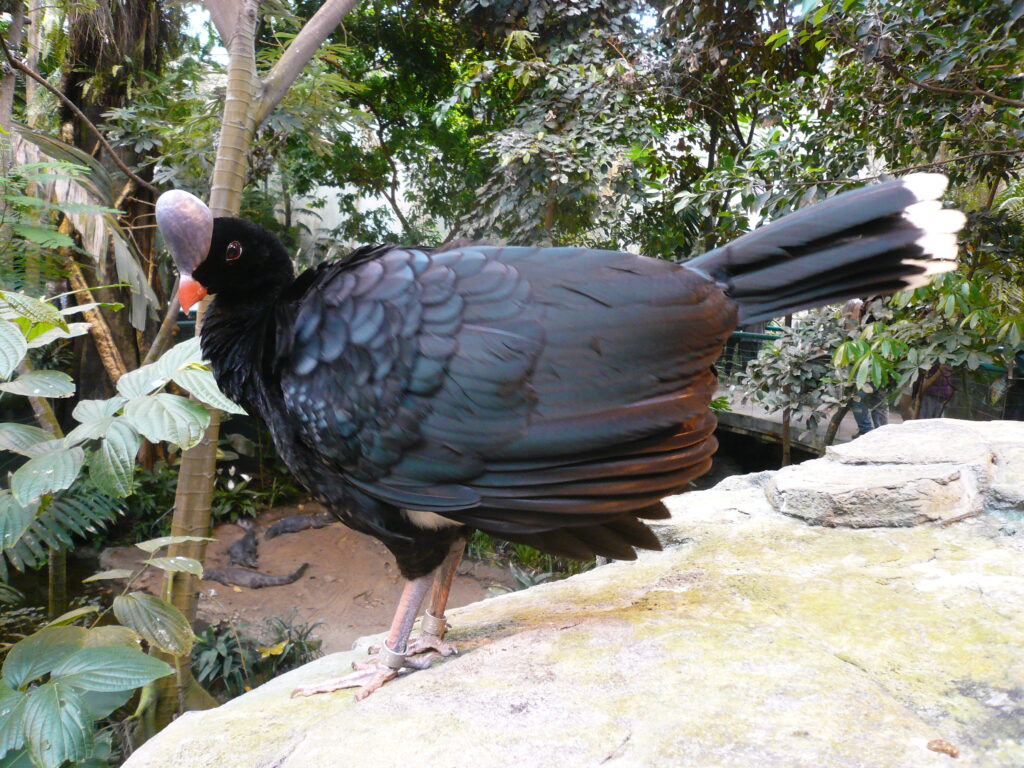
Helmeted Curassow
Photo © https://www.flickr.com/photos/radunzel/
Photo © https://www.flickr.com/photos/radunzel/ — CC BY 4.0 — Source: Wikimedia CommonsIdentification
The helmeted curassow is one of the largest birds in its cloud-forest habitat, measuring 80 to 100 cm in length. Males weigh around 3.6 kg, while females are lighter at approximately 2.6 kg. This species is unmistakable in the field: predominantly black plumage contrasts strikingly with a distinctive bluish-grey casque (helmet) on the forehead, a bright red bill, and white-tipped tail feathers. The mantle and breast feathers display a greenish gloss, while the underparts are white. Both sexes are similar in appearance, though a rare reddish-brown morph with black barring has been observed in some females.
Range & Habitat
The helmeted curassow is found exclusively in the subtropical cloud-forests of the eastern Andes, distributed across steep, mountainous regions of western Venezuela and northern Colombia. Two subspecies occupy different mountain ranges: the Mérida helmeted curassow inhabits the Cordillera de Mérida and Cordillera Oriental, while the Perijá helmeted curassow is restricted to the Serranía del Perijá. Recent surveys in Colombia's Tamá National Natural Park documented significant populations, with a density of 4.8 individuals per square kilometer recorded in suitable habitat.
Behaviour & Diet
This large terrestrial bird forages primarily on the forest floor and in the lower forest strata, where it feeds on seeds, fruits, insects, and small animals. Females lay two cream-colored eggs and incubate them for approximately 30 days. The species' preference for the lower strata and forest floor makes populations vulnerable to poaching pressure, particularly during the dry season when birds may be more accessible.
Best Time & Places to See It
The helmeted curassow is best observed in protected mountain forests within its range, particularly in areas like Tamá National Natural Park in Colombia. Due to the species' endangered status and declining population, sightings require patience and familiarity with its cloud-forest habitat. The dry season may offer increased visibility as birds move through lower forest strata, though this same period increases their vulnerability to disturbance.
Photography Tips
Photographing this species demands dedication, given its rarity and preference for dense cloud-forest understory. Early morning visits to mountain forest areas offer the best light and bird activity. A telephoto lens (400mm or longer) is essential for capturing distant subjects without disturbance. The bird's striking casque, red bill, and glossy black plumage with white tail tips provide excellent photographic subjects when visibility permits. Always maintain a respectful distance and avoid approaching birds during the vulnerable dry season when they are more exposed.
No community photos yet. Log in to add the first one.
No community observations of this species yet.