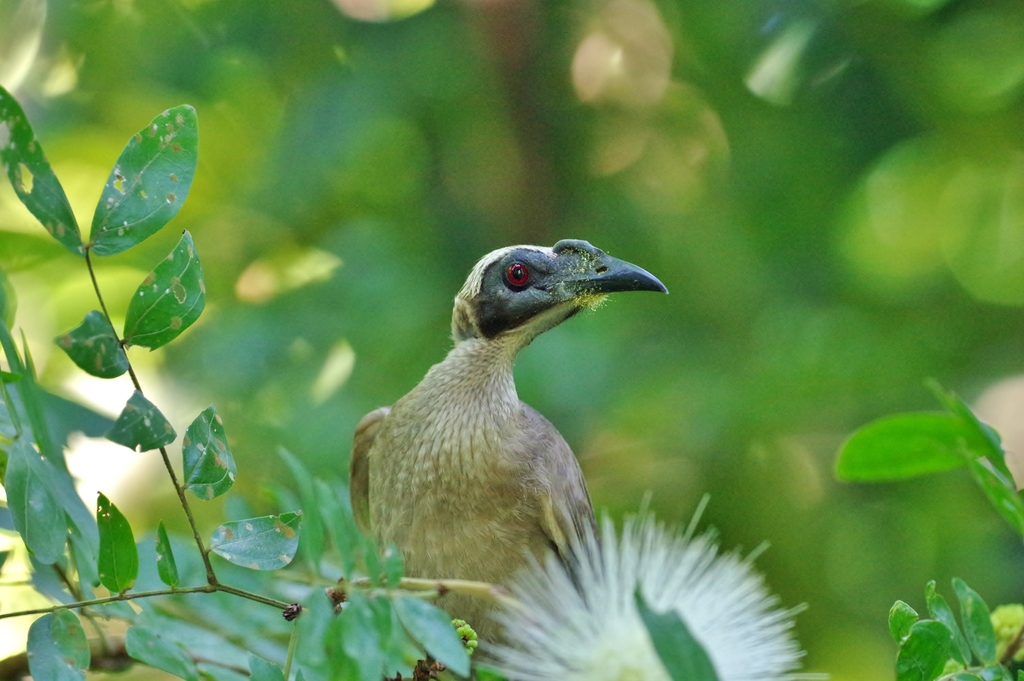
Helmeted Friarbird
Photo © Thibaud Aronson
Photo © Thibaud Aronson — CC BY-SA 4.0 — Source: iNaturalist photo #44320707Identification
The helmeted friarbird is a robust honeyeater measuring 32–36 cm in length, with males averaging around 38 cm and weighing 127–179 g, while females are notably smaller at 92–112 g. The species is characterized by its dark gray face, striking red eyes, and gray-brown upperparts that fade to white on the chest. The spotted underparts gradually darken toward the feet, creating a distinctive graduated appearance. Its common name "leatherhead" reflects the bird's bare, helmet-like facial skin. Ten subspecies are recognized across its range, with notable variation in size and plumage.
Range & Habitat
The helmeted friarbird occurs across Indonesia and northern Australia, with subspecies distributed from the Lesser Sunda Islands (Lombok to Wetar) and New Guinea, including the Aru Islands, D'Entrecasteaux Archipelago, and Louisiade Archipelago, to the Northern Territory and northeastern Australia. The species inhabits subtropical and tropical dry forests, lowland forests, and mangrove forests. It typically nests high in trees close to water bodies, constructing sturdy nests from bark, leaves, stems, sticks, and grass.
Behaviour & Diet
The helmeted friarbird is highly vocal, producing loud, distinctive calls that carry considerable distances. Its repertoire includes loud squawks sounding like "keeyo-keoway" or "kowee ko keeyo," repeated up to a dozen times, and a frequent "kurr-rk" call repeated eight to ten times. The bird is most vocal in early morning and during storms. It feeds primarily on nectar, fruits, and seeds, with occasional invertebrates and rare lizards supplementing its diet. Birds regularly congregate in feeding parties of 10–30 around flowering trees and shrubs.
Best Time & Places to See It
The helmeted friarbird breeds predominantly from September to February, with occasional breeding in February–May and October–December. The species is most abundant along the coasts of Indonesia and Australia's Northern Territory. Look for feeding flocks around flowering vegetation, particularly in mangrove and lowland forest habitats. Morning hours offer the best chance to locate birds through their loud vocalizations.
Photography Tips
Photograph this species in early morning when vocal activity peaks and light is favorable. The bird's distinctive dark facial pattern and red eyes are key identifying features worth capturing. Frame feeding birds against flowering trees and shrubs to document natural behavior. The contrast between the gray face and gray-brown plumage photographs well in soft light. Be patient when waiting for birds to visit flowering trees, as feeding flocks can remain concentrated in a single area for extended periods.
Annan River (Yuku Baja-Muliku) National Park
Daintree National Park
Endeavour River National Park
Girringun National Park
Kakadu National Park
Komodo National Park
Litchfield National Park
Mutis Timau National Park
Nitmiluk National Park
Nothing matches these filters.
No community photos yet. Log in to add the first one.
No community observations of this species yet.