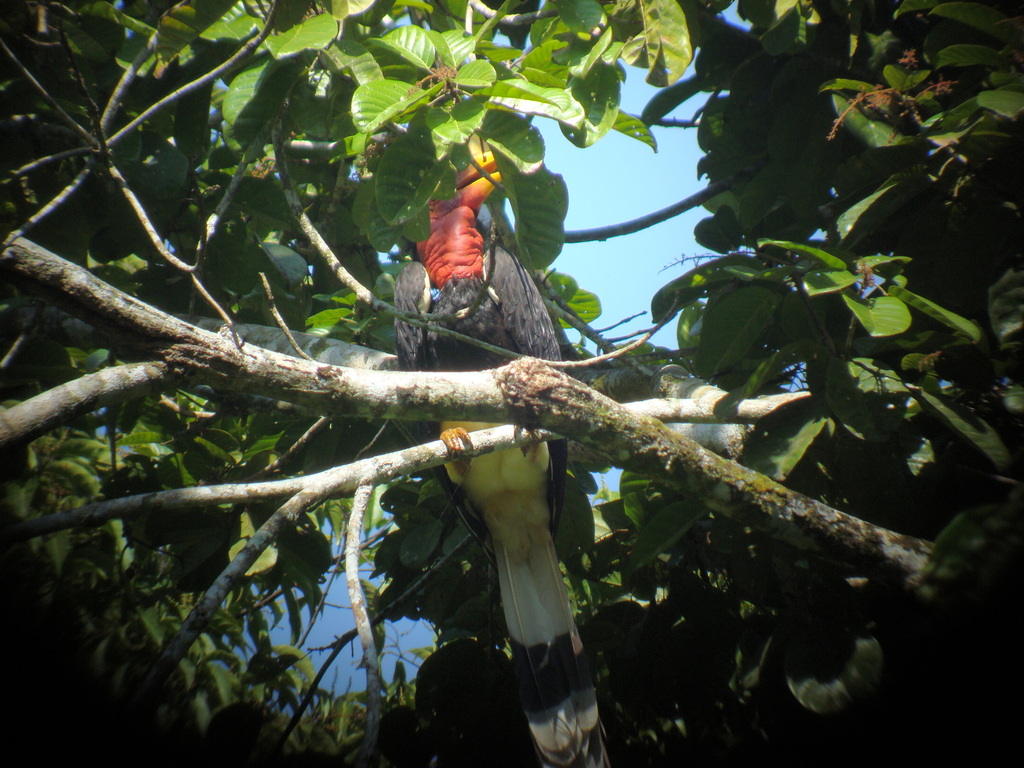
Helmeted Hornbill
Photo © James Eaton
Photo © James Eaton — CC0 1.0 — Source: iNaturalist #199168279Identification
The helmeted hornbill is a very large bird with mostly blackish plumage, distinguished by its white belly, legs, and tail (which features a black band near the tip of each feather). Its most striking feature is the massive, helmet-like casque atop its head—a solid, bony structure that is unique among hornbills and accounts for approximately 11% of the bird's 3 kg weight. The casque and bill are yellow, often covered with red secretion from the preen gland on the top and sides, though the front of the casque frequently remains bright yellow. Males display a distinctive bare, wrinkled red throat patch, while females have a pale blue to greenish one.
At 110–120 cm in body length plus an additional 50 cm of tail feathers, the helmeted hornbill is longer than any other hornbill species, though its body weight is similar to the great hornbill. The two central tail feathers are notably elongated, contributing to its impressive overall length. Males typically weigh around 3.1 kg, while females average about 2.7 kg.
Range & Habitat
The helmeted hornbill inhabits the Malay Peninsula, Sumatra, Borneo, Thailand, and Myanmar. This species is restricted to forested regions where fig trees flourish, as these fruit-bearing trees form the core of its diet. The bird's dependence on primary and mature secondary forests makes it particularly sensitive to habitat loss and deforestation.
Behaviour & Diet
Helmeted hornbills are primarily frugivorous, feeding mainly on the fruit of strangler figs. They are believed to be territorial and monogamous, though their social behaviour remains poorly understood. The species is famous for its distinctive two-part call: a series of loud, intermittent hoots resembling the sound of an axe striking wood—earning it the Malay name "Tebang Mentua" (Kill your mother-in-law bird)—which gradually accelerates into a cackling sound reminiscent of laughter. These vocalizations, audible from 2–3 km away and lasting for minutes, convey information about the caller's age, size, and fitness to other birds.
Males engage in spectacular aerial jousting, ramming each other with their solid casques while fighting over territory. Females accompany males during these aerial contests but veer off in opposite directions as the males collide. The birds breed once yearly, raising a single chick in a sealed tree cavity for the first five months of the chick's life. Their specialized nesting behaviour makes them extremely vulnerable to poaching and habitat destruction.
Best Time & Places to See It
Helmeted hornbills are most easily located by their unmistakable calls, which carry across great distances through forested landscapes. Your best opportunities lie in remaining primary and mature secondary forests across Borneo, Sumatra, Thailand, and Myanmar. However, populations are now critically endangered, with fewer than 100 birds remaining in Thai forests. Patience and knowledge of fig tree fruiting seasons will improve your chances of encountering this spectacular but increasingly elusive bird.
Photography Tips
The helmeted hornbill's impressive size, striking casque, and long tail feathers make it a stunning photographic subject. Early morning hours often coincide with increased calling activity, which can help you locate birds. Position yourself near fig trees during fruiting season, as hornbills return predictably to food sources. The bird's predominantly dark plumage contrasts dramatically with its white belly and tail, so pay attention to lighting to capture the details of the yellow and red casque. Given the species' critical rarity and vulnerability, photograph responsibly without disturbing the bird or using intrusive methods to locate it.
No community photos yet. Log in to add the first one.
No community observations of this species yet.