Herero Chat
Photo © scaup
Photo © scaup — CC BY 4.0 — Source: iNaturalist #199515714Identification
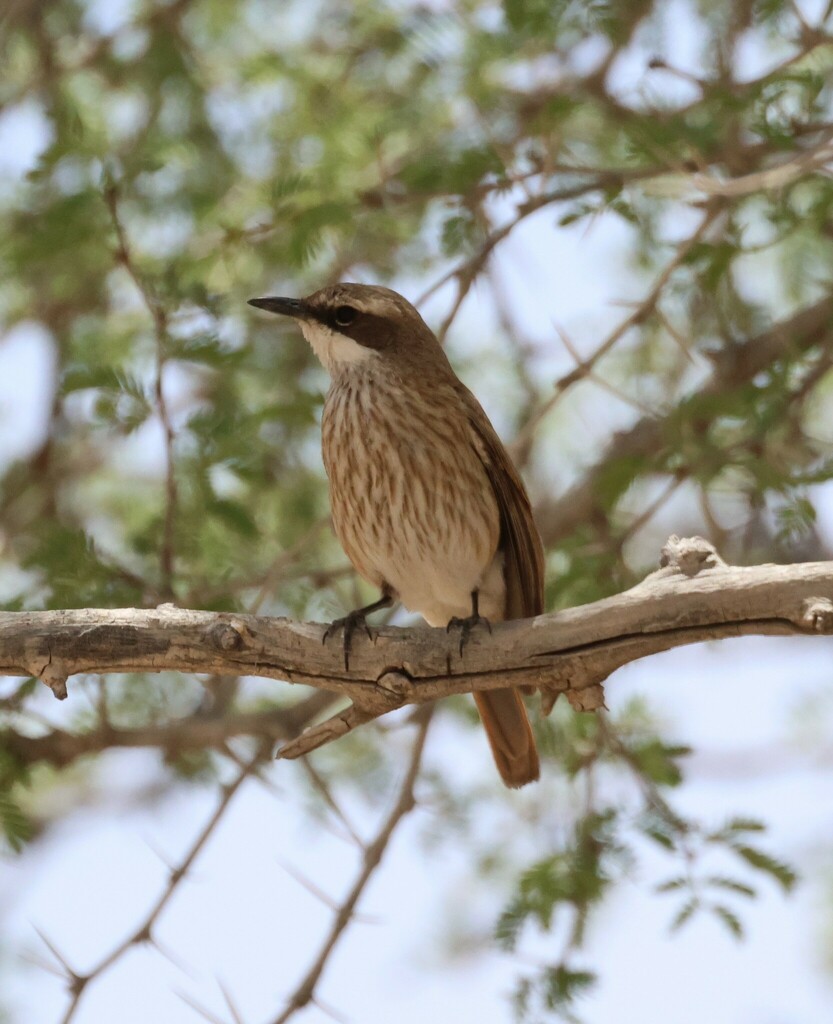
The Herero chat is a compact passerine measuring 17 cm in length. Adults are distinctive and relatively easy to identify in the field. They display a striking blackish mask reminiscent of a shrike, contrasting sharply with a wide white supercilium and white throat. The upperparts are brown, becoming warmer and more rufous on the rump and tail, though the central tail feathers remain blackish-brown. The underparts are whitish, sometimes washed with brown and marked with faint dark streaks. This combination of facial markings and coloration makes it stand out among other small passerines in its range.
Range & Habitat
This species has a restricted range in southwestern Africa, occurring from far southwestern Angola through western Namibia south to the Naukluft Mountains. The Herero chat is locally common in Namibian savanna woodlands, showing a strong preference for inselbergs and escarpments where scattered Acacia, Maerua shrubs, Commiphora, and Terminalia trees grow. It particularly favours areas where vegetation follows drainage lines, making these riparian corridors and rocky outcrops prime locations for finding this species.
Behaviour & Diet
The Herero chat is primarily insectivorous, with ants and termites forming the bulk of its diet, supplemented by grasshoppers, crickets, beetles, and spiders. It forages using several techniques: typically pouncing on prey from shady perches, occasionally hawking insects in flight, and searching the ground at the bases of trees and bushes, sometimes excavating the soil to expose prey items. The species also supplements its diet with berries from Commiphora saxicola and seeds.
Both sexes participate in nest construction, which takes approximately 3 to 4 days. They build an open cup nest by placing grass leaves into tree cracks or forks, then adding rootlets, thin bark strips, and plant fibres before moulding the structure with their bodies. Eggs are typically laid in February and March, coinciding with rainfall. Clutches comprise 2 to 3 eggs, with the female handling most incubation duties over approximately 16 days. Both parents feed the chicks, which fledge in 12 to 16 days. Juveniles remain dependent on adults for 3 to 5 months after fledging.
Best Time & Places to See It
Breeding season from February through March offers the best opportunity to locate this species, when birds are active with nest-building and chick-rearing. Focus your search on inselbergs and escarpments in western Namibia, particularly areas with scattered acacia woodland and rocky outcrops. The vicinity of drainage lines and riparian vegetation increases your chances of encountering this locally common species. Early morning hours are typically most productive for bird watching.
Photography Tips
The Herero chat's striking facial pattern and contrasting plumage make it a rewarding photographic subject. The bold white supercilium and blackish mask are key features to capture clearly. Position yourself to photograph birds against a clean background, as this will emphasise the diagnostic facial markings. Birds foraging on the ground or perched on low branches offer excellent opportunities; patience near rocky outcrops and scattered trees will reward you with close encounters. The warm rufous tones on the rump and tail are particularly striking in side-on views during good light conditions.
Nothing matches these filters.
No community photos yet. Log in to add the first one.
No community observations of this species yet.