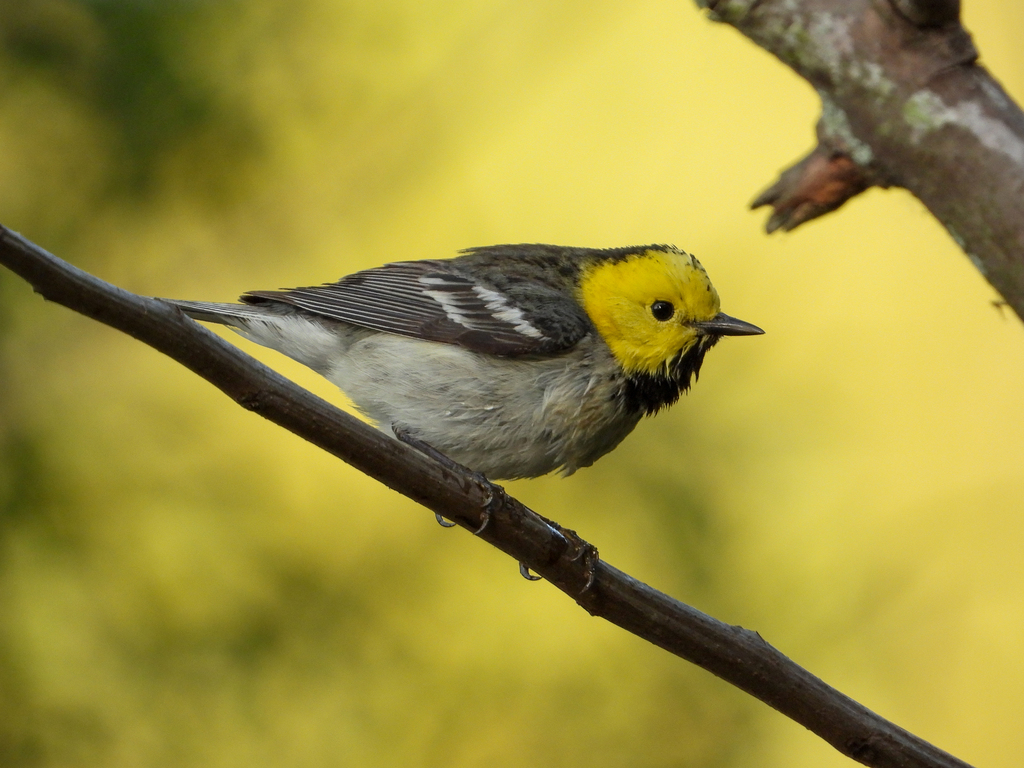
Hermit Warbler
Photo © James M. Maley
Photo © James M. Maley — CC BY 4.0 — Source: iNaturalist photo #129685437Identification
The hermit warbler is a small perching bird measuring 5.5 inches (14 cm) in length with a wingspan of 7.9 inches (20 cm) and weighing between 0.3 to 0.5 oz (8.5 to 14.2 g). It is characterized by dark gray upperparts contrasting with white underparts, black streaking on the flanks, and two diagonal white wing bars. The majority of the head is bright yellow. Males display a distinctive dark black throat patch, while females have considerably less black on their throat bib, and immature birds lack black throat markings entirely.
Range & Habitat
This migratory warbler breeds across the majority of the west coast of the United States, with range extending to Washington. Hermit warblers are common but remarkably shy inhabitants of open coniferous forests, particularly Douglas fir, pine, and redwood stands, as well as various mountain habitats and wetter areas used for nesting. During winter, they migrate to parts of Mexico and Central America, extending as far south as Panama, with some individuals wintering along the southern California coast. During migration, they utilize a broader range of habitats including deciduous forests, water-lined wooded areas, desert oases, and suburban zones.
Behaviour & Diet
Like most warblers, hermit warblers maintain a strict insectivorous diet, feeding on insects and spiders. They employ a characteristic foraging technique, often hanging upside-down from the ends of conifer branches in the manner of chickadees while probing for food. Nesting birds construct neat, cup-shaped nests from stems, grass, twigs, and pine needles, positioning them near the tip of branches high in conifer trees. Females typically lay between three and five white eggs heavily spotted with brown and lilac speckles, though other incubation habits remain poorly documented.
Best Time & Places to See It
Hermit warblers are best observed during breeding season in tall coniferous forests along the west coast of the United States, particularly in areas dominated by Douglas fir, pine, and redwood. Their shy nature makes them challenging to locate despite being relatively common. Birdwatchers should focus on coniferous forest canopies, especially near the tips of branches where they forage. During migration periods, search wooded waterside areas, desert oases, and suburban habitats where they become more dispersed and may be encountered in mixed deciduous and coniferous forest types.
Photography Tips
Photographing hermit warblers requires patience and attention to their preferred microhabitat—the outer reaches of conifer branches where they probe for food. Position yourself to backlight the yellow head to emphasize this key field mark, and watch for their characteristic upside-down foraging posture. Early morning light in coniferous forests will best reveal the yellow head and black throat of males, the diagnostic white wing bars, and streaked flanks. Their shy behavior demands a calm approach; silence and stillness increase your chances of capturing clear images before they disappear into the dense canopy.
Arenal Volcano National Park
Baru Volcano National Park
Big Bend National Park
Bosque del Apache National Wildlife Refuge
Braulio Carrillo National Park
Bryce Canyon National Park
Cabeza Prieta National Wildlife Refuge
Caño Negro National Wildlife Refuge
Carlsbad Caverns National Park
Nothing matches these filters.
No community photos yet. Log in to add the first one.
No community observations of this species yet.