Highland Guan
Photo © jmmaes
Photo © jmmaes — CC BY-SA 4.0 — Source: iNaturalist #5378694Identification
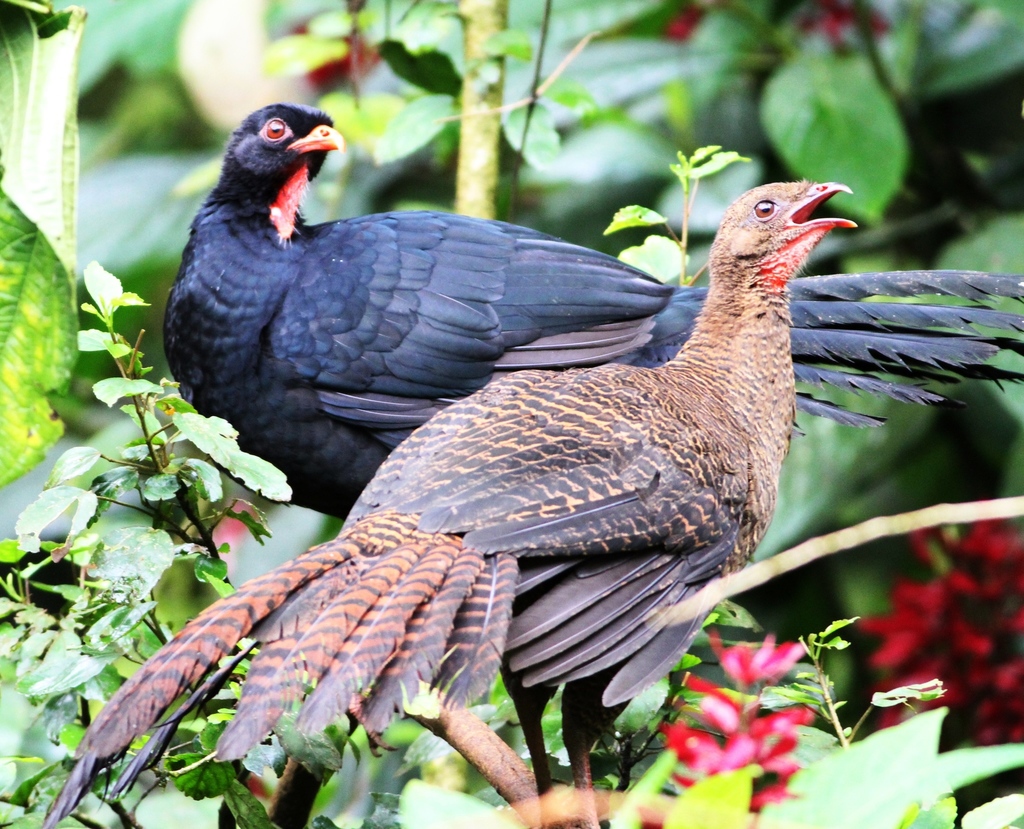
The highland guan is a medium-sized bird measuring 23 to 26 inches in length, belonging to the family Cracidae. Sexual dimorphism is pronounced in this species. Males are predominantly black with glossy green or blue iridescence on the upper parts, while the underparts are duller black. They feature distinctive reddish-brown to purplish bare skin around and behind the eye, reddish-orange beaks, throat skin, and legs, plus a prominent reddish-orange wattle. Females are notably different, displaying black plumage heavily mottled and barred with reddish-brown and cinnamon coloration. Both sexes have distinctive facial features, though females show red bare skin around the beak and purplish skin around the eye.
Range & Habitat
The highland guan is found exclusively in the highlands of Central America, distributed across southern Mexico, Guatemala, Honduras, El Salvador, and Nicaragua, occurring on either side of the mountain ranges in this region. Populations are unevenly distributed: the species is uncommon in Mexico but present in moderate numbers in the El Triunfo Biosphere Reserve, common in some Guatemalan localities, and considerably rarer in Honduras, north-central Nicaragua, and El Salvador, with possible extinction in El Salvador.
This species inhabits humid broad-leaved montane forests, with a strong preference for cloud forests and pine-oak forests at higher elevations. It has also adapted to secondary forests and plantations within its range. The bird forages for fruit both in the canopy and among leaf litter on the forest floor.
Behaviour & Diet
The highland guan is primarily frugivorous, spending much of its time foraging for fruit in trees and on the leaf litter of its forest habitat. Little detailed information about other aspects of its behaviour is provided in current literature, though as a member of the Cracidae family, it likely shares characteristics common to guans, including arboreal habits and preference for montane forest conditions.
Best Time & Places to See It
The El Triunfo Biosphere Reserve in Mexico represents one of the most reliable locations for encountering this species, where it occurs in moderate numbers. Certain localities in Guatemala also offer good opportunities, while sightings in Honduras, Nicaragua, and El Salvador are considerably less predictable due to declining populations. The bird's preference for humid montane forests means that visits during the wet season may prove more productive, as fruit availability typically peaks during these periods.
Photography Tips
Photographing the highland guan presents challenges typical of forest birds. The species' preference for dense montane forest and canopy foraging means patience and early morning sessions are essential. The striking sexual dimorphism offers varied photographic subjects—males provide high-contrast images with their glossy black plumage, while females present more complex patterns. The bird's reddish facial features and wattle are particularly photogenic details. A telephoto lens (at least 300–400mm) is recommended given the species' tendency to remain in the upper canopy and its wariness in areas where it faces hunting pressure.
No community photos yet. Log in to add the first one.
No community observations of this species yet.