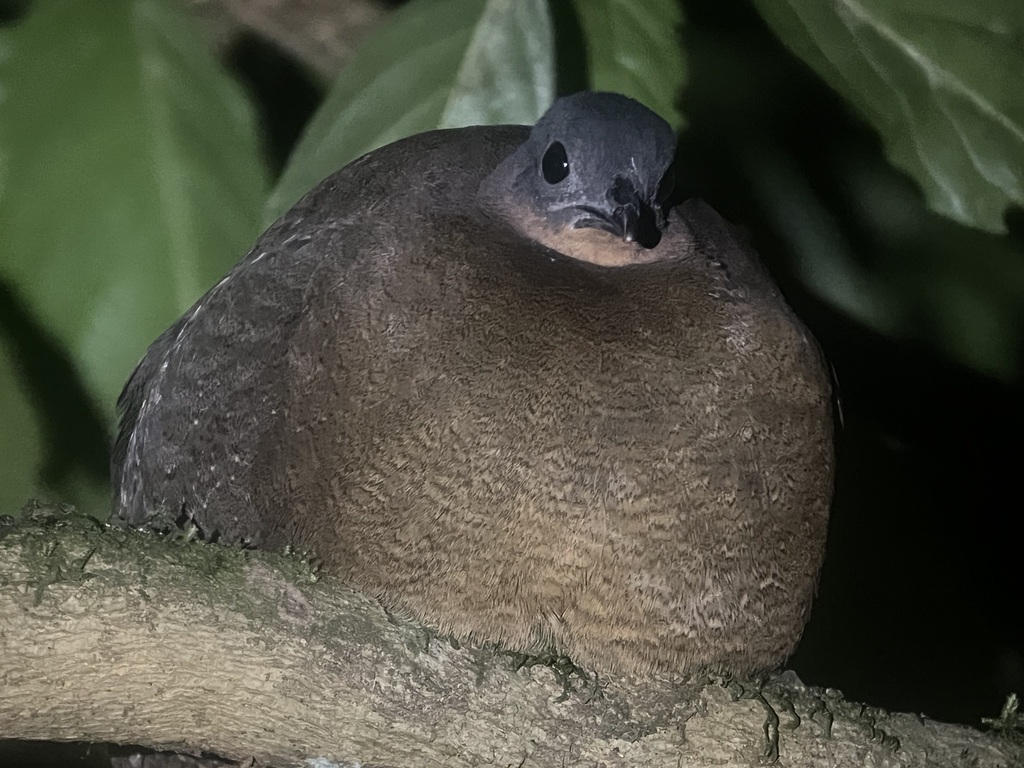
Highland Tinamou
Photo © Roger A. Morales-Flores
Photo © Roger A. Morales-Flores — CC BY 4.0 — Source: iNaturalist #315574695Identification
The highland tinamou is a compact ground bird averaging 38.5 cm (15.2 in) in length and weighing approximately 925 g (2.039 lb). Its plumage is distinctively mottled or barred with black and cinnamon across the back and wings, with a characteristic rufous throat. As a member of the tinamou family, it is a ratite—part of an ancient lineage of birds—yet unlike its flightless relatives, it retains the ability to fly, though it is not considered a strong flier.
Range & Habitat
The highland tinamou is found exclusively in the montane regions of northwestern South America and Central America, with its range spanning the Andes of Colombia, eastern Ecuador, and far northern Peru, as well as western Venezuela and the highlands of Costa Rica and western Panama. The species occurs across an area of approximately 140,000 km² (54,000 sq mi).
This bird frequents montane forest above 1,500 m (4,900 ft) altitude, showing a strong preference for damp areas with dense vegetation. It is particularly fond of bamboo thickets and ravines, where the cool, moist conditions of mountain cloud forests provide ideal cover and feeding grounds.
Behaviour & Diet
The highland tinamou is a shy, elusive bird, typically encountered alone or in small groups of up to five individuals. It forages on the ground or from low-hanging vegetation, feeding primarily on fruit supplemented with insects. The male produces a distinctive repetitive loud and hollow call during breeding season.
Breeding behaviour is unusual and polygamous: males incubate clutches of 4–12 eggs that may be laid by multiple females. After hatching, males continue to be the primary caregiver, tending to the chicks until they are independent. This reversed parental-care system is characteristic of tinamous.
Best Time & Places to See It
The highland tinamou is present year-round throughout its range, though breeding season may offer increased vocal activity and better opportunities for observation. Travellers should focus on montane forests in cloud-forest zones, particularly areas with dense bamboo understory and ravines where moisture concentrates. The most accessible populations for nature tourists are found in the highlands of Costa Rica and western Panama, though dedicated birders may venture into the Colombian and Ecuadorian Andes for less-disturbed populations.
Photography Tips
Photographing the highland tinamou presents considerable challenges due to its shy, secretive nature and preference for dense, shadowed forest habitat. Early morning is often productive, when males may call. Patience and a willingness to sit quietly near suitable habitat—particularly bamboo thickets—increases chances of encounter. A telephoto lens (at least 400–600 mm) is essential, as the bird typically keeps its distance. The mottled plumage blends remarkably well with forest floor debris, so scan carefully and look for movement rather than silhouette.
Arenal Volcano National Park
Peñas Blancas, Costa Rica
+551 birds+21 mammals
Straddling the border between Alajuela and Guanacaste in northwestern Costa Rica, this national park rises dramatically around one of Central America's most active volcanic systems. The…
VIEW NATIONAL PARKChirripó National Park
Rivas, Costa Rica
+274 birds+6 mammals
Where the volcanic spine of Costa Rica's Central Cordillera reaches its apex, Chirripó National Park encompasses a landscape that shifts dramatically with elevation, from montane cloud…
VIEW NATIONAL PARKBraulio Carrillo National Park
Las Horquetas, Costa Rica
+547 birds+18 mammals
Where the Caribbean slope descends from the central volcanic cordillera toward the humid lowlands of Heredia, Braulio Carrillo National Park preserves one of Costa Rica's most…
VIEW NATIONAL PARKVolcán Poás National Park
Toro Amarillo, Costa Rica
+237 birds+4 mammals
Where volcanic slopes rise sharply from the Central Valley floor, Volcán Poás National Park protects one of Costa Rica's most active and accessible volcanic systems. The…
VIEW NATIONAL PARKNatural Serranía de los Yariguíes National Park
El Carmen de Chucurí, Colombia
+320 birds+3 mammals
Where the northern cordilleras of Colombia rise toward cloud forest, the Serranía de los Yariguíes unfolds across nearly 1,820 square kilometers of some of the most…
VIEW NATIONAL PARKNatural Farallones de Cali National Park
Buenaventura, Colombia
+733 birds+27 mammals
Where the Pacific coastal plain meets the western slopes of the Andes, Farallones de Cali National Park sprawls across nearly 3,500 square kilometers of dramatic topography…
VIEW NATIONAL PARKNatural Chingaza National Park
Junín, Colombia
+285 birds+6 mammals
Where the Andes rise above three thousand metres in the Cundinamarca region, high-altitude grasslands and cloud forests converge in a landscape shaped by both geology and…
VIEW NATIONAL PARKNatural el Cocuy National Park
Güicán, Colombia
+313 birds+3 mammals
Where the Andes rise to their highest peaks in Colombia's eastern cordillera, El Cocuy National Park sprawls across more than 6,600 square kilometers of some of…
VIEW NATIONAL PARKGuácharos Cave National Natural Park
Acevedo, Colombia
+359 birds
High in the Andean foothills of southern Huila, where mist-laden slopes rise above 1,600 metres, lies a landscape carved by underground rivers and crowned by karst…
VIEW NATIONAL PARKNatural Sumapaz National Park
Cubarral, Colombia
+368 birds+1 mammals
Where the Andes descend toward the Amazon basin, the high páramo grasslands of Sumapaz National Park sprawl across more than five thousand square kilometers of Meta…
VIEW NATIONAL PARKEl Tamá National Park
Toledo, Colombia
+435 birds
Where the Andes descend toward the Caribbean coastal lowlands of northern Colombia, El Tamá National Park sprawls across nearly 3,800 square kilometres of montane forest, cloud…
VIEW NATIONAL PARKBaru Volcano National Park
Cerro Punta, Panama
+402 birds+6 mammals
Where the land rises sharply toward the Caribbean's western spine, Baru Volcano National Park sprawls across roughly 220 square kilometres of southwestern Panama, anchored by the…
VIEW NATIONAL PARKParque Internacional la Amistad
Teribe, Panama
+325 birds+11 mammals
Where the continental divide rises between the Caribbean and Pacific watersheds, a wilderness of extraordinary biological richness unfolds across the Talamanca Range and into lowland rainforest—a…
VIEW NATIONAL PARKLos Quetzales National Park
Copey, Costa Rica
+232 birds+3 mammals
Cloud forest sweeps across the upper slopes of the Central Valley watershed, where elevation and persistent moisture forge an ecosystem unlike any other in Costa Rica.…
VIEW NATIONAL PARKTapantí Macizo de la Muerte National Park
Orosi, Costa Rica
+503 birds+18 mammals
Where montane cloud forest rises steeply from the Orosi Valley, Tapantí Macizo de la Muerte National Park enfolds a landscape of perpetual moisture and emerald complexity.…
VIEW NATIONAL PARKLa Amistad International Park
Crorina, Costa Rica
+532 birds+20 mammals
Where the Caribbean slopes of Costa Rica's Talamanca Mountains rise steeply inland from Limón, the boundary between two nations dissolves into an unbroken expanse of rainforest.…
VIEW NATIONAL PARKNo community photos yet. Log in to add the first one.
No community observations of this species yet.