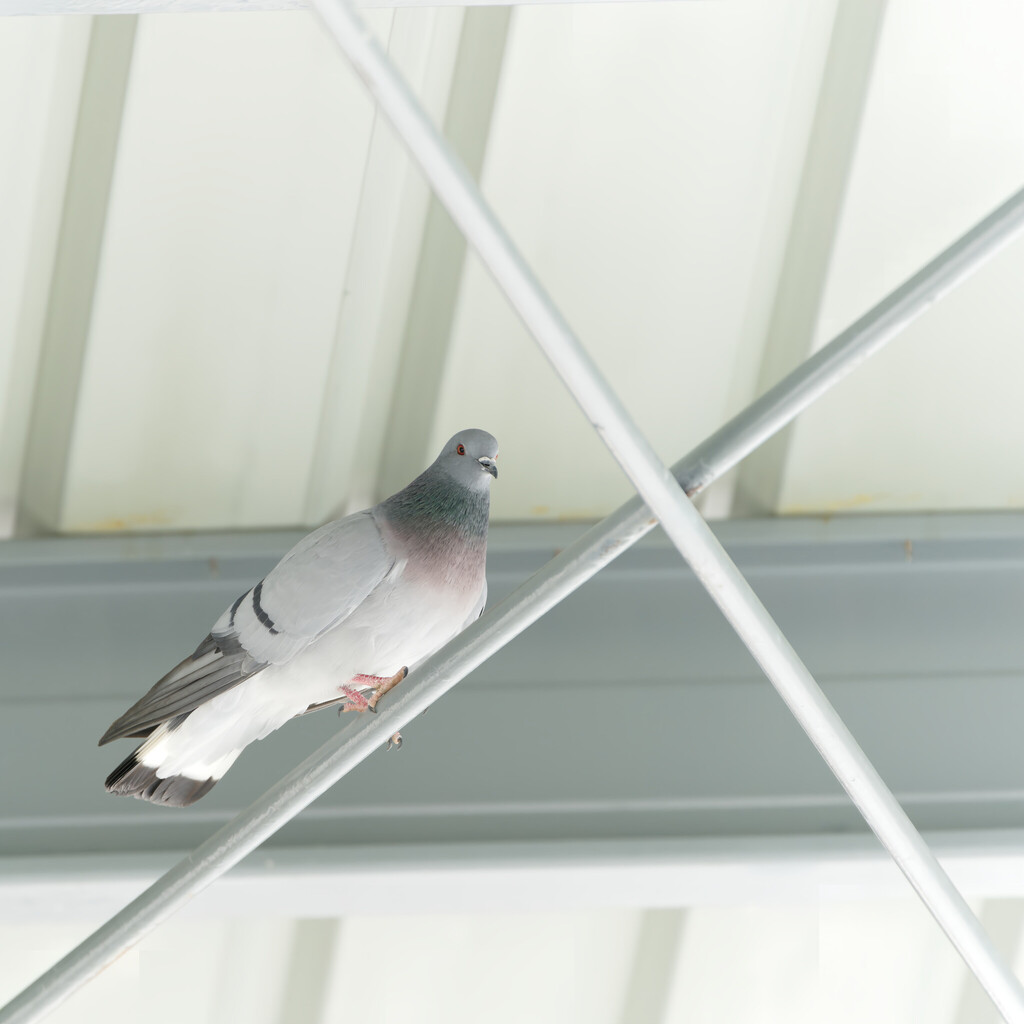
Hill Pigeon
Photo © Jiao Sun (孙娇)
Photo © Jiao Sun (孙娇) — CC BY 4.0 — Source: iNaturalist #331457449Identification
The hill pigeon is a stout-bodied pigeon closely resembling the rock dove in size and overall appearance, but with distinctive field marks that set it apart. The most striking feature is its tail pattern: a broad white band crosses the otherwise black tail, creating a striking contrast visible both perched and in flight. Additional distinguishing features include a paler mantle and upper wings compared to the rock dove, and a white patch on the back. In flight, the tail pattern bears similarity to the snow pigeon, though the hill pigeon lacks the strong head and neck contrast characteristic of that species.
Range & Habitat
The hill pigeon is found across a broad swathe of high-altitude Asia, distributed through China, Pakistan, India, Nepal, Kazakhstan, North Korea, South Korea, Mongolia, Russia, Tajikistan, Afghanistan, and Turkmenistan. In Pakistan, its range is comparatively restricted to the furthest northern inner valleys of the Karakoram, Hindu Kush, and Pamirs, including northern Chitral, the valleys of Gilgit in Yasin and Hunza, and the Karakoram ranges in Baltistan.
This species frequents open rugged country at elevations between 1,500 and 6,100 metres above sea level, with altitudinal movements driven by season—wintering as low as 2,000 metres in Pakistan but ascending to 5,500 metres or higher during summer months. Though the overall population is decreasing, the bird remains widely distributed and abundant across its range, classified as least concern by the IUCN.
Behaviour & Diet
Hill pigeons are highly gregarious throughout the year, feeding in flocks in terraced cultivated fields and often mixing with rock dove flocks. Remarkably tame birds, they are commonly found near human settlements, camps, and pilgrimage routes. Males perform bowing displays similar to rock doves, with courtship behaviour paralleling that species. These pigeons nest in dense colonies on cliffs, gorges, and rocky outcrops, though in Tibet they frequently nest in houses—both occupied and abandoned—or in wall holes, constructing simple twig or plant-stem platforms on which they typically lay two eggs.
Like rock doves, hill pigeons are primarily granivorous, supplementing their diet with green shoots, leaves, and occasionally small mollusks such as snails. They display remarkable opportunism, feeding on leftover human food, partially digested material from kiang (wild ass) dung, and even undigested food from kiang carcasses opened by predators. Nesting can begin as early as February in Tajikistan, with young from later broods fledging as late as September in northeastern Tibet. They typically raise two broods annually.
Best Time & Places to See It
The hill pigeon is best sought in the high mountain valleys of the Karakoram, Hindu Kush, and Pamirs, particularly in northern Pakistan's Chitral, Gilgit, and Baltistan regions. The species is most reliably found in open rugged terrain near human habitation, making areas around settlements, camps, and pilgrimage routes productive. Seasonal altitudinal movements mean that lower elevations are occupied in winter months while higher elevations host birds during summer. The long breeding season extending from February through September offers extended opportunities for observation.
Photography Tips
The hill pigeon's distinctive white tail-band is the key diagnostic feature to capture, and this is best recorded in flight shots where the tail pattern is most clearly visible. The white back patch is another important identifying mark to document. Position yourself near cultivated terraces or cliff faces where flocks gather to feed or nest. Early morning light will best showcase the paler mantle and upper wing coloration that distinguishes this species from rock doves. Since these birds are notably tame around human settlements and pilgrimage routes, patient stalking near such areas offers excellent opportunities for close approach and detailed photography without excessive disturbance.
Langtang National Park
Helambu, Nepal
+364 birds+14 mammals
Where the southern slopes of the Himalayan highlands descend toward the subtropical valleys of central Nepal, Langtang National Park sprawls across one of the subcontinent's most…
VIEW NATIONAL PARKSagarmatha National Park
Khumjung, Nepal
+219 birds+7 mammals
Soaring peaks and deep glacial valleys define this alpine wilderness in northeastern Nepal, where the terrain rises from forested foothills into a realm of high-altitude tundra…
VIEW NATIONAL PARKKhangchendzonga National Park
Sakkyong, India
+290 birds+1 mammals
Where the eastern Himalayas surge toward their crowning peaks, Khangchendzonga National Park embraces a landscape of almost overwhelming vertical drama. Rising from subtropical river valleys into…
VIEW NATIONAL PARKBaikal National Park
Ольхонский район, Russia
+184 birds+11 mammals
Where the world's deepest freshwater lake meets ancient Siberian taiga, Baikal National Park sprawls across 66,203 square kilometers of one of Earth's most singular ecosystems. The…
VIEW NATIONAL PARKTransbaikal National Park
Barguzinsky Rayon, Russia
+83 birds+7 mammals
Where the eastern shore of Lake Baikal meets the Barguzinsky Range, a vast wilderness of boreal forest, alpine tundra, and rocky shoreline unfolds across more than…
VIEW NATIONAL PARKGiant Panda National Park
Mianyang, China
+447 birds+47 mammals
Where the eastern slopes of China's Sichuan plateau descend into cloud-wrapped valleys, one of Asia's most biodiverse landscapes unfolds across more than 350,000 square kilometres. This…
VIEW NATIONAL PARKJiuzhai Valley
Jiuzhaigou County, China
+226 birds+7 mammals
Where crystalline alpine streams cascade through limestone gorges and karst terrain rises in dramatic vertical walls, Jiuzhai Valley unfolds across nearly 1,300 square kilometers of southwestern…
VIEW NATURAL MONUMENTHuanglong Scenic and Historic Interest Area
Ngawa Tibetan and Qiang Autonomous Prefecture, China
+194 birds+7 mammals
Across the high plateau of northwestern Sichuan, a geological wonder unfolds where limestone terraces and mineral-rich springs have sculpted one of China's most distinctive natural monuments.…
VIEW NATURAL MONUMENTHemis National Park
Raigahar Dhar, India
+131 birds+13 mammals
Where granite gorges cleave through the Himalayas at dizzying altitudes, a vast wilderness of alpine desert unfolds across the rain shadow of Ladakh. Hemis sprawls across…
VIEW NATIONAL PARKKhangai Nuruu National Park
Erdenetsogt, Mongolia
+136 birds+7 mammals
Where granite ridges pierce Mongolia's central steppe, alpine meadows give way to dense coniferous forests that climb toward windswept summits. Khangai Nuruu sweeps across 1.2 million…
VIEW NATIONAL PARKGorkhi-Terelj National Park
Ulaanbaatar, Mongolia
+137 birds+5 mammals
Where granite monoliths rise abruptly from rolling steppe grasslands, Gorkhi-Terelj National Park unfolds across the landscape north of Ulaanbaatar, a sanctuary where forest and alpine meadow…
VIEW NATIONAL PARKAltai Tavan Bogd National Park
Tsengel, Mongolia
+146 birds+3 mammals
Where the Altai Mountains rise in jagged defiance along Mongolia's western frontier, the terrain transforms into a realm of alpine tundra, rocky plateaus, and glacier-carved valleys…
VIEW NATIONAL PARKHustai National Park
Altanbulag, Mongolia
+198 birds+16 mammals
Where the steppe rolls endlessly beneath vast Mongolian skies, Hustai National Park preserves one of Central Asia's most dynamic grassland ecosystems. Rolling hills and open prairie…
VIEW NATIONAL PARKGobi Gurvan Saikhan National Park
Tsagaan Subarga Hural, Mongolia
+183 birds+23 mammals
Where rust-coloured badlands rise from the southern Gobi steppe, the terrain transforms into a landscape of geological drama that few visitors expect to find in Mongolia's…
VIEW NATIONAL PARKKhoridol Saridag National Park
Khatgal, Mongolia
+164 birds+6 mammals
Where granite peaks thrust skyward across Mongolia's remote southeastern reaches, a landscape of raw geological drama unfolds. Deep river gorges carved through ancient stone create a…
VIEW NATIONAL PARKLand of the Leopard National Park
Khasansky District, Russia
+83 birds+11 mammals
Where coniferous and mixed forests sweep across the rolling terrain of Russia's Far East, Land of the Leopard National Park embraces a landscape shaped by the…
VIEW NATIONAL PARKSanjiangyuan National Park
Nagqu, China
+187 birds+25 mammals
Where the headwaters of three great Asian rivers emerge from a high alpine plateau, the landscape unfolds in tundra and dwarf shrubland—a world of austere beauty…
VIEW NATIONAL PARKNortheast China Tiger and Leopard National Park
Mu Dan Jiang Shi, China
+202 birds+19 mammals
Across the temperate forests of northeastern China, where winters grip the landscape in subzero silence and summers remain cool and brief, the Mudanjiang region supports a…
VIEW NATIONAL PARKWolong National Nature Reserve
Wenchuan County, China
+333 birds+17 mammals
Where the Qingyi River cuts through the eastern flanks of the Minshan Range, a temperate montane forest cloaks steep valleys in dense canopy that thins dramatically…
VIEW NATURE RESERVEQiangtang National Nature Reserve
Ngari Prefecture, China
+34 birds+5 mammals
Across the high Tibetan plateau north of Nagqu sprawls one of Earth's most extreme alpine tundra ecosystems, where vast expanses of sparse grassland and barren terrain…
VIEW NATURE RESERVEQinghai Lake National Nature Reserve
Hainan Tibetan Autonomous Prefecture, China
+243 birds+11 mammals
At 3,200 metres above sea level on the Tibetan plateau, where winter temperatures plunge far below freezing and snow blankets the landscape for half the year,…
VIEW NATURE RESERVEBaima Snow Mountain National Nature Reserve
Diqing Tibetan Autonomous Prefecture, China
+204 birds+3 mammals
High-altitude ridges and steep-sided valleys define this reserve in northwestern Yunnan, where elevations surge from around 3,000 metres to peaks above 4,100 metres. The terrain supports…
VIEW NATURE RESERVENo community photos yet. Log in to add the first one.
No community observations of this species yet.