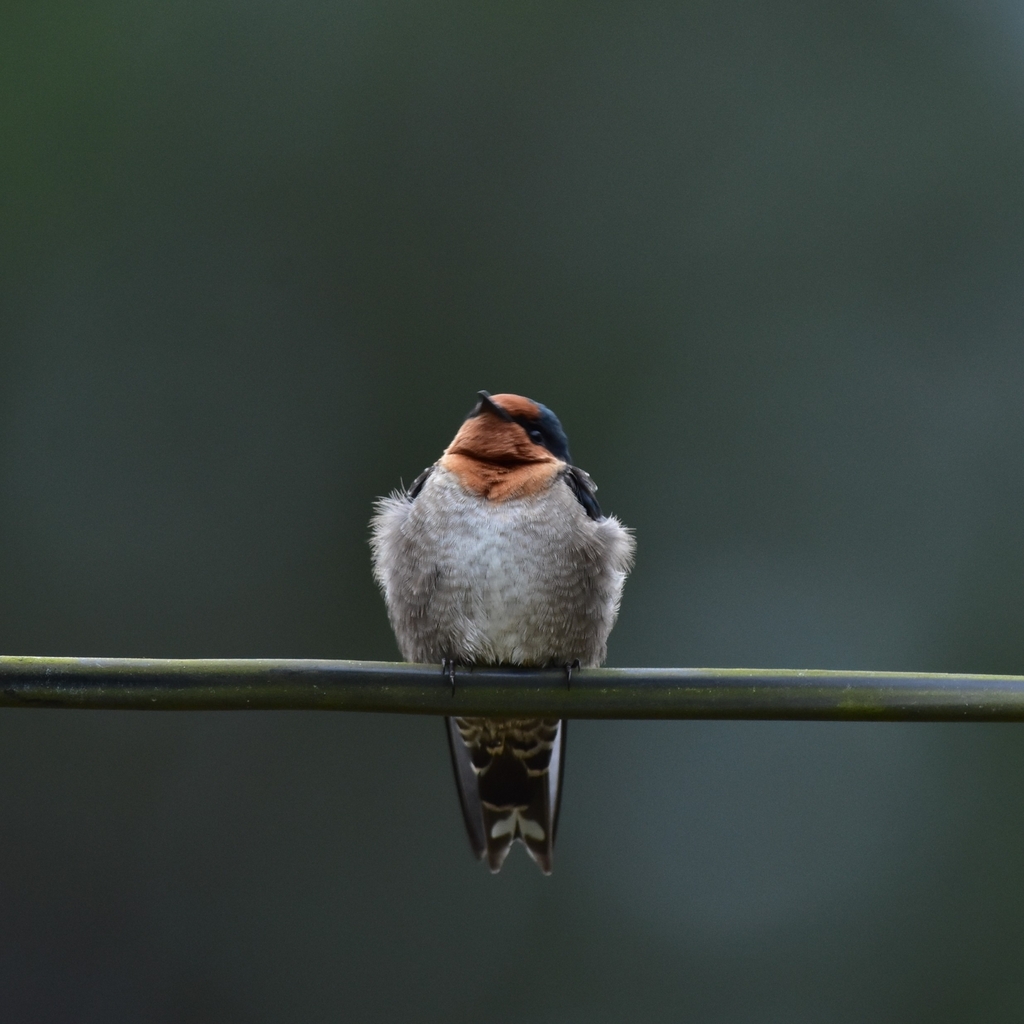
Hill Swallow
Photo © Renjith Jacob Mathews
Photo © Renjith Jacob Mathews — CC BY 4.0 — Source: iNaturalist #140676707Identification
The hill swallow is a small passerine at just 13 cm (5.1 in) in length, making it one of the more diminutive members of the swallow family. The most distinctive features are its striking red face and throat contrasting sharply with a blue back, browner wings and tail, and dusky underparts. A key identification point that separates it from similar species is its shorter, less forked tail compared to the barn swallow and the closely related welcome swallow—a useful distinction when observing birds in flight or at rest.
Range & Habitat
The hill swallow is endemic to the Indian subcontinent, with its breeding range confined to southern India and Sri Lanka. It is largely resident throughout the year, though some populations undertake local seasonal movements. Traditionally associated with coastal regions, this species has shown an interesting ecological shift in recent decades, increasingly spreading into forested uplands and expanding its habitat use beyond its historic range.
Behaviour & Diet
Like other aerial insectivores, the hill swallow is a fast and agile flyer, hunting insects—particularly flies—while airborne. This feeding strategy is characteristic of swallows and swifts, allowing them to exploit the aerial insect fauna efficiently. During the breeding season, pairs construct remarkably neat cup-shaped nests built with mud pellets collected in their beaks. These nests are typically positioned under cliff ledges or on man-made structures such as buildings, bridges, and tunnels, demonstrating the species' adaptability to human environments. The nest interior is lined with softer material for insulation, and clutches typically consist of up to four eggs.
Best Time & Places to See It
Hill swallows can be observed year-round in southern India and Sri Lanka, though local seasonal movements mean that visibility may fluctuate. Coastal areas remain reliable locations, but birdwatchers seeking this species should also explore forested uplands, where populations are increasingly established. Notable study sites include Silent Valley National Park and Muthikkulam reserve forests in Kerala, both of which have yielded detailed observations of the species' breeding ecology and behaviour.
Photography Tips
Photographing hill swallows presents both challenges and rewards. Their small size and swift, erratic flight patterns demand a fast shutter speed and good tracking ability. The striking contrast between the red face and throat and the blue back provides excellent compositional opportunities, particularly in good natural light. Look for birds perched near their nesting sites on buildings, bridges, or cliff faces, where they may pause briefly between feeding flights. Early morning and late afternoon, when insect activity peaks, are optimal times to observe and photograph these acrobatic hunters in action.
Eravikulam National Park
Devikulam, India
+192 birds+7 mammals
High in the Western Ghats of Kerala, where monsoon mists cling to slopes that rise above 2,000 metres, Eravikulam National Park preserves one of South India's…
VIEW NATIONAL PARKPeriyar National Park
Mlappara, India
+232 birds+4 mammals
Dawn breaks over mist-shrouded ridges where the Western Ghats tumble toward Kerala's spice-scented lowlands. Here, ancient tropical forests envelope a glittering artificial lake, creating a mosaic…
VIEW NATIONAL PARKPampadum Shola National Park
Vattavada, India
+258 birds+14 mammals
Where misty shola forests cling to the high plateaus of the Nilgiri Mountains, ancient evergreen remnants create a world apart. This 2,316-hectare reserve protects one of…
VIEW NATIONAL PARKNo community photos yet. Log in to add the first one.
No community observations of this species yet.