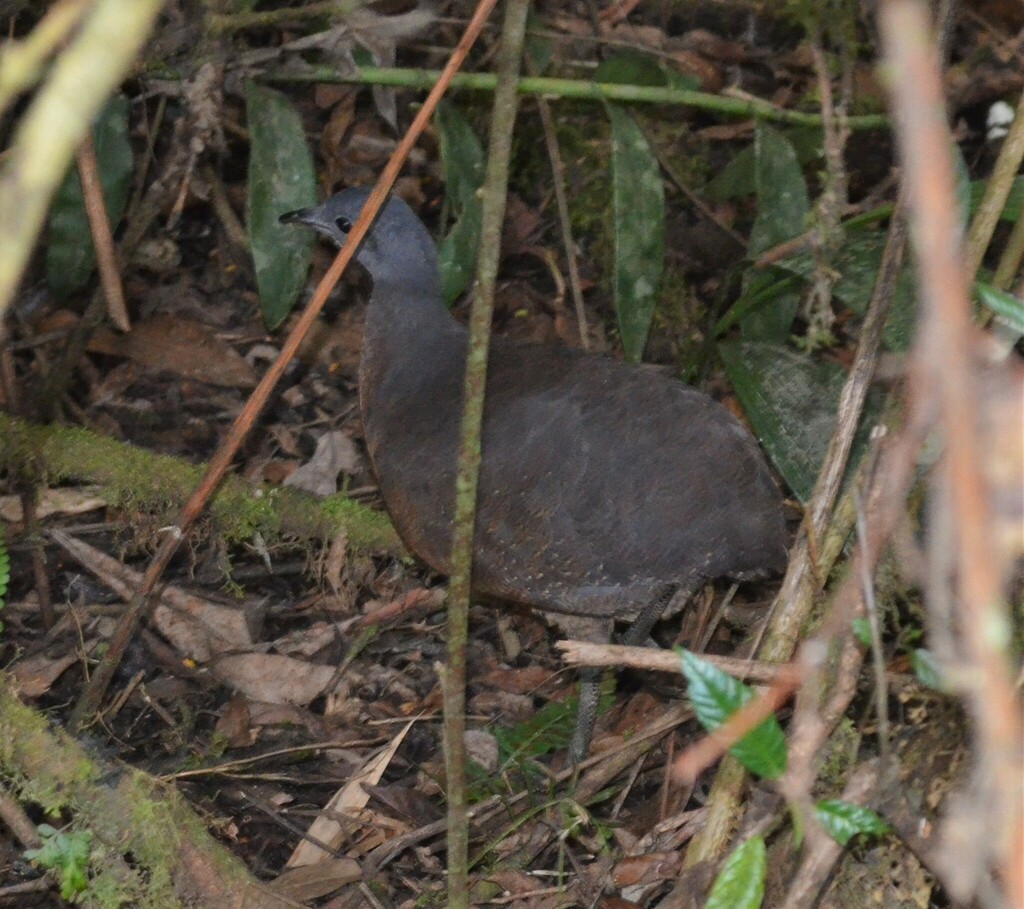
Hooded Tinamou
Photo © Zac Peterson
Photo © Zac Peterson — CC BY 4.0 — Source: iNaturalist #69110939Identification
The hooded tinamou is a compact ground-dwelling bird averaging 33 centimetres (13 inches) in length. Its plumage is light brown above, finely freckled with black markings that give it subtle, cryptic patterning well-suited to forest floors. The underparts are notably paler, adorned with dusky barring on the flanks and pale spotting on the belly, creating a streaked appearance that blends seamlessly into dappled forest shade.
Range & Habitat
The hooded tinamou is endemic to the Andes Mountains, with its range confined to Bolivia and Peru. Two subspecies are recognised: N. n. cadwaladeri inhabits the Andes of northwestern Peru, while N. n. nigrocapillus occurs in the Andes of central Peru and Bolivia. The species favours montane moist forests at elevations between 1,550 and 3,000 metres (5,090–9,840 feet), where humid forest conditions prevail year-round.
Behaviour & Diet
Like all tinamous, the hooded tinamou is primarily frugivorous, gleaning fallen fruit from the forest floor and low-lying vegetation. This foraging strategy is supplemented by small amounts of invertebrates, flower buds, tender leaves, seeds, and roots, making it an opportunistic omnivore adapted to montane forest resources. The species exhibits an unusual reproductive system wherein males are the sole care-givers, incubating eggs that may originate from up to four different females. After hatching, the male guards the chicks until they reach independence at approximately 2–3 weeks of age.
Nests are invariably positioned on the ground in dense brush or nestled between the raised root buttresses of forest trees, providing concealment from predators in the understory environment. This ground-nesting habit, combined with cryptic plumage and terrestrial habits, represents an adaptation to forest-floor life shared across the tinamou family.
Best Time & Places to See It
The hooded tinamou's restricted Andean range and preference for montane moist forests make it a speciality species for birders targeting Peru and Bolivia's highland cloud forests. The species' estimated global extent of occurrence spans approximately 35,000 square kilometres, concentrating sightings within specific montane regions. Most sightings occur in primary or mature secondary montane forest where fruiting understory vegetation is abundant. Early morning hours are typically most productive for observation, when the birds actively forage on the forest floor.
Photography Tips
Photographing the hooded tinamou presents considerable challenges owing to its cryptic colouration, preference for dense forest understory, and terrestrial habits. Success requires patience and positioning along forest trails or clearings where the bird may venture to feed. The species' light brown and black freckled plumage demands careful exposure metering to retain detail in both highlights and shadows. A telephoto lens (400–600mm equivalent) allows unobtrusive observation from distance, while attention to ground-level angles captures the bird's natural posture foraging amongst leaf litter and low vegetation. Early morning light filtering through forest canopy provides ideal conditions for revealing the subtle patterning and barring that characterises this understory specialist.
Yanachaga–chemillén National Park
Palcazu, Peru
+639 birds+6 mammals
Where the eastern slopes of Peru's central cordillera plunge into cloud forest, Yanachaga–Chemillén National Park protects nearly three thousand square kilometres of montane wilderness that few…
VIEW NATIONAL PARKManu National Park
Manu, Peru
+892 birds+26 mammals
Across the eastern slopes of the Peruvian Andes, tropical rainforest descends into the Amazon basin with a complexity that few terrestrial ecosystems match. Manu National Park…
VIEW NATIONAL PARKNo community photos yet. Log in to add the first one.
No community observations of this species yet.