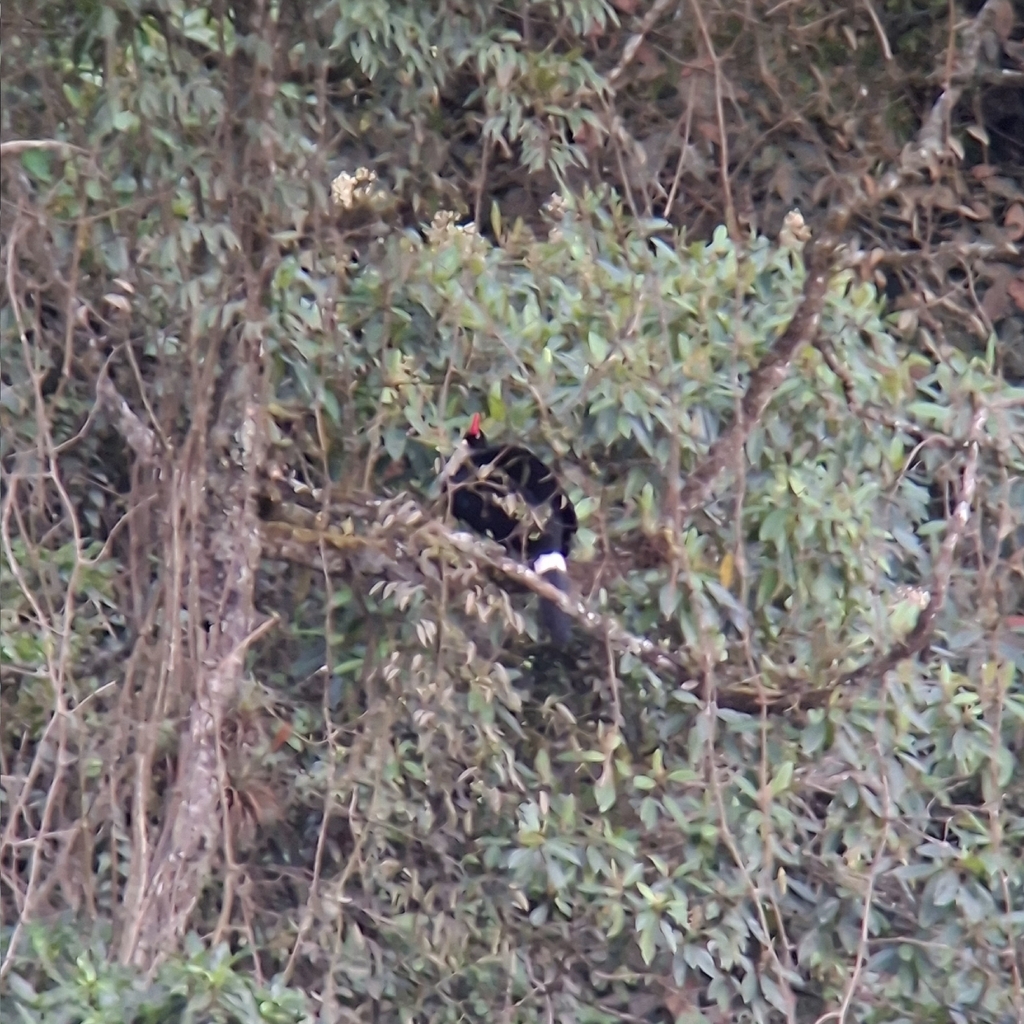
Horned Guan
Photo © Tommy Andriollo
Photo © Tommy Andriollo — CC BY 4.0 — Source: iNaturalist #331702525Identification
The horned guan is a striking and unmistakable bird, measuring 75 to 85 centimetres in length. Its most distinctive feature is the tall, red, fleshy "horn" protruding from its forehead—a unique characteristic among guans that makes this species instantly recognizable. Adults display glossy black plumage on the head, neck, and upperparts with a bluish sheen, contrasting with a black tail marked by a wide white band near its base. The throat, breast, and upper belly are whitish with black flecking, while the lower belly and flanks are brown. Look for the small red dewlap, white iris, yellow bill, and red legs and feet. Males are noticeably larger than females, with a taller horn and longer wings, tail, and legs. Juveniles resemble adults but appear duller with a smaller horn.
Range & habitat
The horned guan is found in the southern Mexican state of Chiapas, possibly in Oaxaca, and in southern Guatemala, with unconfirmed reports from Honduras. Its distribution is highly local and fragmented rather than continuous. The species inhabits humid subtropical montane evergreen forest, cloudforest, and pine-oak forest characterized by dense undergrowth of tree ferns, epiphytes, mosses, and vines. Elevations typically range between 2,300 and 3,100 metres, though the bird locally occurs as low as 1,200 metres and as high as 3,350 metres.
Behaviour & diet
The horned guan is a year-round resident of its montane forest home. It feeds primarily on a wide variety of fruits, supplemented significantly by green leaves, with flowers and possibly insects eaten occasionally. The bird forages singly or in small groups throughout all forest levels, from the canopy to the ground, and likely serves as an important seed dispersal agent as many seeds pass intact through its digestive system.
The species is polygynous, with breeding season spanning at least January to March. Males court multiple females, typically three to five, spending only a few days with each. Females construct oval nests of dry leaves and roots high in trees, usually positioned near running water. Clutches contain two eggs, which females incubate for 34 to 36 days. Chicks fledge three to six days after hatching. Male and female vocalizations differ dramatically: males produce a deep, slow "mooing" call comprising paired hums that can continue for an hour, while females respond with louder, guttural calls described as "guurk, guurk, guurk" or "guauuu, guauuu, guauuu."
Best time & places to see it
The horned guan is classified as endangered with an estimated population of 600 to 1,700 mature individuals and a declining trend. Its severely restricted and fragmented range makes it a challenging species to encounter. Protected areas in Mexico and Guatemala offer some opportunities, though notably one of the species' largest populations inhabits the unprotected Volcán Tacaná on the Mexico-Guatemala border. Birders should focus efforts during the breeding season from January to March, when birds are more vocal and active, increasing detection chances in suitable montane cloudforest habitat.
Photography tips
Photographing the horned guan requires patience and access to remote montane forest. The species' preference for high-elevation cloudforest with dense undergrowth makes visibility challenging; listening for the distinctive deep "mooing" calls of males during breeding season will help locate birds. The red horn and contrasting white tail band are key features to capture, along with the glossy black plumage with its subtle bluish sheen. Early morning is typically most productive for both seeing and hearing these birds. Given the species' endangered status and extremely limited range, all photography should be conducted responsibly, minimizing disturbance during the critical breeding season.
No community photos yet. Log in to add the first one.
No community observations of this species yet.