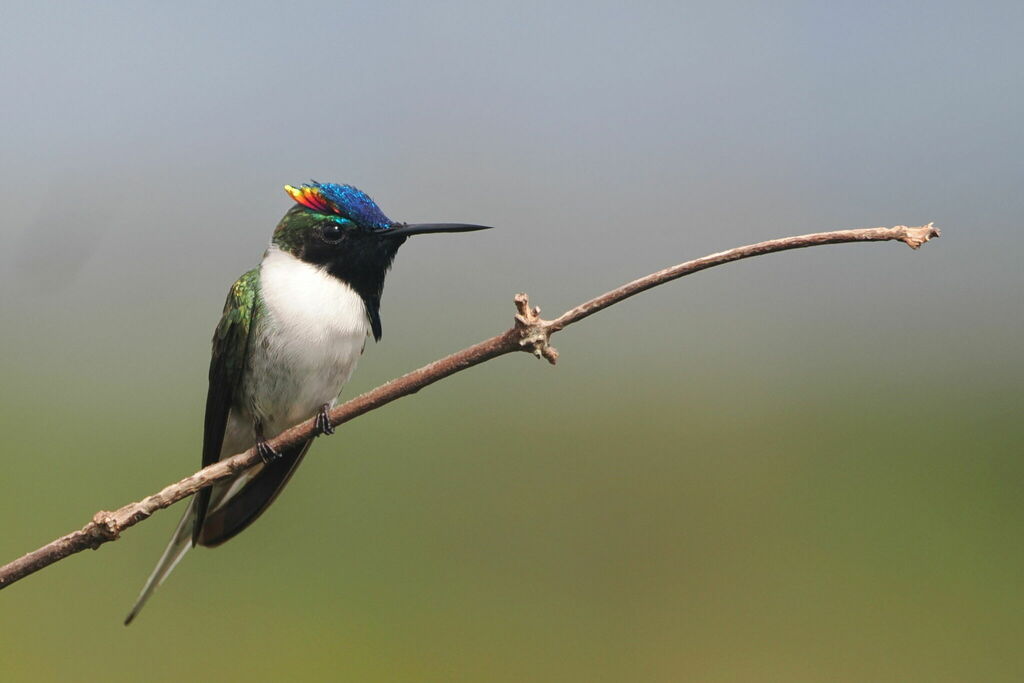
Horned Sungem
Photo © steve b
Photo © steve b — CC0 1.0 — Source: iNaturalist photo #363243160Identification
The horned sungem is a small hummingbird, measuring 9.5 to 11 cm in length, with a long tail and comparatively short, straight black bill. Both sexes display light coloration with a metallic yellow-green back and white underside, creating a distinctive half-collar effect on the neck. The flight feathers are black-brown, and pointed tail feathers show a characteristic V-shaped black band when viewed from below.
Sexual dimorphism is striking. Males are spectacular, sporting two iridescent feather tufts ("horns") above the eyes that transition from fiery red at the base, through golden in the middle, to golden-green at the tips. They also display a shiny blue head crest and a black throat with a pointed "beard." Females are considerably plainer, with a brown or yellow-buff throat and lack the elaborate head ornamentation. The middle tail feathers are buff in males and green in females.
Range & Habitat
The horned sungem is native to much of central Brazil, with populations extending into parts of Bolivia and Suriname. Remarkably, this species has recently expanded its range into southern Amazonas and Espírito Santo, likely due to deforestation—a range expansion few other hummingbird species have achieved in recent times.
The species strongly prefers open habitats such as savanna and grassland. It readily occupies human-created environments including gardens and cultivated areas, making it accessible to travellers in various regions of its range.
Behaviour & Diet
The horned sungem is a nomadic species, moving between areas in response to the seasonal flowering of plants. It relies on a broad variety of flowering plants for nectar, and when flower shapes are incompatible with its short bill, it opportunistically robs nectar by piercing a hole at the flower's base. The species also supplements its diet with small insects.
The horned sungem is notably territorial and readily defends its territory against both conspecifics and subordinate hummingbird species. Only females build the nest, incubate the two white eggs (taking approximately 13 days), and rear the chicks. Newly hatched chicks are naked and black, becoming capable of flight at 20 to 22 days old.
Best Time & Places to See It
The horned sungem's nomadic movements follow flowering plant cycles, so timing visits to coincide with local flowering seasons increases sighting success. The species' recent range expansion means it may be encountered in previously unreliable locations, particularly in southern Amazonas and Espírito Santo.
Look for this hummingbird in open savanna, grassland, and gardens throughout central Brazil and adjacent areas of Bolivia and Suriname. Its attraction to flowering plants and human gardens makes it relatively accessible compared to forest-dwelling hummingbirds, and patient observation in suitable habitat often rewards visitors.
Photography Tips
The horned sungem's small size (under 12 cm) and rapid movements demand fast shutter speeds and continuous autofocus. Males are visually spectacular with their iridescent horn tufts and crest, which display best in direct sunlight; position yourself to maximize side-lighting to capture the brilliant reds, golds, and greens of the head ornaments.
The species' nomadic nature and preference for open habitats work in the photographer's favour—they are relatively approachable and often visit flowering plants and gardens predictably. The white underside contrasts dramatically with metallic upperparts, creating strong compositional opportunities. Early morning light accentuates the male's iridescent features, making this the optimal shooting time.
Brasília National Park
Chapada Diamantina National Park
Chapada dos Guimarães National Park
Chapada dos Veadeiros National Park
Emas National Park
Serra do Cipó National Park
Terra Ronca State Park
Nothing matches these filters.
No community photos yet. Log in to add the first one.
No community observations of this species yet.