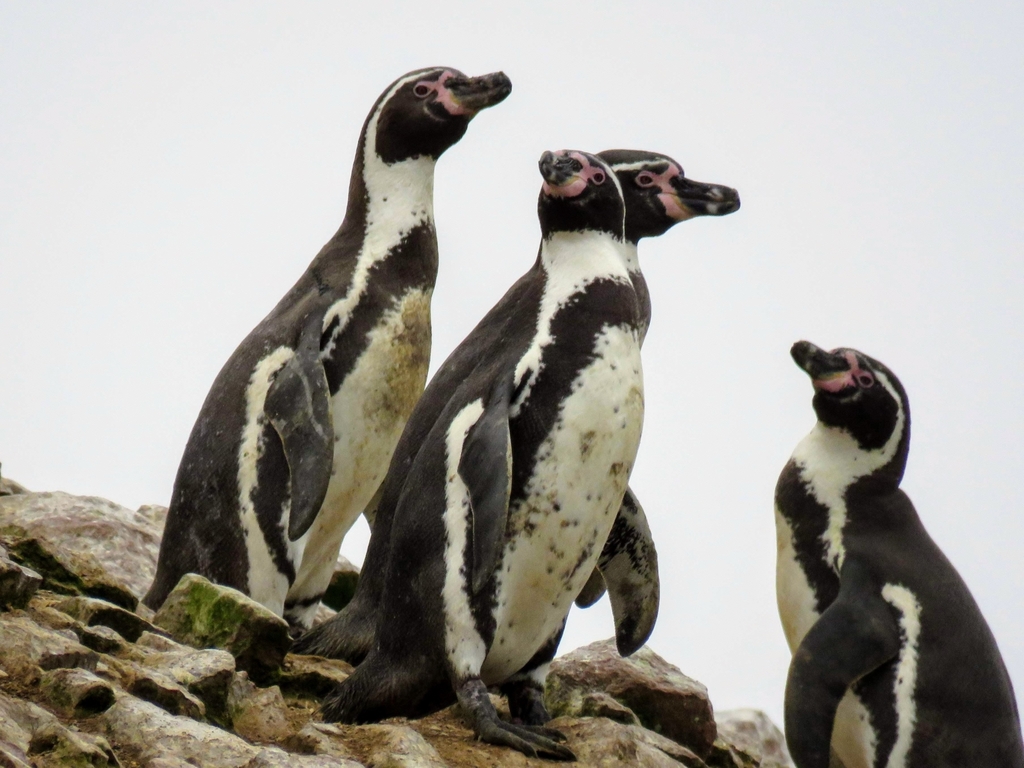
Humboldt Penguin
Photo © Pirataber
Photo © Pirataber — CC BY 4.0 — Source: iNaturalist photo #107936558Identification
The Humboldt penguin is a medium-sized penguin, growing to 56–70 cm (22–28 in) long and weighing 2.9 to 6 kg (6.4 to 13.2 lb), making it the heaviest species in its genus. Males are noticeably larger and heavier than females, though the sexes cannot be distinguished by plumage alone. These penguins are instantly recognizable by their distinctive black head with a striking white border running from behind the eye, around the black ear-coverts and chin, joining at the throat. Their upperparts are blackish-grey while the underparts are whitish, marked by a bold black breast-band that extends down the flanks to the thigh. The base of the bill has a characteristic fleshy-pink coloration. Juveniles are darker with no visible breast-band.
Range & Habitat
The Humboldt penguin is endemic to the west coast of South America, found exclusively along the Pacific coasts of Peru and Chile. Their breeding range extends from southern Chile through the dry and arid coastal regions of the Atacama Desert to subtropical Isla Foca in northern Peru. They are restricted to coastal areas and offshore islands influenced by the Humboldt current, a cold-water current that provides the nutrients and abundant food stocks supporting the region's seabird populations. In Chile, the most important breeding colony is located at Isla Chañaral. Their range overlaps with the Magellanic penguin on the central Chilean coast, and they have been known to nest in mixed-species colonies with this relative in at least two locations in southern Chile. The species is vagrant in Ecuador and Colombia.
Behaviour & Diet
Humboldt penguins are visual hunters that feed predominantly on pelagic schooling fish, particularly Atlantic saury and garfish in northern colonies, while southern populations favor anchovy, Araucanian herring, silver-side, pilchard and squid. Cephalopods and crustaceans supplement their diet, with consumption varying between populations and seasons. These birds leave their islands to forage after sunrise, with foraging patterns influenced by light intensity and varying distances from the colony depending on the population.
These penguins are vocal and social birds with distinct calls serving different communicative purposes: the Yell is a territorial warning, the Throb is used between mates at the nest, the Haw is given by juveniles or separated pairs, the Bray advertises territory and attracts mates during breeding periods, and chicks produce Peeps when begging for food. Most Humboldt penguins moult between mid-January and mid-February, becoming confined to land during this critical 2-week period when feathers are completely replaced.
Best Time & Places to See It
The Humboldt penguin has become a significant focus of ecotourism along the South American Pacific coast in recent decades. Isla Chañaral in Chile represents the most important breeding colony for viewing opportunities. The species is migratory, so timing your visit to coincide with breeding and nesting seasons will maximize your chances of observing these penguins at their colonies on islands and rocky coasts where they burrow holes in guano deposits or utilize natural scrapes and caves.
Photography Tips
The Humboldt penguin's striking black-and-white plumage and distinctive facial markings make it a rewarding photographic subject. Their characteristic postures during vocalizations—particularly the upright posture with raised heads and flapping flippers during the Bray call—offer excellent compositional opportunities. Photographing during breeding seasons will capture more behavioral diversity and interaction. The contrast between their dark upperparts and white underparts, combined with the fleshy-pink bill base, provides rich color variation to exploit in your images. Note that these are vulnerable birds in declining populations, so approach colonies respectfully and follow local ecotourism guidelines.
Chiloé National Park
Dalcahue, Chile
+122 birds+6 mammals
Temperate rainforest cloaks the Chiloé archipelago's northwestern reaches, where granite ridges thrust through dense, moisture-laden canopy and freshwater streams carve ravines toward the Pacific. Across approximately…
VIEW NATIONAL PARKPan de Azúcar National Park
Chañaral, Chile
+74 birds+4 mammals
Where the Atacama Desert plunges toward the Pacific, Pan de Azúcar National Park sprawls across 727 square kilometres of one of Earth's most extreme transitions—a landscape…
VIEW NATIONAL PARKNo community photos yet. Log in to add the first one.
No community observations of this species yet.