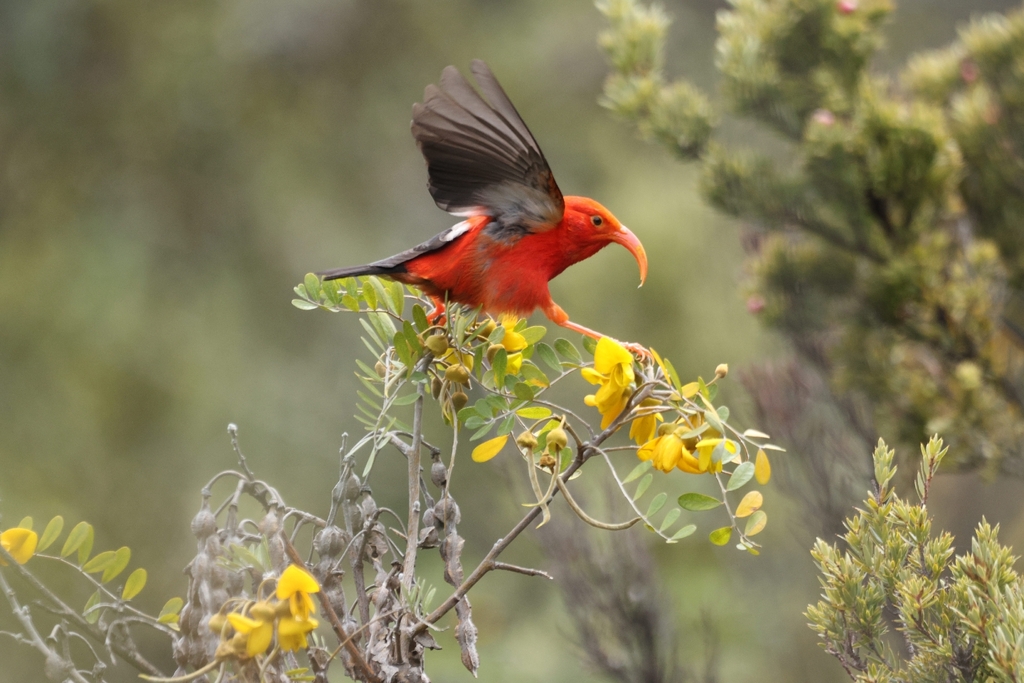
Iiwi
Photo © Damien Wallace
Photo © Damien Wallace — CC BY 4.0 — Source: iNaturalist photo #639463493The ʻiʻiwi (pronounced , ee-EE-wee) or scarlet honeycreeper (Drepanis coccinea), is a species of Hawaiian honeycreeper. The ʻiʻiwi is a highly recognizable symbol of Hawaii. == Etymology == Linguists derive the Hawaiian language word ʻiʻiwi from Proto-Nuclear-Polynesian *kiwi, which in central Polynesia refers to the bristle-thighed curlew (Numenius tahitiensis), a migratory bird. The long decurved bill of the curlew somewhat resembles that of the ʻiʻiwi. == Description == The adult ʻiʻiwi is mostly scarlet, with black wings and tail and a long, curved, salmon-colored bill used primarily for drinking nectar. The contrast of the red and black plumage with surrounding green foliage makes the ʻiʻiwi one of Hawaiʻi's most easily seen native birds. Younger birds have golden plumage with more spots and ivory bills and were mistaken for a different species by early naturalists. Observations of young birds moulting into adult plumage resolved this confusion. Along with the Hawaiʻi Mamo, ʻiʻiwi were used in the feather trade. The ʻiʻiwi's feathers were highly prized by Hawaiian aliʻi (nobility) for use in decorating ʻahuʻula (feather cloaks) and mahiole (feathered helmets), and such uses gave the species its original scientific name: Vestiaria, which comes from the Latin for "clothing", and coccinea meaning "scarlet-colored".…
Hawaiʻi Volcanoes National Park
Hawaiʻi County, United States
+84 birds+2 mammals
Where volcanic slopes descend toward the Pacific across more than five thousand square kilometers, Hawaiʻi Volcanoes National Park presents one of Earth's most dynamic laboratories of…
VIEW NATIONAL PARKHaleakalā National Park
Maui County, United States
+66 birds+4 mammals
Ascending from sea level to over 10,000 feet across a mere thirty miles, Haleakalā National Park commands one of the Pacific's most dramatic elevation gradients, where…
VIEW NATIONAL PARKNo community photos yet. Log in to add the first one.
No community observations of this species yet.