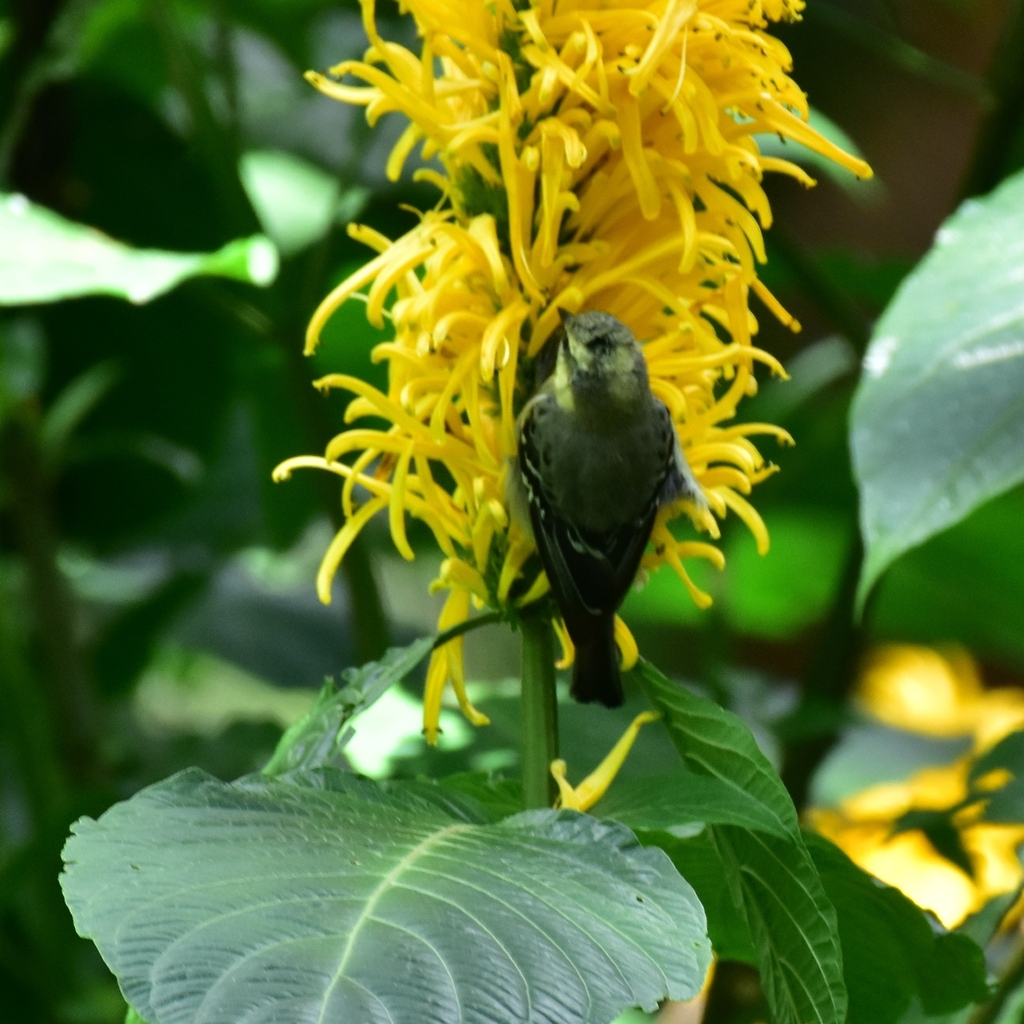
Indian Black-lored Tit
Photo © Renjith Jacob Mathews
Photo © Renjith Jacob Mathews — CC BY 4.0 — Source: iNaturalist #190761022Identification
The Indian black-lored tit is a large tit, measuring 13 cm, and is easy to recognize across most of India. Males are particularly striking, featuring a broad black line running down an otherwise bright yellow front, contrasting sharply with olive-green upperparts. The large crest, neck, throat, and head are black, while distinctive yellow cheeks and supercilia (eyebrows) provide an elegant accent to the dark plumage. Two white or yellowish wingbars and white outer tail feathers complete the pattern.
Females and young birds are noticeably duller than males, and an interesting geographical trend exists: underpart coloration becomes progressively duller from north to south across the bird's range. These features make it a relatively straightforward species to identify in the field, particularly when compared to other Indian tit species.
Range & Habitat
The Indian black-lored tit is a resident breeder on the Indian subcontinent, meaning populations remain year-round rather than migrating. It does not occur in Sri Lanka. The species is common in open tropical forests throughout its range, where it has adapted well to these woodland habitats.
Behaviour & Diet
This species is an active and agile feeder, moving energetically through the canopy in search of food. It primarily takes insects and spiders from the foliage, though it will also consume fruit opportunistically. Like other members of the tit family, the Indian black-lored tit is a highly vocal bird with a large repertoire of calls. The most familiar vocalization is a distinctive "si-si" call, while its song is described as sometimes nuthatch-like, consisting of repeated "chi-chi-chi" notes.
During breeding season, this species shows considerable flexibility in nest-site selection. It readily uses existing woodpecker or barbet holes, will excavate its own cavity, or may use man-made nest sites. The typical clutch consists of 3–5 white eggs spotted with red. Females are close sitters, hissing defensively when disturbed at the nest—a characteristic behavior shared with many cavity-nesting birds.
Best Time & Places to See It
As a resident breeder, the Indian black-lored tit can be found year-round throughout the Indian subcontinent, making it accessible to travelers at any season. Look for it in open tropical forest habitats across its range, where it is described as common. The bird's active, acrobatic foraging style and vocal nature make it relatively easy to locate once you are in suitable habitat.
Photography Tips
The striking contrast between black and yellow plumage makes the Indian black-lored tit a rewarding photographic subject. Males offer the most visually dramatic images, particularly the bold black line down the yellow breast and the prominent crest. Photograph birds in open canopy areas where light penetrates well, which will help capture the brilliance of the yellow coloring. Its active, agile movements through branches mean fast shutter speeds are advisable. Early morning when birds are most vocal and active will provide the best opportunities for both photography and observation.
Eravikulam National Park
Devikulam, India
+192 birds+7 mammals
High in the Western Ghats of Kerala, where monsoon mists cling to slopes that rise above 2,000 metres, Eravikulam National Park preserves one of South India's…
VIEW NATIONAL PARKKanha Tiger Reserve
Kanha Kisli F.V., India
+321 birds+23 mammals
Where sal forests give way to emerald meadows and crystalline streams carve through ancient valleys, one of India's finest wilderness reserves unfolds across the Maikal Range.…
VIEW NATIONAL PARKTadoba National Park
Palasgaon Singru, India
+270 birds+20 mammals
Where sal forests meet open grasslands and rocky outcrops rise from red laterite soil, central India's landscape unfolds in raw, untamed beauty. Ancient teak woodlands and…
VIEW NATIONAL PARKBandhavgarh National Park
Garhpuri, India
+285 birds+17 mammals
Where granite ridges rise dramatically above sal and bamboo forests, one of India's most pristine tiger reserves unfolds across the Vindhyan plateau. Ancient rock formations tower…
VIEW NATIONAL PARKPeriyar National Park
Mlappara, India
+232 birds+4 mammals
Dawn breaks over mist-shrouded ridges where the Western Ghats tumble toward Kerala's spice-scented lowlands. Here, ancient tropical forests envelope a glittering artificial lake, creating a mosaic…
VIEW NATIONAL PARKPampadum Shola National Park
Vattavada, India
+258 birds+14 mammals
Where misty shola forests cling to the high plateaus of the Nilgiri Mountains, ancient evergreen remnants create a world apart. This 2,316-hectare reserve protects one of…
VIEW NATIONAL PARKBandipur National Park
Hirehalli, India
+302 birds+19 mammals
Where the Western Ghats descend into the Deccan plateau, ancient deciduous forests blanket a landscape carved by the Nugu River. Bandipur unfolds across 880 square kilometres…
VIEW NATIONAL PARKNagarahole Tiger Reserve
Nalkeri Forest, India
+323 birds+23 mammals
Where granite escarpments rise above dense deciduous forests and the Kabini River carves through pristine wilderness, one of India's most biodiverse landscapes unfolds across the Western…
VIEW NATIONAL PARKNo community photos yet. Log in to add the first one.
No community observations of this species yet.