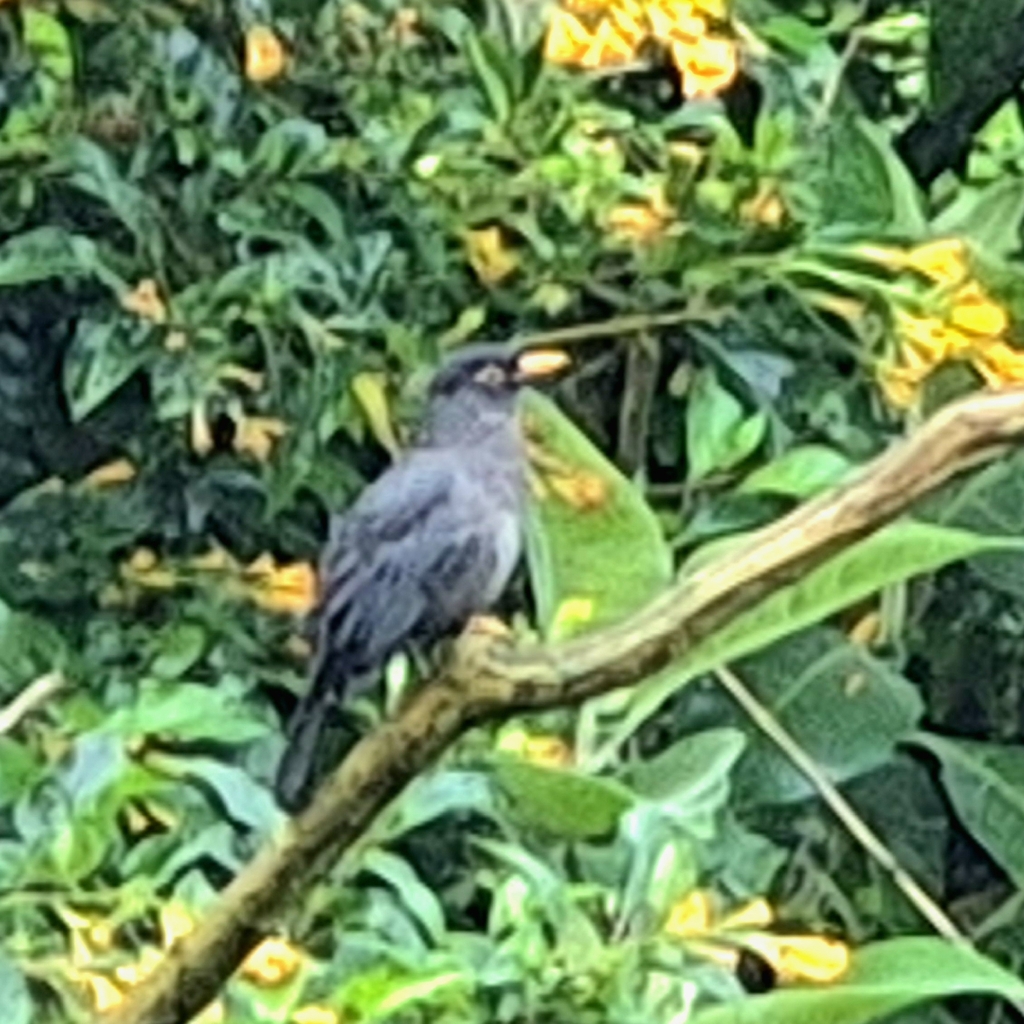
Indian Blackbird
Photo © Siya ul haque
Photo © Siya ul haque — CC BY 4.0 — Source: iNaturalist #252683394Identification
The Indian blackbird is a small thrush, measuring just 19–20 centimetres (7.5–7.9 inches) in length. Despite its name, this species is not uniformly black; plumage varies considerably across its four Indian subspecies and Sri Lankan population. All subspecies share a distinctive broad yellow eye-ring, a key field mark that separates them from the common blackbird, to which they were once thought to belong. The species differs from its European relative in proportions, wing formula, egg colour, and voice.
The black-capped blackbird (T. s. nigropileus) of the Western Ghats displays a slate-grey male with a contrasting dark cap, while females are mid-brown and paler below. Bourdillon's blackbird (T. s. bourdilloni) of southern Kerala and Tamil Nadu shows a uniform slate-brown male. Spence's blackbird (T. s. spencei) of the Eastern Ghats closely resembles nigropileus but with a less pronounced cap. The Nilgiri blackbird (T. s. simillimus) inhabits the southern Western Ghats. Kinnis' blackbird (T. s. kinnisii), endemic to Sri Lanka, occupies montane forests on the island.
Range & Habitat
The Indian blackbird is found exclusively in India and Sri Lanka, distributed across several montane regions. Different subspecies occupy distinct geographical areas: the Western Ghats from the Biligirirangans and Nilgiris southward, the Eastern Ghats, the southern hills of Kerala and Tamil Nadu, and the montane forests of Sri Lanka. These birds are altitudinal residents and migrants, with some populations moving to lower elevations during winter months.
Altitudinally, the species inhabits hill regions from approximately 900 metres upward, with the black-capped blackbird reaching elevations up to 1,820 metres and the Nilgiri blackbird up to 2,000 metres. These montane forest habitats provide the cool, moist conditions that suit this thrush family member.
Behaviour & Diet
Information on the specific feeding habits and dietary preferences of the Indian blackbird is limited in available sources, though as a thrush family member it likely forages for insects, berries, and other invertebrates typical of the group. Breeding occurs seasonally, with Kinnis' blackbird in Sri Lanka showing a main breeding season from March to April, with additional breeding possibly occurring August to September.
Best Time & Places to See It
To observe Indian blackbirds, visit the Western or Eastern Ghats during the resident season. The Nilgiris, Palni Hills, and southern Kerala and Tamil Nadu hills above 900 metres offer the best chances of encounters with Bourdillon's blackbird. For Kinnis' blackbird, the montane forests of Sri Lanka are essential. Some populations migrate seasonally, so checking local guides for timing will improve your sightings.
Photography Tips
The broad yellow eye-ring is the key diagnostic feature to capture in photographs, distinguishing the Indian blackbird from similar species. The small size of these birds—among the tiniest in the thrush family—requires patience and a steady telephoto lens. Montane forest habitats can be densely vegetated; position yourself near clearings or forest edges where light is better and birds more visible. Early morning hours typically offer the best light and activity levels for photography in hill forests.
Ranthambhore National Park
Sawai Madhopur, India
+294 birds+20 mammals
Granite ridges and ravines carved through the Aravalli Range frame this protected landscape in eastern Rajasthan, where deciduous forest mingles with open scrubland and seasonal water…
VIEW NATIONAL PARKEravikulam National Park
Devikulam, India
+192 birds+7 mammals
High in the Western Ghats of Kerala, where monsoon mists cling to slopes that rise above 2,000 metres, Eravikulam National Park preserves one of South India's…
VIEW NATIONAL PARKKanha Tiger Reserve
Kanha Kisli F.V., India
+321 birds+23 mammals
Where sal forests give way to emerald meadows and crystalline streams carve through ancient valleys, one of India's finest wilderness reserves unfolds across the Maikal Range.…
VIEW NATIONAL PARKTadoba National Park
Palasgaon Singru, India
+270 birds+20 mammals
Where sal forests meet open grasslands and rocky outcrops rise from red laterite soil, central India's landscape unfolds in raw, untamed beauty. Ancient teak woodlands and…
VIEW NATIONAL PARKBandhavgarh National Park
Garhpuri, India
+285 birds+17 mammals
Where granite ridges rise dramatically above sal and bamboo forests, one of India's most pristine tiger reserves unfolds across the Vindhyan plateau. Ancient rock formations tower…
VIEW NATIONAL PARKPanna National Park
Badgadi Kalan, India
+271 birds+17 mammals
Where granite gorges slice through central India's Vindhyan plateau, a landscape of stark beauty unfolds across nearly six hundred square kilometers. The Ken River carves through…
VIEW NATIONAL PARKPeriyar National Park
Mlappara, India
+232 birds+4 mammals
Dawn breaks over mist-shrouded ridges where the Western Ghats tumble toward Kerala's spice-scented lowlands. Here, ancient tropical forests envelope a glittering artificial lake, creating a mosaic…
VIEW NATIONAL PARKPampadum Shola National Park
Vattavada, India
+258 birds+14 mammals
Where misty shola forests cling to the high plateaus of the Nilgiri Mountains, ancient evergreen remnants create a world apart. This 2,316-hectare reserve protects one of…
VIEW NATIONAL PARKBandipur National Park
Hirehalli, India
+302 birds+19 mammals
Where the Western Ghats descend into the Deccan plateau, ancient deciduous forests blanket a landscape carved by the Nugu River. Bandipur unfolds across 880 square kilometres…
VIEW NATIONAL PARKNagarahole Tiger Reserve
Nalkeri Forest, India
+323 birds+23 mammals
Where granite escarpments rise above dense deciduous forests and the Kabini River carves through pristine wilderness, one of India's most biodiverse landscapes unfolds across the Western…
VIEW NATIONAL PARKGir National Park
Asundrali, India
+258 birds+13 mammals
Dry deciduous forests cloak the rolling hills of western Gujarat where the Gir landscape rises as a final sanctuary for one of the world's rarest felids:…
VIEW NATIONAL PARKNo community photos yet. Log in to add the first one.
No community observations of this species yet.