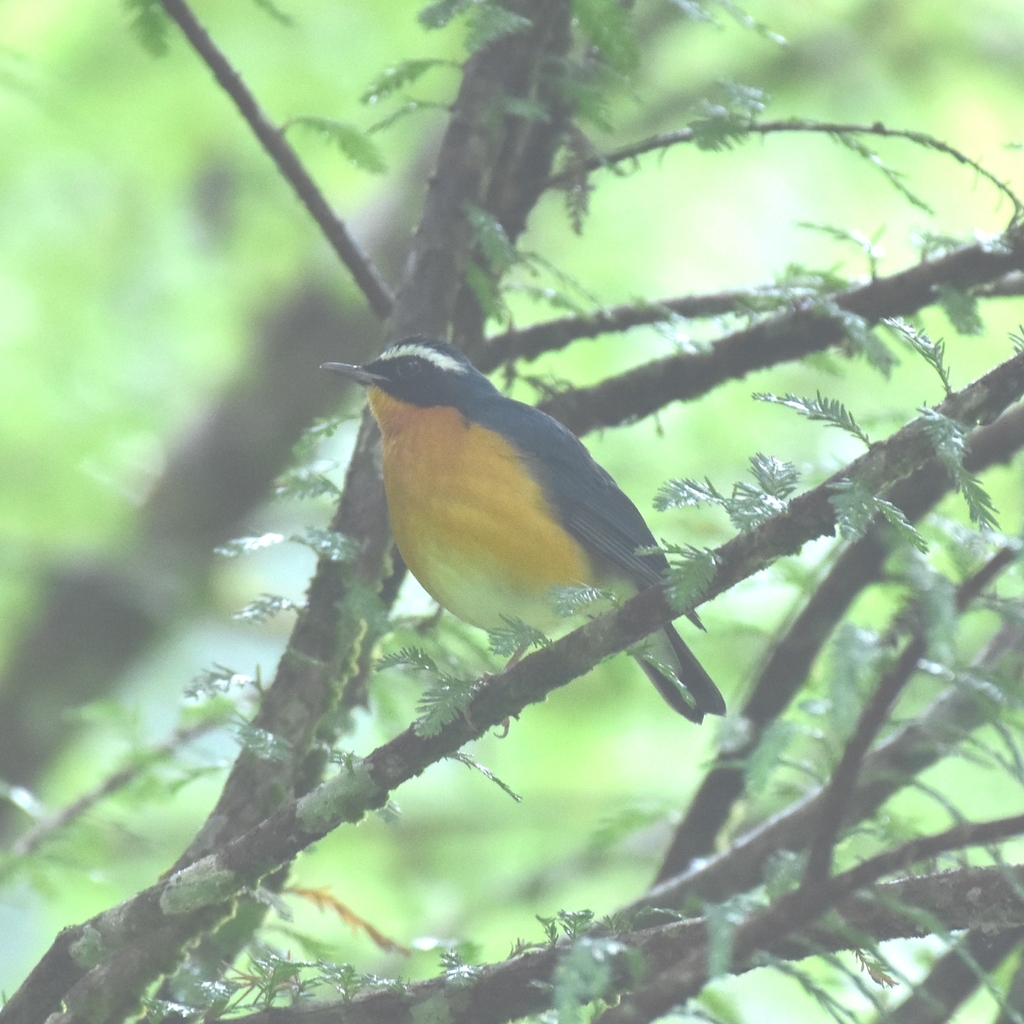
Indian Blue Robin
Photo © Renjith Jacob Mathews
Photo © Renjith Jacob Mathews — CC BY 4.0 — Source: iNaturalist #190762056Identification
The Indian blue robin is a small bird measuring 15 cm long, comparable in size to the bluethroat. The striking adult male is unmistakable, with bright blue upperparts contrasting sharply against rufous underparts. A distinctive white supercilium (eyebrow stripe) stands out prominently against a bold black mask that extends down the neck, while the lower belly and undertail are whitish. Females are considerably duller, with olive-brown upperparts and buff underparts, a light eye-ring, and a rufescent rump; the breast and flanks are buffy. Young birds are dark brown with buff spots, making them less conspicuous than adults.
Range & Habitat
The Indian blue robin is found across the Indian subcontinent as a migratory species. It breeds in the forests along the Himalayas of Nepal, India, Myanmar, and Bangladesh, with the nominate race ranging from eastern Afghanistan to the eastern Himalayas. A separate non-migratory race, wickhami, breeds in the Chin Hills of western Myanmar. The species winters in the hill forests of the Western Ghats of India and in Sri Lanka.
This robin favours dense, dark forest with thick undergrowth and abundant leaf litter. It is a skulking bird that prefers to remain hidden within this protective vegetation, making it more often heard than seen.
Behaviour & Diet
The Indian blue robin is strictly insectivorous, feeding mainly on the ground where it hops and forages, frequently flicking and fanning its tail in characteristic fashion. The breeding season runs from May to July, with pairs constructing large cup-shaped nests made of vegetation and placed on the ground between the roots of large fir trees or in natural depressions. Nests are lined with roots, hair, and down, and typically contain four light blue eggs. While only the female incubates, both sexes participate in feeding the young.
These birds arrive at their Himalayan breeding grounds in May and depart by September. Southward migration begins in August, and birds may be encountered as passage migrants across peninsular India during this period. They arrive at winter quarters in mid-September and depart in mid-April. Males appear more numerous than females in winter surveys, suggesting possible differences in migration timing or wintering areas between the sexes. In their winter grounds, they sing and call, producing a distinctive song of sudden sharp whistles that end in rapid notes, along with sharp, low clicking alarm calls.
Best Time & Places to See It
Birdwatchers seeking this species should visit the Himalayan breeding grounds between May and August, or winter in the hill forests of the Western Ghats and Sri Lanka from mid-September to mid-April. The species is a regular passage migrant throughout peninsular India in August and September during southward migration, and again in April during northward movement. Notable observation points include the Nilgiris region and Point Calimere, where the species has been regularly trapped during October and November migration.
Photography Tips
Patience and low-angle positioning are essential when photographing this skulking species. Keep your camera ready at ground level, as the bird forages among leaf litter and undergrowth where it is most active. Early morning light during the breeding season offers the best opportunity to photograph males in full plumage, when they are most visible during song and territorial activity. The striking contrast between the male's blue upperparts and rufous underparts, along with the dramatic white supercilium and black mask, make for compelling images when successfully captured in natural forest light.
Lunugamvehera National Park
Sri Lanka
+204 birds+14 mammals
Dry scrubland and shallow wetlands converge in Sri Lanka's southeastern lowlands, where Lunugamvehera National Park anchors one of the island's most ecologically vital landscapes. The park's…
VIEW NATIONAL PARKLangtang National Park
Helambu, Nepal
+364 birds+14 mammals
Where the southern slopes of the Himalayan highlands descend toward the subtropical valleys of central Nepal, Langtang National Park sprawls across one of the subcontinent's most…
VIEW NATIONAL PARKSagarmatha National Park
Khumjung, Nepal
+219 birds+7 mammals
Soaring peaks and deep glacial valleys define this alpine wilderness in northeastern Nepal, where the terrain rises from forested foothills into a realm of high-altitude tundra…
VIEW NATIONAL PARKKhangchendzonga National Park
Sakkyong, India
+290 birds+1 mammals
Where the eastern Himalayas surge toward their crowning peaks, Khangchendzonga National Park embraces a landscape of almost overwhelming vertical drama. Rising from subtropical river valleys into…
VIEW NATIONAL PARKEravikulam National Park
Devikulam, India
+192 birds+7 mammals
High in the Western Ghats of Kerala, where monsoon mists cling to slopes that rise above 2,000 metres, Eravikulam National Park preserves one of South India's…
VIEW NATIONAL PARKGiant Panda National Park
Mianyang, China
+447 birds+47 mammals
Where the eastern slopes of China's Sichuan plateau descend into cloud-wrapped valleys, one of Asia's most biodiverse landscapes unfolds across more than 350,000 square kilometres. This…
VIEW NATIONAL PARKJiuzhai Valley
Jiuzhaigou County, China
+226 birds+7 mammals
Where crystalline alpine streams cascade through limestone gorges and karst terrain rises in dramatic vertical walls, Jiuzhai Valley unfolds across nearly 1,300 square kilometers of southwestern…
VIEW NATURAL MONUMENTNanda Devi National Park
Garpak, India
+218 birds+5 mammals
Where the Himalayas surge into their most dramatic alpine amphitheater, a wilderness of raw geological power unfolds across 624 square kilometers of pristine terrain. Nanda Devi,…
VIEW NATIONAL PARKValley of Flowers National Park
Ghangaria, India
+117 birds+1 mammals
Where alpine meadows explode with color each monsoon season, the Himalayan slopes of Uttarakhand rise to create one of Earth's most extraordinary floral displays. Perched between…
VIEW NATIONAL PARKPeriyar National Park
Mlappara, India
+232 birds+4 mammals
Dawn breaks over mist-shrouded ridges where the Western Ghats tumble toward Kerala's spice-scented lowlands. Here, ancient tropical forests envelope a glittering artificial lake, creating a mosaic…
VIEW NATIONAL PARKPampadum Shola National Park
Vattavada, India
+258 birds+14 mammals
Where misty shola forests cling to the high plateaus of the Nilgiri Mountains, ancient evergreen remnants create a world apart. This 2,316-hectare reserve protects one of…
VIEW NATIONAL PARKBandipur National Park
Hirehalli, India
+302 birds+19 mammals
Where the Western Ghats descend into the Deccan plateau, ancient deciduous forests blanket a landscape carved by the Nugu River. Bandipur unfolds across 880 square kilometres…
VIEW NATIONAL PARKNagarahole Tiger Reserve
Nalkeri Forest, India
+323 birds+23 mammals
Where granite escarpments rise above dense deciduous forests and the Kabini River carves through pristine wilderness, one of India's most biodiverse landscapes unfolds across the Western…
VIEW NATIONAL PARKGir National Park
Asundrali, India
+258 birds+13 mammals
Dry deciduous forests cloak the rolling hills of western Gujarat where the Gir landscape rises as a final sanctuary for one of the world's rarest felids:…
VIEW NATIONAL PARKWolong National Nature Reserve
Wenchuan County, China
+333 birds+17 mammals
Where the Qingyi River cuts through the eastern flanks of the Minshan Range, a temperate montane forest cloaks steep valleys in dense canopy that thins dramatically…
VIEW NATURE RESERVEBaima Snow Mountain National Nature Reserve
Diqing Tibetan Autonomous Prefecture, China
+204 birds+3 mammals
High-altitude ridges and steep-sided valleys define this reserve in northwestern Yunnan, where elevations surge from around 3,000 metres to peaks above 4,100 metres. The terrain supports…
VIEW NATURE RESERVENo community photos yet. Log in to add the first one.
No community observations of this species yet.