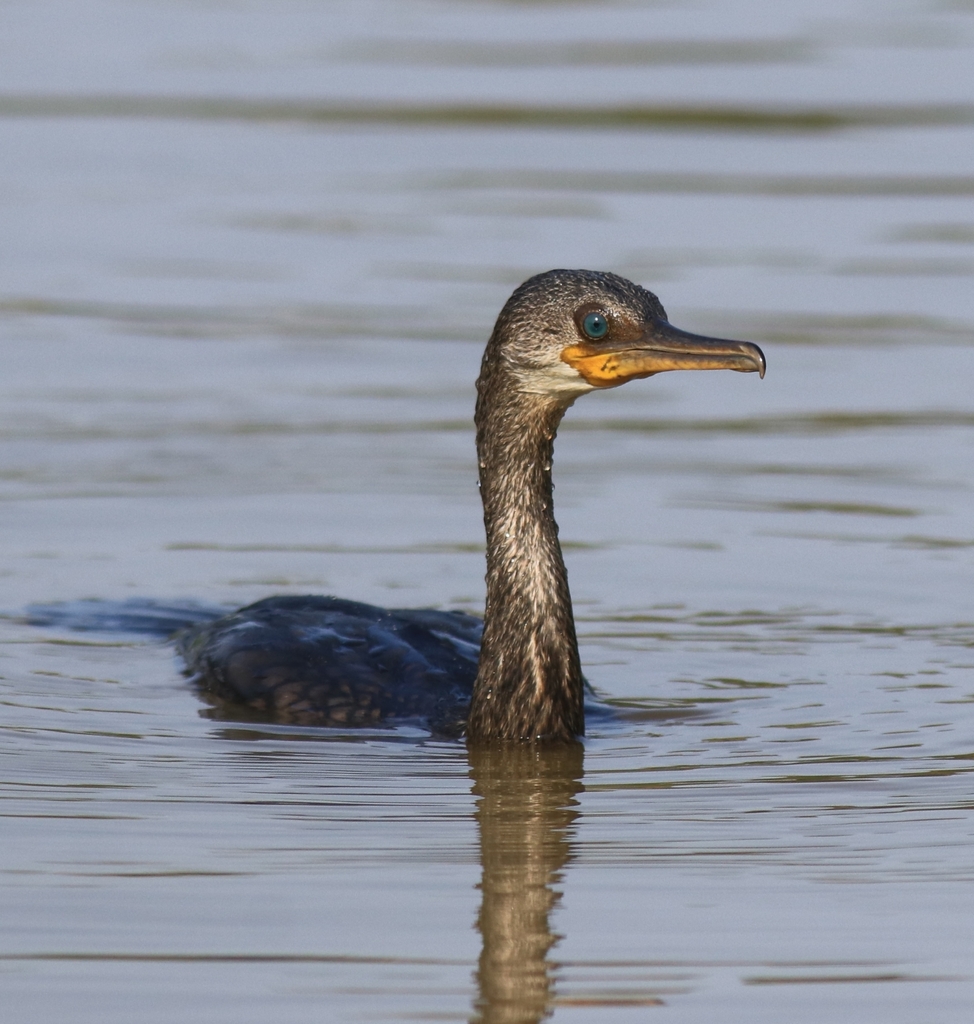
Indian Cormorant
Photo © Afsar Nayakkan
Photo © Afsar Nayakkan — CC BY 4.0 — Source: iNaturalist #260581207Identification
The Indian cormorant is a medium-sized bronze-brown waterbird with distinctive blue eyes that set it apart from similar species. Its plumage is scalloped in black on the upper parts, and it lacks a crest. The head is notably small and slightly peaked, with a long, narrow bill that terminates in a hooked tip—perfect for gripping slippery prey. Non-breeding birds display bare yellow facial skin, while breeding adults develop a short white ear tuft. Some individuals show white on the throat, though this marking is restricted below the gape, distinguishing it from the much larger great cormorant. Juveniles and non-breeding adults tend to be browner overall, while sexes are otherwise similar in appearance.
Range & Habitat
This gregarious cormorant is found primarily along the inland waters of the Indian subcontinent, ranging from Sri Lanka's northern regions through peninsular India and extending northeast to Assam. Its distribution stretches eastward into Thailand, Burma, and Cambodia, with populations also present in Sind to the west. Rather than coastal waters, the Indian cormorant favors inland rivers, large wetlands, estuaries, and mangrove systems. They breed very locally in mixed-species breeding colonies, typically establishing nests in the forks of partially submerged trees or those growing on islands, often organizing in dense colonies with multiple tiers of nests.
Behaviour & Diet
The Indian cormorant is an accomplished fish hunter that typically makes short dives to capture its prey. Remarkably social hunters, these birds often fish communally in groups, coordinating their efforts to form a broad front that drives fish into a corner, making capture easier for the entire flock. Breeding occurs seasonally, with timing dependent on rainfall and water conditions. In northern India, breeding extends from July through February, while in Sri Lanka it occurs between November and February. Nests consist of twigs arranged in platform structures, with clutches typically containing three to five bluish-green eggs bearing a chalky surface.
Best Time & Places to See It
The best opportunities to observe Indian cormorants are during their breeding season—July to February in northern India and November to February in Sri Lanka—when they gather in visible colonies. Look for them on inland rivers, large wetlands, and estuarine systems throughout the Indian subcontinent, particularly in peninsular India and extending northeast toward Assam. They prefer areas where they can gather in communal fishing groups, making waterbird hotspots and protected wetland reserves ideal locations for encounters. Their gregarious nature means that when found, they are often present in substantial numbers.
Photography Tips
Capture the Indian cormorant's distinctive blue eyes and small, peaked head as your primary subjects—these features are key identification marks. Look for opportunities to photograph cooperative hunting behavior, where groups form broad fronts in the water. The breeding season offers additional photographic interest with birds displaying their short white ear tufts and bare yellow facial skin. Early morning light on inland wetlands will accentuate the bronze-brown plumage and black scalloping. Photographing nesting colonies during breeding season can yield compelling images of the dense, multi-tiered nest arrangements, though approach carefully to avoid disturbing these sensitive breeding sites.
Lunugamvehera National Park
Sri Lanka
+204 birds+14 mammals
Dry scrubland and shallow wetlands converge in Sri Lanka's southeastern lowlands, where Lunugamvehera National Park anchors one of the island's most ecologically vital landscapes. The park's…
VIEW NATIONAL PARKMinneriya National Park
Sri Lanka
+158 birds+9 mammals
Across the dry zone of Sri Lanka's North Central Province spreads a landscape of shallow tanks, grassland margins, and scattered dry forest—a mosaic of water and…
VIEW NATIONAL PARKWasgamuwa National Park
Sri Lanka
+156 birds+8 mammals
Dry deciduous forest and open grassland sweep across the North Central lowlands where Wasgamuwa National Park protects one of Sri Lanka's largest remaining tracts of this…
VIEW NATIONAL PARKRanthambhore National Park
Sawai Madhopur, India
+294 birds+20 mammals
Granite ridges and ravines carved through the Aravalli Range frame this protected landscape in eastern Rajasthan, where deciduous forest mingles with open scrubland and seasonal water…
VIEW NATIONAL PARKEravikulam National Park
Devikulam, India
+192 birds+7 mammals
High in the Western Ghats of Kerala, where monsoon mists cling to slopes that rise above 2,000 metres, Eravikulam National Park preserves one of South India's…
VIEW NATIONAL PARKKhao Yai National Park
Prachantakham District, Thailand
+377 birds+46 mammals
Evergreen dipterocarp forest blankets the rolling terrain of this national park in eastern Thailand, where limestone hills rise abruptly from the forest floor and seasonal streams…
VIEW NATIONAL PARKKhao Laem Ya-Mu Ko Samet National Park
Mueang Rayong District, Thailand
+159 birds+3 mammals
Where limestone hills meet the Gulf of Thailand, Khao Laem Ya–Mu Ko Samet National Park stitches together a mosaic of terrestrial and marine worlds that few…
VIEW NATIONAL PARKKanha Tiger Reserve
Kanha Kisli F.V., India
+321 birds+23 mammals
Where sal forests give way to emerald meadows and crystalline streams carve through ancient valleys, one of India's finest wilderness reserves unfolds across the Maikal Range.…
VIEW NATIONAL PARKTadoba National Park
Palasgaon Singru, India
+270 birds+20 mammals
Where sal forests meet open grasslands and rocky outcrops rise from red laterite soil, central India's landscape unfolds in raw, untamed beauty. Ancient teak woodlands and…
VIEW NATIONAL PARKBandhavgarh National Park
Garhpuri, India
+285 birds+17 mammals
Where granite ridges rise dramatically above sal and bamboo forests, one of India's most pristine tiger reserves unfolds across the Vindhyan plateau. Ancient rock formations tower…
VIEW NATIONAL PARKPanna National Park
Badgadi Kalan, India
+271 birds+17 mammals
Where granite gorges slice through central India's Vindhyan plateau, a landscape of stark beauty unfolds across nearly six hundred square kilometers. The Ken River carves through…
VIEW NATIONAL PARKKaziranga National Park
Kohora, India
+422 birds+26 mammals
Dawn breaks over the floodplains of the Brahmaputra, where tall grasslands stretch endlessly beneath monsoon-heavy skies. This sprawling wilderness of northeastern Assam is a mosaic of…
VIEW NATIONAL PARKKeoladeo National Park
Shreenagar Rural, India
+326 birds+14 mammals
Where shallow wetlands shimmer beneath vast Rajasthani skies, one of Asia's finest bird sanctuaries pulses with extraordinary life. This former maharaja's hunting reserve, now spanning 29…
VIEW NATIONAL PARKPeriyar National Park
Mlappara, India
+232 birds+4 mammals
Dawn breaks over mist-shrouded ridges where the Western Ghats tumble toward Kerala's spice-scented lowlands. Here, ancient tropical forests envelope a glittering artificial lake, creating a mosaic…
VIEW NATIONAL PARKPampadum Shola National Park
Vattavada, India
+258 birds+14 mammals
Where misty shola forests cling to the high plateaus of the Nilgiri Mountains, ancient evergreen remnants create a world apart. This 2,316-hectare reserve protects one of…
VIEW NATIONAL PARKBandipur National Park
Hirehalli, India
+302 birds+19 mammals
Where the Western Ghats descend into the Deccan plateau, ancient deciduous forests blanket a landscape carved by the Nugu River. Bandipur unfolds across 880 square kilometres…
VIEW NATIONAL PARKNagarahole Tiger Reserve
Nalkeri Forest, India
+323 birds+23 mammals
Where granite escarpments rise above dense deciduous forests and the Kabini River carves through pristine wilderness, one of India's most biodiverse landscapes unfolds across the Western…
VIEW NATIONAL PARKGir National Park
Asundrali, India
+258 birds+13 mammals
Dry deciduous forests cloak the rolling hills of western Gujarat where the Gir landscape rises as a final sanctuary for one of the world's rarest felids:…
VIEW NATIONAL PARKNo community photos yet. Log in to add the first one.
No community observations of this species yet.