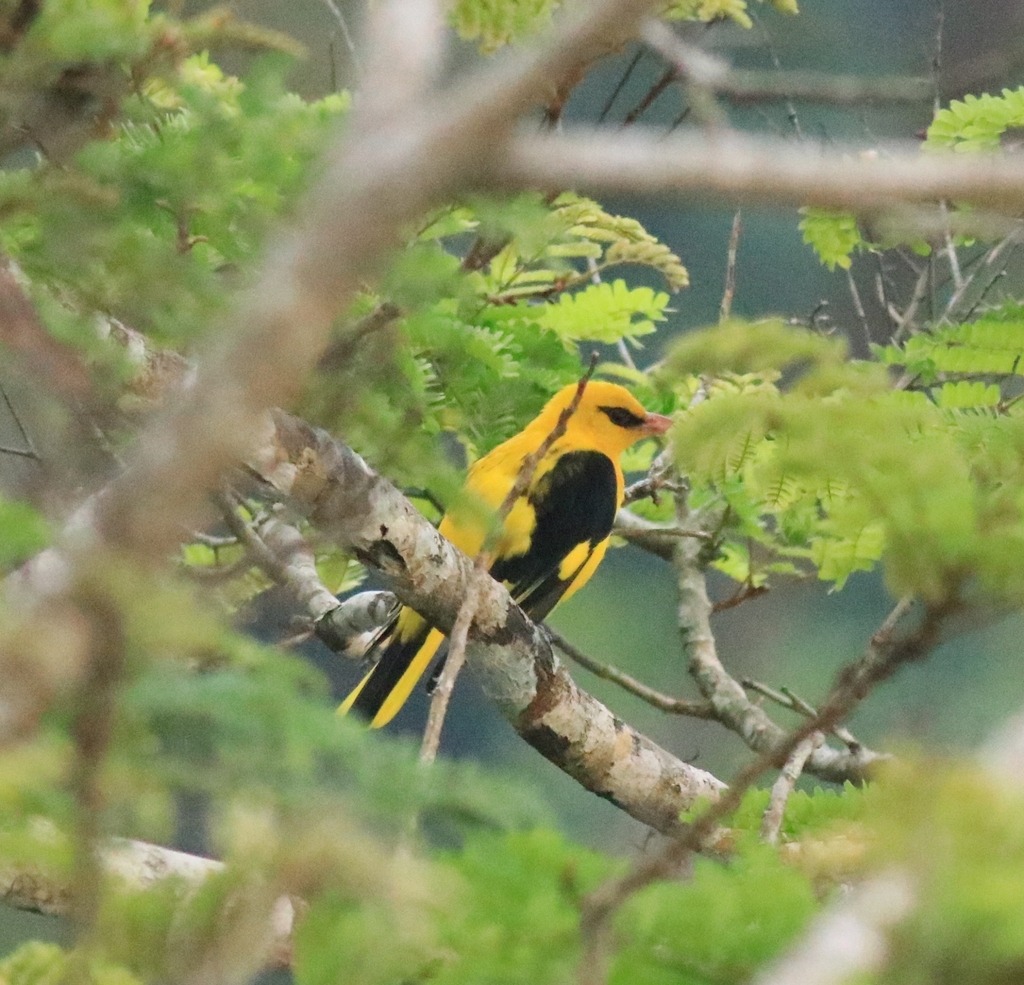
Indian Golden Oriole
Photo © Afsar Nayakkan
Photo © Afsar Nayakkan — CC BY 4.0 — Source: iNaturalist #265071809Identification
The Indian golden oriole is a striking yellow and black bird, very similar to its European cousin the Eurasian golden oriole but with several useful field marks. Males are particularly distinctive, with bright yellow plumage, black wings and back, and a characteristic black eye stripe that extends behind the eye—a key feature separating them from Eurasian birds. Look also for a large black patch on the wing coverts and wide yellow tips to the flight feathers. Females are duller and more olive-yellow with streaked underparts that are sharper and more defined than those of female Eurasian golden orioles. The Indian species is noticeably smaller than its European relative, with a more slender build.
Range & Habitat
This oriole breeds across a wide swathe of Asia, from Baluchistan and Afghanistan eastward along the Himalayas to Nepal, with some local populations in peninsular India. Northern breeding birds migrate south in winter to southern India and Sri Lanka. The species shows remarkable habitat flexibility, thriving in open deciduous and semi-evergreen forests, woodland edges, mangroves, scattered trees in open country, and human-modified landscapes including parks, gardens, orchards, and plantations.
Behaviour & Diet
Indian golden orioles are agile fliers, capable of reaching speeds around 40 km/h, with a characteristically dipping flight pattern. They are partial migrants—northern populations travel seasonally while Indian populations tend to remain year-round. During breeding season (April to August), pairs construct delicate cup nests in branch forks, often positioning them near black drongos' nests. Clutches of two or three white eggs with reddish and brown speckling are typical, and both parents vigorously defend the nest against predators and competitors. Their diet comprises fruits, nectar, and insects; they play an important ecological role dispersing seeds of berry-bearing plants, including the invasive Lantana camara, and have even been recorded taking southern flying lizards.
Best Time & Places to See It
Breeding season (April to August) offers the best viewing opportunities in their Himalayan and subcontinent range. Northern populations are most visible before they depart southward. Peninsular India hosts resident populations year-round, though these are locally distributed. Winter months bring northern migrants to southern India and Sri Lanka. Scan flowering and fruiting trees in woodland edges, gardens, and open forest areas where their bright plumage makes them relatively conspicuous despite their often secretive behavior.
Photography Tips
The male's bright yellow and black pattern provides excellent contrast and sharp detail in photographs. Early morning light is ideal for capturing the subtle plumage tones, particularly the paler iris and bill and the yellow tail markings that distinguish this species from the Eurasian golden oriole. Patience is rewarded when birds visit fruiting or flowering trees; position yourself with backlighting to enhance the yellow plumage. The dipping flight action is characteristic—anticipate the undulating rhythm to capture birds in motion. Distant or partially obscured views should focus on the diagnostic black eye stripe extending behind the eye.
Langtang National Park
Helambu, Nepal
+364 birds+14 mammals
Where the southern slopes of the Himalayan highlands descend toward the subtropical valleys of central Nepal, Langtang National Park sprawls across one of the subcontinent's most…
VIEW NATIONAL PARKRanthambhore National Park
Sawai Madhopur, India
+294 birds+20 mammals
Granite ridges and ravines carved through the Aravalli Range frame this protected landscape in eastern Rajasthan, where deciduous forest mingles with open scrubland and seasonal water…
VIEW NATIONAL PARKEravikulam National Park
Devikulam, India
+192 birds+7 mammals
High in the Western Ghats of Kerala, where monsoon mists cling to slopes that rise above 2,000 metres, Eravikulam National Park preserves one of South India's…
VIEW NATIONAL PARKKanha Tiger Reserve
Kanha Kisli F.V., India
+321 birds+23 mammals
Where sal forests give way to emerald meadows and crystalline streams carve through ancient valleys, one of India's finest wilderness reserves unfolds across the Maikal Range.…
VIEW NATIONAL PARKTadoba National Park
Palasgaon Singru, India
+270 birds+20 mammals
Where sal forests meet open grasslands and rocky outcrops rise from red laterite soil, central India's landscape unfolds in raw, untamed beauty. Ancient teak woodlands and…
VIEW NATIONAL PARKBandhavgarh National Park
Garhpuri, India
+285 birds+17 mammals
Where granite ridges rise dramatically above sal and bamboo forests, one of India's most pristine tiger reserves unfolds across the Vindhyan plateau. Ancient rock formations tower…
VIEW NATIONAL PARKPanna National Park
Badgadi Kalan, India
+271 birds+17 mammals
Where granite gorges slice through central India's Vindhyan plateau, a landscape of stark beauty unfolds across nearly six hundred square kilometers. The Ken River carves through…
VIEW NATIONAL PARKHemis National Park
Raigahar Dhar, India
+131 birds+13 mammals
Where granite gorges cleave through the Himalayas at dizzying altitudes, a vast wilderness of alpine desert unfolds across the rain shadow of Ladakh. Hemis sprawls across…
VIEW NATIONAL PARKKeoladeo National Park
Shreenagar Rural, India
+326 birds+14 mammals
Where shallow wetlands shimmer beneath vast Rajasthani skies, one of Asia's finest bird sanctuaries pulses with extraordinary life. This former maharaja's hunting reserve, now spanning 29…
VIEW NATIONAL PARKPeriyar National Park
Mlappara, India
+232 birds+4 mammals
Dawn breaks over mist-shrouded ridges where the Western Ghats tumble toward Kerala's spice-scented lowlands. Here, ancient tropical forests envelope a glittering artificial lake, creating a mosaic…
VIEW NATIONAL PARKPampadum Shola National Park
Vattavada, India
+258 birds+14 mammals
Where misty shola forests cling to the high plateaus of the Nilgiri Mountains, ancient evergreen remnants create a world apart. This 2,316-hectare reserve protects one of…
VIEW NATIONAL PARKBandipur National Park
Hirehalli, India
+302 birds+19 mammals
Where the Western Ghats descend into the Deccan plateau, ancient deciduous forests blanket a landscape carved by the Nugu River. Bandipur unfolds across 880 square kilometres…
VIEW NATIONAL PARKNagarahole Tiger Reserve
Nalkeri Forest, India
+323 birds+23 mammals
Where granite escarpments rise above dense deciduous forests and the Kabini River carves through pristine wilderness, one of India's most biodiverse landscapes unfolds across the Western…
VIEW NATIONAL PARKGir National Park
Asundrali, India
+258 birds+13 mammals
Dry deciduous forests cloak the rolling hills of western Gujarat where the Gir landscape rises as a final sanctuary for one of the world's rarest felids:…
VIEW NATIONAL PARKNo community photos yet. Log in to add the first one.
No community observations of this species yet.