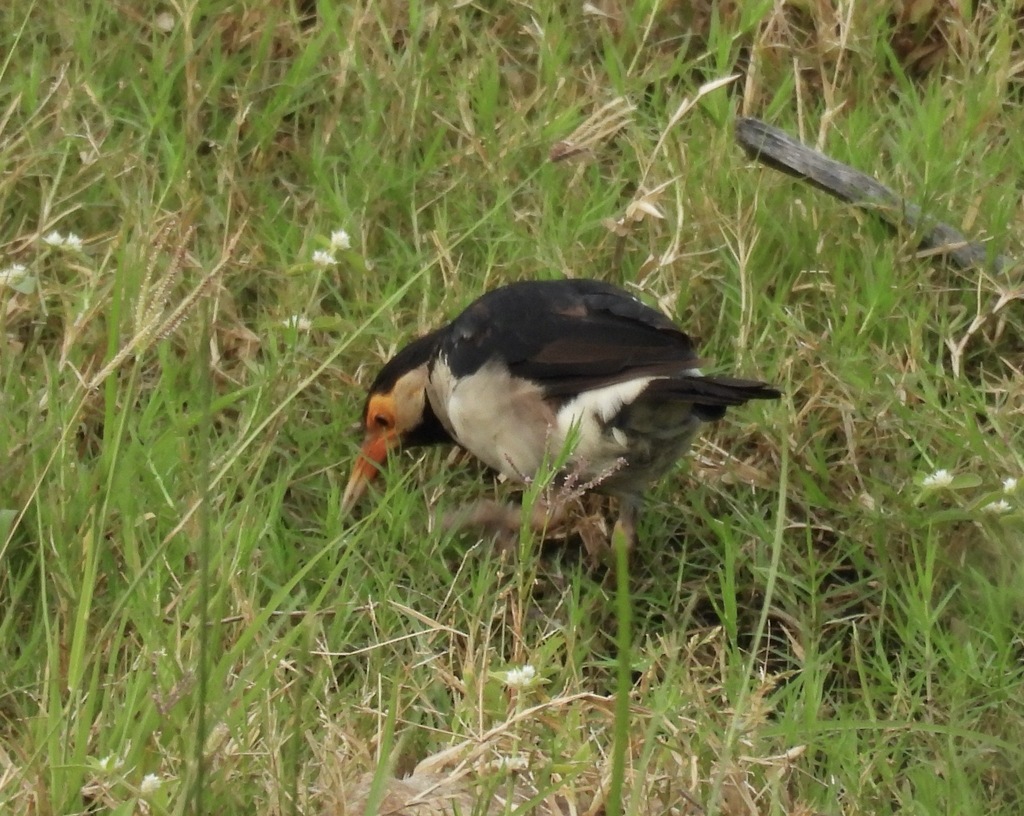
Indian Pied Myna
Photo © Ram Dayal Vaishnav
Photo © Ram Dayal Vaishnav — CC BY 4.0 — Source: iNaturalist #247282986Identification
The Indian pied myna is a strikingly marked starling with bold black and white plumage. The upper body, throat, and breast are glossy black, while the cheeks, lores, wing coverts, and rump are contrasting white. The bird has a yellowish bill with a reddish base, and distinctive reddish bare skin around the eye. Young birds show dark brown rather than black plumage. The sexes are similar in appearance, and the flight is characteristically slow and butterfly-like on rounded wings.
Range & Habitat
The Indian pied myna is found across the Indian subcontinent, with its main distribution along the Gangetic plains extending south to the Krishna River, across to Bangladesh, and into Nepal. Two subspecies are recognized, with populations also present in Myanmar and southwest China. The species' range has been expanding westward into Pakistan and other parts of India in recent decades, aided by changes in irrigation patterns and possibly by escapes from the caged bird trade.
This myna favors lowland open areas with scattered trees near water, typically found from the plains up to about 700 meters elevation. It frequents areas with human habitation, including sewage farms, refuse tips, grazing lands, and open grasslands where it often forages near cattle. Access to open water is an important feature of suitable habitat.
Behaviour & Diet
Indian pied mynas are usually seen in small groups that call frequently throughout the day, producing a wide repertoire of sounds including whistles, trills, buzzes, clicks, and warbling notes. They forage mainly on the ground but perch readily on trees and buildings. Like other starlings, they employ a characteristic feeding technique, using their strong bill muscles to part grass mats and probe soil, then opening their bill to dislodge hidden prey. They feed on grains, fruit, insects, earthworms, and molluscs.
Both males and females sing. During the breeding season (March to September in India), flock sizes decline as birds pair up. Courtship involves calling, feather fluffing, and head bobbing. Nests are loose dome-shaped structures made of straw, placed in large trees or man-made structures near human habitation. A typical clutch consists of four to six glossy blue eggs, with incubation lasting 14 to 15 days.
Best Time & Places to See It
The Indian pied myna is a year-round resident throughout its range. To observe them, visit open grasslands, fields, and agricultural areas near water sources in the plains and low foothills of the Indian subcontinent. They are often found near human settlements, making them accessible in and around villages and cities. Early morning and late afternoon typically offer the best viewing opportunities when birds are actively foraging on the ground.
Photography Tips
The striking black-and-white plumage of the Indian pied myna makes it a rewarding photographic subject with excellent contrast. Photograph birds as they forage on the ground to capture their characteristic feeding behavior, or focus on perched birds to highlight the distinctive white cheeks and rump against the black body. The reddish bill base and eye-ring provide good focal points for close-up shots. Early morning light will best emphasize the glossy finish of their black plumage and make the white markings pop. Be patient when photographing flocks, as multiple birds calling and interacting provide dynamic compositional opportunities.
Orang National Park
Rangagarapathar, India
+298 birds+1 mammals
Where the Brahmaputra's floodplains meet the foothills of Assam, Orang National Park unfolds across a mosaic of riverine grasslands, forests and wetlands that pulse with the…
VIEW NATIONAL PARKIndravati National Park
Bijapur, India
+41 birds
Where the Indravati River cuts through the elevated plateaus of central India, a landscape of deciduous forest and open woodland unfolds across Bijapur district in Chhattisgarh.…
VIEW NATIONAL PARKRanthambhore National Park
Sawai Madhopur, India
+294 birds+20 mammals
Granite ridges and ravines carved through the Aravalli Range frame this protected landscape in eastern Rajasthan, where deciduous forest mingles with open scrubland and seasonal water…
VIEW NATIONAL PARKKanha Tiger Reserve
Kanha Kisli F.V., India
+321 birds+23 mammals
Where sal forests give way to emerald meadows and crystalline streams carve through ancient valleys, one of India's finest wilderness reserves unfolds across the Maikal Range.…
VIEW NATIONAL PARKTadoba National Park
Palasgaon Singru, India
+270 birds+20 mammals
Where sal forests meet open grasslands and rocky outcrops rise from red laterite soil, central India's landscape unfolds in raw, untamed beauty. Ancient teak woodlands and…
VIEW NATIONAL PARKBandhavgarh National Park
Garhpuri, India
+285 birds+17 mammals
Where granite ridges rise dramatically above sal and bamboo forests, one of India's most pristine tiger reserves unfolds across the Vindhyan plateau. Ancient rock formations tower…
VIEW NATIONAL PARKPanna National Park
Badgadi Kalan, India
+271 birds+17 mammals
Where granite gorges slice through central India's Vindhyan plateau, a landscape of stark beauty unfolds across nearly six hundred square kilometers. The Ken River carves through…
VIEW NATIONAL PARKKaziranga National Park
Kohora, India
+422 birds+26 mammals
Dawn breaks over the floodplains of the Brahmaputra, where tall grasslands stretch endlessly beneath monsoon-heavy skies. This sprawling wilderness of northeastern Assam is a mosaic of…
VIEW NATIONAL PARKKeoladeo National Park
Shreenagar Rural, India
+326 birds+14 mammals
Where shallow wetlands shimmer beneath vast Rajasthani skies, one of Asia's finest bird sanctuaries pulses with extraordinary life. This former maharaja's hunting reserve, now spanning 29…
VIEW NATIONAL PARKNo community photos yet. Log in to add the first one.
No community observations of this species yet.