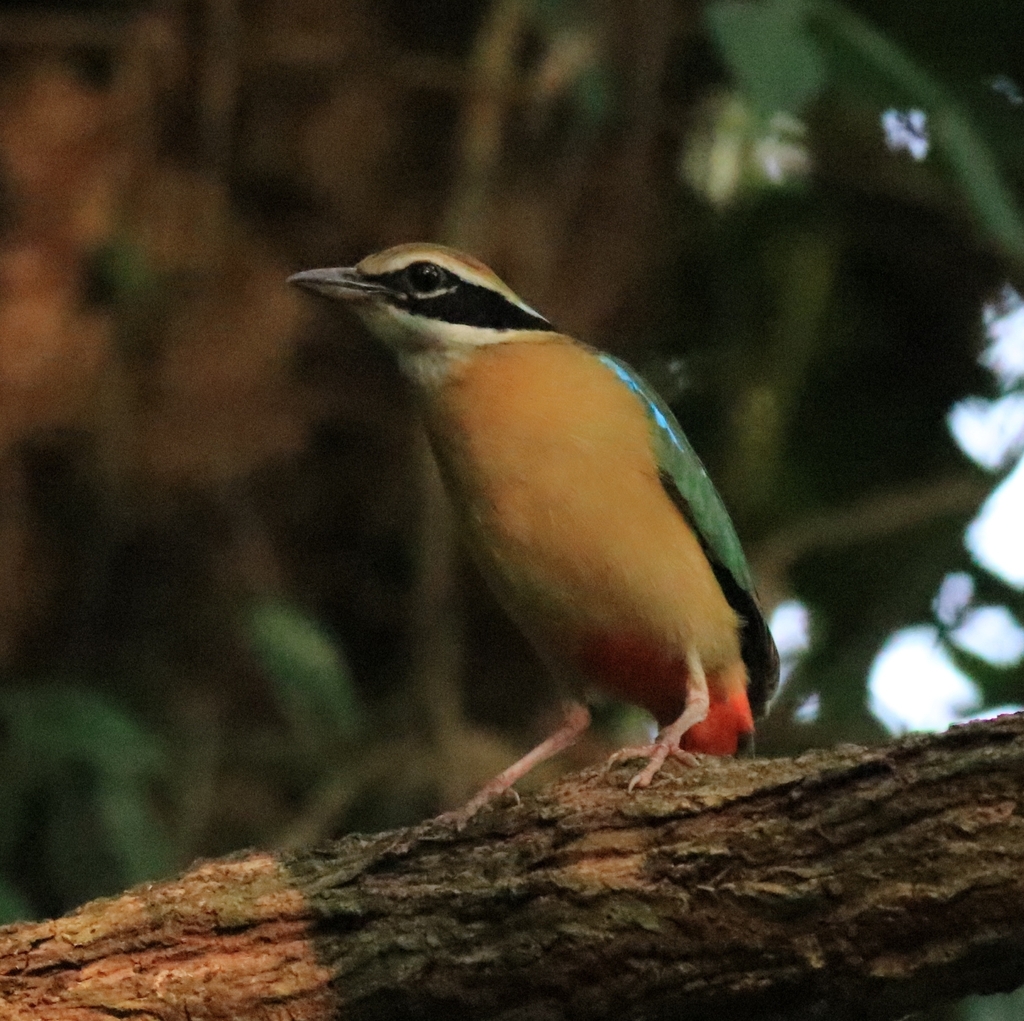
Indian Pitta
Photo © Afsar Nayakkan
Photo © Afsar Nayakkan — CC BY 4.0 — Source: iNaturalist #263058290Identification
The Indian Pitta is a small, strikingly colourful bird with a stocky build, short tail, and strong legs adapted for ground foraging. Look for a buff-coloured crown stripe bordered by bold black coronal stripes, a thick black eye stripe, and a white throat and neck. The upperparts are green with a distinctive blue tail, while the underparts are predominantly buff with bright red on the lower belly and vent. Its stout, pointed bill and compact frame make it unmistakable among ground-dwelling forest birds.
The Indian Pitta is far more often heard than seen, making its distinctive two-note whistling call—typically rendered as "wheeet-tieu" or "wieet-pyou"—one of the best ways to locate it. The bird also produces single mewing notes and sometimes triple-note calls. When vocalizing, it throws its head back and points its bill upward. Its local names across India, such as "Navrang" or "Navaranga," reflect its vivid nine-colour plumage pattern.
Range & Habitat
The Indian Pitta is native to the Indian subcontinent, breeding in the Himalayan foothills from the Margalla Hills in northern Pakistan through Nepal and possibly Sikkim, as well as in the hills of central India and the Western Ghats south to Karnataka. It is a migratory species, moving to all parts of peninsular India and Sri Lanka during winter, making it a familiar bird across much of the region during these months. The species is rare in the Thar Desert.
This pitta favours scrub jungle, deciduous forests, and dense evergreen forest. It spends much of its time on the forest floor or under heavy undergrowth, where it remains shy and well-hidden despite its colourful plumage. Exhausted migratory birds occasionally venture into human settlements.
Behaviour & Diet
The Indian Pitta is a ground forager, hopping along the forest floor and through leaf litter in search of insects and other small invertebrates. It will also occasionally take kitchen food scraps. The bird roosts in trees but conducts most of its daily activity at ground level, where its strong legs and compact frame make it perfectly adapted for searching through dense vegetation.
Breeding occurs during the south-west monsoon, from June to August, with regional variation—peaks occur in June in central India and July in the north. The species builds a distinctive globular nest made of dry leaves and grasses on the ground or low branches, with a circular opening. Clutches typically contain four to five glossy white, spherical eggs spotted with deep maroon or purple markings.
Best Time & Places to See It
The best time to encounter Indian Pittas is during the breeding season from June to August in the Himalayan foothills, central Indian hills, and Western Ghats, or in winter when they disperse across peninsular India and Sri Lanka. Early morning and dusk are optimal times, as the birds call regularly at these times—particularly around dawn and dusk—earning them the Tamil name "Six-O'Clock bird."
Listen for the characteristic loud two-note whistle to locate birds. Patience and careful observation of undergrowth and forest floors in suitable habitats will reward dedicated watchers, though the bird's shy, secretive nature means sightings remain a pleasant surprise rather than a certainty.
Photography Tips
Photographing the Indian Pitta presents a genuine challenge due to its preference for dense undergrowth and shy temperament. Use sound recording to locate birds during dawn and dusk calling periods, then position yourself quietly nearby. A telephoto lens (at least 300–400mm) is essential for capturing details from a respectful distance without disturbing the bird.
The forest floor and low vegetation where pittas forage present dappled, low-light conditions; fast film speed or high ISO settings will help freeze the bird's movements as it hops through leaf litter. The vibrant contrast between its green upperparts, buff underparts, and brilliant red belly makes for striking images when adequate light reaches the bird. Patience, early starts, and acceptance that many visits will yield only audio rewards are essential mindsets for pitta photographers.
Lunugamvehera National Park
Sri Lanka
+204 birds+14 mammals
Dry scrubland and shallow wetlands converge in Sri Lanka's southeastern lowlands, where Lunugamvehera National Park anchors one of the island's most ecologically vital landscapes. The park's…
VIEW NATIONAL PARKMinneriya National Park
Sri Lanka
+158 birds+9 mammals
Across the dry zone of Sri Lanka's North Central Province spreads a landscape of shallow tanks, grassland margins, and scattered dry forest—a mosaic of water and…
VIEW NATIONAL PARKWasgamuwa National Park
Sri Lanka
+156 birds+8 mammals
Dry deciduous forest and open grassland sweep across the North Central lowlands where Wasgamuwa National Park protects one of Sri Lanka's largest remaining tracts of this…
VIEW NATIONAL PARKRanthambhore National Park
Sawai Madhopur, India
+294 birds+20 mammals
Granite ridges and ravines carved through the Aravalli Range frame this protected landscape in eastern Rajasthan, where deciduous forest mingles with open scrubland and seasonal water…
VIEW NATIONAL PARKKanha Tiger Reserve
Kanha Kisli F.V., India
+321 birds+23 mammals
Where sal forests give way to emerald meadows and crystalline streams carve through ancient valleys, one of India's finest wilderness reserves unfolds across the Maikal Range.…
VIEW NATIONAL PARKTadoba National Park
Palasgaon Singru, India
+270 birds+20 mammals
Where sal forests meet open grasslands and rocky outcrops rise from red laterite soil, central India's landscape unfolds in raw, untamed beauty. Ancient teak woodlands and…
VIEW NATIONAL PARKBandhavgarh National Park
Garhpuri, India
+285 birds+17 mammals
Where granite ridges rise dramatically above sal and bamboo forests, one of India's most pristine tiger reserves unfolds across the Vindhyan plateau. Ancient rock formations tower…
VIEW NATIONAL PARKPanna National Park
Badgadi Kalan, India
+271 birds+17 mammals
Where granite gorges slice through central India's Vindhyan plateau, a landscape of stark beauty unfolds across nearly six hundred square kilometers. The Ken River carves through…
VIEW NATIONAL PARKKeoladeo National Park
Shreenagar Rural, India
+326 birds+14 mammals
Where shallow wetlands shimmer beneath vast Rajasthani skies, one of Asia's finest bird sanctuaries pulses with extraordinary life. This former maharaja's hunting reserve, now spanning 29…
VIEW NATIONAL PARKPeriyar National Park
Mlappara, India
+232 birds+4 mammals
Dawn breaks over mist-shrouded ridges where the Western Ghats tumble toward Kerala's spice-scented lowlands. Here, ancient tropical forests envelope a glittering artificial lake, creating a mosaic…
VIEW NATIONAL PARKPampadum Shola National Park
Vattavada, India
+258 birds+14 mammals
Where misty shola forests cling to the high plateaus of the Nilgiri Mountains, ancient evergreen remnants create a world apart. This 2,316-hectare reserve protects one of…
VIEW NATIONAL PARKBandipur National Park
Hirehalli, India
+302 birds+19 mammals
Where the Western Ghats descend into the Deccan plateau, ancient deciduous forests blanket a landscape carved by the Nugu River. Bandipur unfolds across 880 square kilometres…
VIEW NATIONAL PARKNagarahole Tiger Reserve
Nalkeri Forest, India
+323 birds+23 mammals
Where granite escarpments rise above dense deciduous forests and the Kabini River carves through pristine wilderness, one of India's most biodiverse landscapes unfolds across the Western…
VIEW NATIONAL PARKGir National Park
Asundrali, India
+258 birds+13 mammals
Dry deciduous forests cloak the rolling hills of western Gujarat where the Gir landscape rises as a final sanctuary for one of the world's rarest felids:…
VIEW NATIONAL PARKNo community photos yet. Log in to add the first one.
No community observations of this species yet.