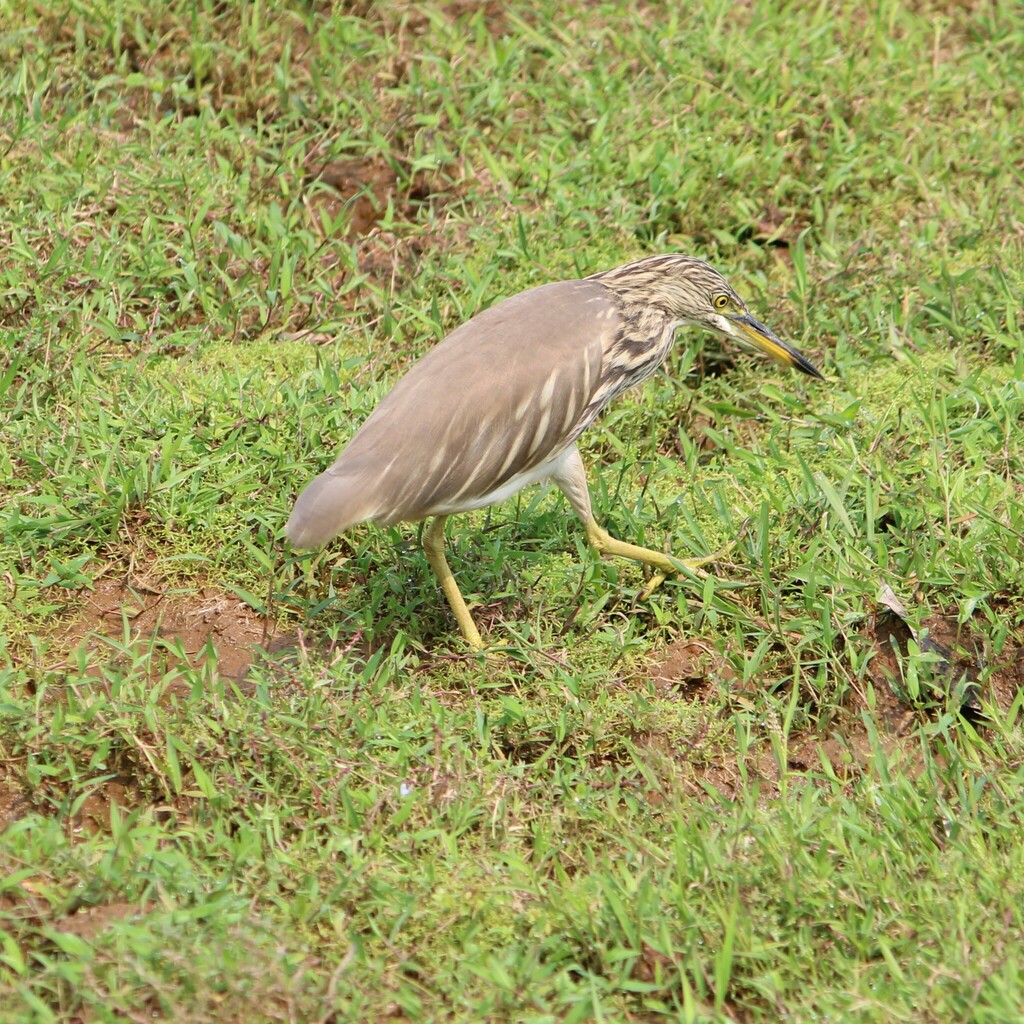
Indian Pond Heron
Photo © Name
Photo © Name — CC BY 4.0 — Source: iNaturalist #189931662Identification
The Indian pond heron is a small, stocky heron with a short neck, short thick bill, and buff-brown back that renders it remarkably inconspicuous at rest. In breeding season, adults develop long neck feathers. The bird's true beauty reveals itself in flight: the wings flash brilliant white in striking contrast to the cryptic streaked olive and brown body plumage. This dramatic transformation makes identification straightforward once the bird takes wing, though at rest it closely resembles the squacco heron but with a darker back.
Occasional individuals display red legs during the breeding season, though these are rare enough that they may represent genetic variants rather than normal seasonal changes. The species is usually silent, but may utter a harsh croak when alarmed or defending its nest. The bird's excellent camouflage has given rise to folk names and widespread beliefs that it is partially blind, leading to the Sinhala name "kana koka," meaning "half-blind heron."
Range & Habitat
The Indian pond heron is widespread and common throughout its range, which extends from southern Iran eastward across the Indian subcontinent, Burma, and Sri Lanka. Despite their abundance, these birds can easily be missed as they stalk prey at the edges of small water-bodies or roost close to human habitations. They favour marshy wetlands and are particularly drawn to areas with floating vegetation such as water hyacinth, which allows them to access deeper water.
These adaptable herons are not confined to natural wetlands alone. During dry seasons, they sometimes forage on well-watered lawns and dry grassland, and have even been observed feeding at garbage heaps. They form communal roosts in avenue trees over busy urban areas, demonstrating their comfort in proximity to human settlements.
Behaviour & Diet
Indian pond herons are typically solitary foragers but gather in numbers during dry seasons when small wetlands concentrate prey. Semi-colonial breeders, they nest in small colonies often with other wading birds, building stick platforms in trees or shrubs usually at heights of 9 to 10 metres. Breeding begins with the onset of monsoons, and successful nest sites may be reused year after year. Pairs lay three to five eggs, which hatch asynchronously over 18 to 24 days, with both parents feeding the young primarily on fish.
These herons employ diverse feeding strategies to catch their prey. They typically feed at pond edges but also make use of floating vegetation, and occasionally swim or fish from the air. They have been observed flying low over water to drive frogs and fishes toward shore, and exhibit remarkable hunting innovation: they have been noted dropping breadcrumbs on water to bait fishes, and capturing fish leaping out of water mid-flight. Their diet comprises crustaceans, aquatic insects, fish, tadpoles, and occasionally leeches; away from wetlands they take insects including crickets and dragonflies, as well as amphibians.
Best Time & Places to See It
The best time to observe Indian pond herons is during the breeding season beginning with the monsoons, when they are actively nesting and more visible. They are common throughout the Indian subcontinent, particularly in areas with suitable wetlands, paddy fields, and small ponds. Look for them at the edges of water-bodies at dawn and dusk when they are most active.
Urban and suburban areas near water bodies are excellent locations, as these birds readily inhabit areas close to human habitation. Avenue trees over busy urban areas often host their communal roosts. During dry seasons, check well-watered gardens and grasslands, as birds may abandon traditional wetlands to forage in these alternative habitats.
Photography Tips
Photographing Indian pond herons requires patience and positioning. Their remarkable camouflage makes them challenging to locate at rest, so scan likely wetland edges methodically. Once found, approach slowly and carefully—these birds allow surprisingly close approach before flushing, sometimes requiring you to be within just a few metres before they take flight.
The dramatic moment when the heron flushes offers the best photographic opportunity: the sudden flash of white wings contrasting against the dull body is striking and memorable. Position yourself with the sun behind or to the side to capture this transformation. Early morning light will best showcase the contrast between the cryptic plumage and brilliant white wings. Patience at known roost sites, particularly avenue trees in urban areas, can also yield good results as birds settle for the evening.
Lunugamvehera National Park
Sri Lanka
+204 birds+14 mammals
Dry scrubland and shallow wetlands converge in Sri Lanka's southeastern lowlands, where Lunugamvehera National Park anchors one of the island's most ecologically vital landscapes. The park's…
VIEW NATIONAL PARKMinneriya National Park
Sri Lanka
+158 birds+9 mammals
Across the dry zone of Sri Lanka's North Central Province spreads a landscape of shallow tanks, grassland margins, and scattered dry forest—a mosaic of water and…
VIEW NATIONAL PARKWasgamuwa National Park
Sri Lanka
+156 birds+8 mammals
Dry deciduous forest and open grassland sweep across the North Central lowlands where Wasgamuwa National Park protects one of Sri Lanka's largest remaining tracts of this…
VIEW NATIONAL PARKAngamedilla National Park
Polonnaruwa, Sri Lanka
+40 birds+2 mammals
Ancient tanks and sal forests define this water-rich sanctuary in Sri Lanka's North Central heartland, where seasonal wetlands and dry deciduous woodland create a mosaic of…
VIEW NATIONAL PARKLangtang National Park
Helambu, Nepal
+364 birds+14 mammals
Where the southern slopes of the Himalayan highlands descend toward the subtropical valleys of central Nepal, Langtang National Park sprawls across one of the subcontinent's most…
VIEW NATIONAL PARKOrang National Park
Rangagarapathar, India
+298 birds+1 mammals
Where the Brahmaputra's floodplains meet the foothills of Assam, Orang National Park unfolds across a mosaic of riverine grasslands, forests and wetlands that pulse with the…
VIEW NATIONAL PARKIndravati National Park
Bijapur, India
+41 birds
Where the Indravati River cuts through the elevated plateaus of central India, a landscape of deciduous forest and open woodland unfolds across Bijapur district in Chhattisgarh.…
VIEW NATIONAL PARKRanthambhore National Park
Sawai Madhopur, India
+294 birds+20 mammals
Granite ridges and ravines carved through the Aravalli Range frame this protected landscape in eastern Rajasthan, where deciduous forest mingles with open scrubland and seasonal water…
VIEW NATIONAL PARKEravikulam National Park
Devikulam, India
+192 birds+7 mammals
High in the Western Ghats of Kerala, where monsoon mists cling to slopes that rise above 2,000 metres, Eravikulam National Park preserves one of South India's…
VIEW NATIONAL PARKKanha Tiger Reserve
Kanha Kisli F.V., India
+321 birds+23 mammals
Where sal forests give way to emerald meadows and crystalline streams carve through ancient valleys, one of India's finest wilderness reserves unfolds across the Maikal Range.…
VIEW NATIONAL PARKTadoba National Park
Palasgaon Singru, India
+270 birds+20 mammals
Where sal forests meet open grasslands and rocky outcrops rise from red laterite soil, central India's landscape unfolds in raw, untamed beauty. Ancient teak woodlands and…
VIEW NATIONAL PARKBandhavgarh National Park
Garhpuri, India
+285 birds+17 mammals
Where granite ridges rise dramatically above sal and bamboo forests, one of India's most pristine tiger reserves unfolds across the Vindhyan plateau. Ancient rock formations tower…
VIEW NATIONAL PARKPanna National Park
Badgadi Kalan, India
+271 birds+17 mammals
Where granite gorges slice through central India's Vindhyan plateau, a landscape of stark beauty unfolds across nearly six hundred square kilometers. The Ken River carves through…
VIEW NATIONAL PARKKaziranga National Park
Kohora, India
+422 birds+26 mammals
Dawn breaks over the floodplains of the Brahmaputra, where tall grasslands stretch endlessly beneath monsoon-heavy skies. This sprawling wilderness of northeastern Assam is a mosaic of…
VIEW NATIONAL PARKNanda Devi National Park
Garpak, India
+218 birds+5 mammals
Where the Himalayas surge into their most dramatic alpine amphitheater, a wilderness of raw geological power unfolds across 624 square kilometers of pristine terrain. Nanda Devi,…
VIEW NATIONAL PARKKeoladeo National Park
Shreenagar Rural, India
+326 birds+14 mammals
Where shallow wetlands shimmer beneath vast Rajasthani skies, one of Asia's finest bird sanctuaries pulses with extraordinary life. This former maharaja's hunting reserve, now spanning 29…
VIEW NATIONAL PARKPeriyar National Park
Mlappara, India
+232 birds+4 mammals
Dawn breaks over mist-shrouded ridges where the Western Ghats tumble toward Kerala's spice-scented lowlands. Here, ancient tropical forests envelope a glittering artificial lake, creating a mosaic…
VIEW NATIONAL PARKPampadum Shola National Park
Vattavada, India
+258 birds+14 mammals
Where misty shola forests cling to the high plateaus of the Nilgiri Mountains, ancient evergreen remnants create a world apart. This 2,316-hectare reserve protects one of…
VIEW NATIONAL PARKBandipur National Park
Hirehalli, India
+302 birds+19 mammals
Where the Western Ghats descend into the Deccan plateau, ancient deciduous forests blanket a landscape carved by the Nugu River. Bandipur unfolds across 880 square kilometres…
VIEW NATIONAL PARKNagarahole Tiger Reserve
Nalkeri Forest, India
+323 birds+23 mammals
Where granite escarpments rise above dense deciduous forests and the Kabini River carves through pristine wilderness, one of India's most biodiverse landscapes unfolds across the Western…
VIEW NATIONAL PARKGir National Park
Asundrali, India
+258 birds+13 mammals
Dry deciduous forests cloak the rolling hills of western Gujarat where the Gir landscape rises as a final sanctuary for one of the world's rarest felids:…
VIEW NATIONAL PARKNo community photos yet. Log in to add the first one.
No community observations of this species yet.