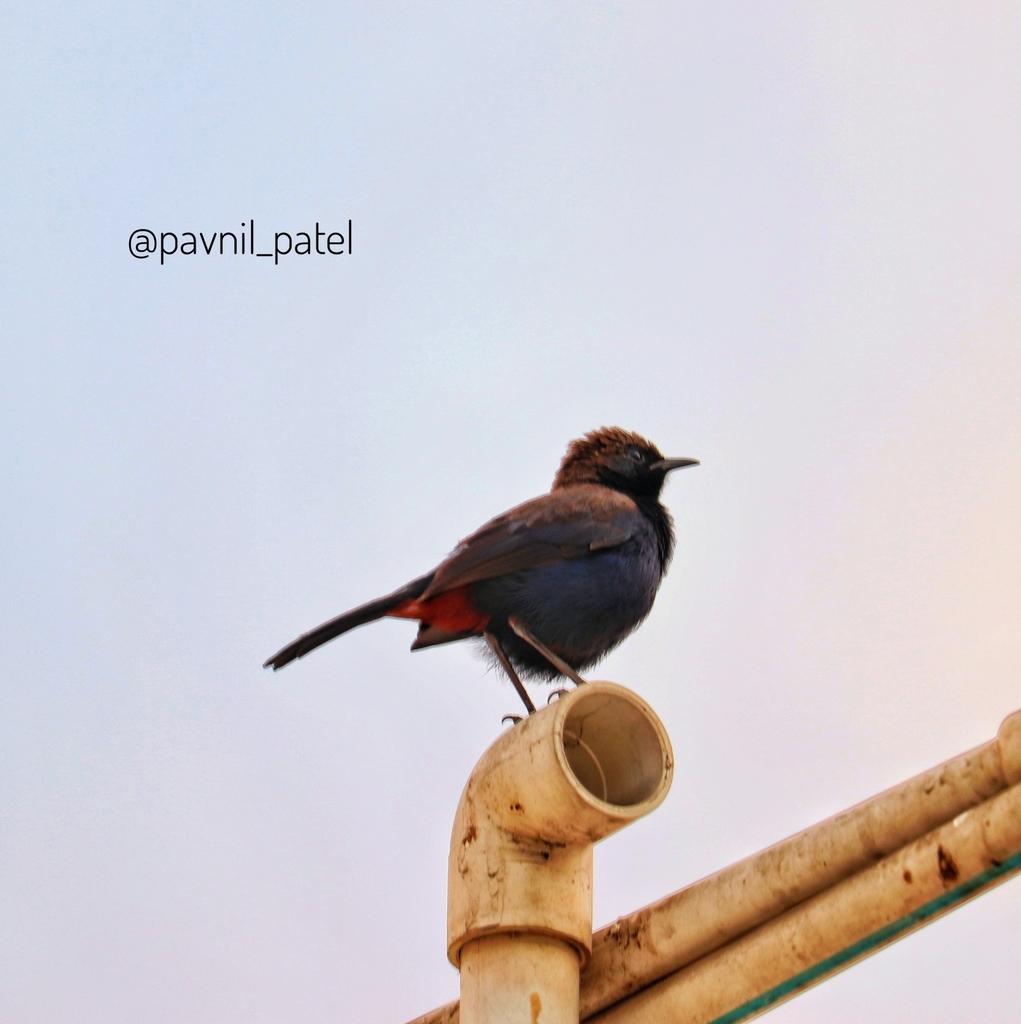
Indian Robin
Photo © Pavnil Patel
Photo © Pavnil Patel — CC BY 4.0 — Source: iNaturalist #73921719Identification
The Indian robin is a striking and sexually dimorphic bird, with males and females displaying distinctly different plumage. Males are mainly black with a distinctive white shoulder patch or stripe, though the visibility of this marking can vary with posture. The key identifying feature across both sexes is the chestnut undertail coverts, which are particularly conspicuous as the bird habitually holds its 6–8 cm long tail raised upright. The females are brownish above, lack the white shoulder stripe, and are greyish below with paler chestnut on the vent. Juvenile birds resemble females but have a mottled throat.
Geographical variation is notable: males of northern subspecies have brown backs, while southern populations have all-black backs. The chestnut undertail coverts and dark body plumage make Indian robins easily distinguishable from similar species such as pied bushchats and Oriental magpie-robins, which share some of their preferred habitats.
Range & Habitat
The Indian robin is widespread throughout the Indian subcontinent, with populations found across Bangladesh, Bhutan, India, Nepal, Pakistan, and Sri Lanka. All populations are resident and non-migratory, maintaining year-round presence in their territories. The species favours open stony, grassy, and scrub forest habitats, predominantly in dry environments. They are largely absent from thicker forest regions and areas with high rainfall.
These birds are remarkably adaptable to human presence and are frequently seen close to human habitation, often perching on rooftops. Human activities such as forest clearance and firewood removal appear to benefit the species by maintaining the open habitats they prefer.
Behaviour & Diet
Indian robins are ground-active birds, commonly seen running along the ground or perching on low thorny shrubs and rocks. They are primarily insectivorous but will also take frogs and lizards, particularly when feeding young at the nest. They may forage late into the evening to capture insects attracted to lights. During the breeding season, males exhibit territorial and aggressive behaviour, patrolling their territories by flying with slow wing beats from perch to perch, and will even attack their own reflections. Territory size for males is estimated at approximately 6650 m².
During breeding, males display through lowering and spreading their tail feathers while strutting around females, displaying their sides and fluffing their undertail coverts. Males sing during the breeding season with distinct variants—one for inviting mates and another for deterring rival males. An aggressive display involves fluffing up the feathers and holding the bill high.
Best Time & Places to See It
The breeding season varies by region but generally spans from December to September, typically beginning with the first rains. Peak breeding occurs in June in northern India and earlier in southern India, while Sri Lankan populations breed from March to June and August to September. Males are most vocal and visible during these breeding periods, making them easier to locate and observe.
Look for Indian robins in open scrub areas, stony grasslands, and dry habitats throughout the Indian subcontinent. They are often found near human settlements and are commonly encountered on or near rooftops. Population densities can be quite high in suitable habitat—estimates from the Pondicherry University campus indicate 193–240 individuals per square kilometre.
Photography Tips
The raised tail and distinctive plumage make Indian robins rewarding subjects for photography. Males' white shoulder patches and chestnut undertail coverts are most visible when the bird is active and displaying. Photograph birds during the breeding season when males are most conspicuous and vocal, and when their behavioural displays—tail spreading, strutting, and fluffing—provide dynamic shooting opportunities.
The birds' habit of foraging on the ground and perching on low rocks and shrubs makes them accessible for ground-level photography. They are also known to forage late into the evening around artificial lights, offering opportunities for different lighting conditions and behaviour documentation. Exercise caution when photographing near human habitations, where these birds are commonly found.
Lunugamvehera National Park
Sri Lanka
+204 birds+14 mammals
Dry scrubland and shallow wetlands converge in Sri Lanka's southeastern lowlands, where Lunugamvehera National Park anchors one of the island's most ecologically vital landscapes. The park's…
VIEW NATIONAL PARKMinneriya National Park
Sri Lanka
+158 birds+9 mammals
Across the dry zone of Sri Lanka's North Central Province spreads a landscape of shallow tanks, grassland margins, and scattered dry forest—a mosaic of water and…
VIEW NATIONAL PARKWasgamuwa National Park
Sri Lanka
+156 birds+8 mammals
Dry deciduous forest and open grassland sweep across the North Central lowlands where Wasgamuwa National Park protects one of Sri Lanka's largest remaining tracts of this…
VIEW NATIONAL PARKAngamedilla National Park
Polonnaruwa, Sri Lanka
+40 birds+2 mammals
Ancient tanks and sal forests define this water-rich sanctuary in Sri Lanka's North Central heartland, where seasonal wetlands and dry deciduous woodland create a mosaic of…
VIEW NATIONAL PARKMaduru Oya National Park
Sri Lanka
+74 birds+1 mammals
Granite ridges rise abruptly from the humid lowlands of Sri Lanka's Uva Province, their weathered slopes clothed in dry monsoon forest and scattered woodland where deciduous…
VIEW NATIONAL PARKIndravati National Park
Bijapur, India
+41 birds
Where the Indravati River cuts through the elevated plateaus of central India, a landscape of deciduous forest and open woodland unfolds across Bijapur district in Chhattisgarh.…
VIEW NATIONAL PARKValmiki National Park
Ramnagar, India
+66 birds+6 mammals
Along Bihar's western frontier, where the Gandak River winds through subtropical forest and grassland, Valmiki National Park sprawls across terrain shaped by monsoon rains and seasonal…
VIEW NATIONAL PARKRanthambhore National Park
Sawai Madhopur, India
+294 birds+20 mammals
Granite ridges and ravines carved through the Aravalli Range frame this protected landscape in eastern Rajasthan, where deciduous forest mingles with open scrubland and seasonal water…
VIEW NATIONAL PARKEravikulam National Park
Devikulam, India
+192 birds+7 mammals
High in the Western Ghats of Kerala, where monsoon mists cling to slopes that rise above 2,000 metres, Eravikulam National Park preserves one of South India's…
VIEW NATIONAL PARKKanha Tiger Reserve
Kanha Kisli F.V., India
+321 birds+23 mammals
Where sal forests give way to emerald meadows and crystalline streams carve through ancient valleys, one of India's finest wilderness reserves unfolds across the Maikal Range.…
VIEW NATIONAL PARKTadoba National Park
Palasgaon Singru, India
+270 birds+20 mammals
Where sal forests meet open grasslands and rocky outcrops rise from red laterite soil, central India's landscape unfolds in raw, untamed beauty. Ancient teak woodlands and…
VIEW NATIONAL PARKBandhavgarh National Park
Garhpuri, India
+285 birds+17 mammals
Where granite ridges rise dramatically above sal and bamboo forests, one of India's most pristine tiger reserves unfolds across the Vindhyan plateau. Ancient rock formations tower…
VIEW NATIONAL PARKPanna National Park
Badgadi Kalan, India
+271 birds+17 mammals
Where granite gorges slice through central India's Vindhyan plateau, a landscape of stark beauty unfolds across nearly six hundred square kilometers. The Ken River carves through…
VIEW NATIONAL PARKKeoladeo National Park
Shreenagar Rural, India
+326 birds+14 mammals
Where shallow wetlands shimmer beneath vast Rajasthani skies, one of Asia's finest bird sanctuaries pulses with extraordinary life. This former maharaja's hunting reserve, now spanning 29…
VIEW NATIONAL PARKPeriyar National Park
Mlappara, India
+232 birds+4 mammals
Dawn breaks over mist-shrouded ridges where the Western Ghats tumble toward Kerala's spice-scented lowlands. Here, ancient tropical forests envelope a glittering artificial lake, creating a mosaic…
VIEW NATIONAL PARKPampadum Shola National Park
Vattavada, India
+258 birds+14 mammals
Where misty shola forests cling to the high plateaus of the Nilgiri Mountains, ancient evergreen remnants create a world apart. This 2,316-hectare reserve protects one of…
VIEW NATIONAL PARKBandipur National Park
Hirehalli, India
+302 birds+19 mammals
Where the Western Ghats descend into the Deccan plateau, ancient deciduous forests blanket a landscape carved by the Nugu River. Bandipur unfolds across 880 square kilometres…
VIEW NATIONAL PARKNagarahole Tiger Reserve
Nalkeri Forest, India
+323 birds+23 mammals
Where granite escarpments rise above dense deciduous forests and the Kabini River carves through pristine wilderness, one of India's most biodiverse landscapes unfolds across the Western…
VIEW NATIONAL PARKGir National Park
Asundrali, India
+258 birds+13 mammals
Dry deciduous forests cloak the rolling hills of western Gujarat where the Gir landscape rises as a final sanctuary for one of the world's rarest felids:…
VIEW NATIONAL PARKNo community photos yet. Log in to add the first one.
No community observations of this species yet.